Subscribe to our social channels to get the latest news about Hungary!


Germany has issued an unprecedented open threat against Hungary over the Government’s stance on the Ukrainian oil blockade, but ministers insist they will not abandon the defence of national interests or allow Ukrainians to triple the energy bills of Hungarian families, Foreign Minister Péter Szijjártó declared in Brussels on Monday.
According to the ministry, Szijjártó described as without precedent what transpired at the EU foreign affairs council meeting, claiming his German counterpart delivered “a very coarse, open and shameless threat”. The German minister warned of severe consequences should Hungary’s Government forsake its national interests and refuse to approve the €90 billion war loan for Ukraine or the steps required for its EU accession, the Hungarian News Agency wrote.
“This blunt Berlin threat over Hungary’s defence of its national interests was made crystal clear by the German foreign minister today,” he stated. “It is abundantly evident that the Brussels-Berlin-Kyiv axis seeks a change of government in Hungary, as it wishes to drag Europe into war – and our sovereign national Government stands in the way of that axis,” he continued.
Without mincing words, Szijjártó said the German minister had threatened Hungary openly and aggressively: abandon the representation of national interests and cease blocking key Ukrainian decisions unconditionally, or face dire repercussions. “We shall not yield on defending national interests, no matter the German foreign minister’s menaces. We will not tolerate Ukraine’s oil blockade jeopardising Hungary’s energy supply, nor allow it to triple Hungarian families’ utility costs. We shall protect Hungarian families, low energy prices and Hungary itself,” he affirmed. He further condemned the “war fanaticism” prevailing in Brussels, where long-term plans appear to envisage perpetual conflict, with no expectation of peace in Ukraine this year.
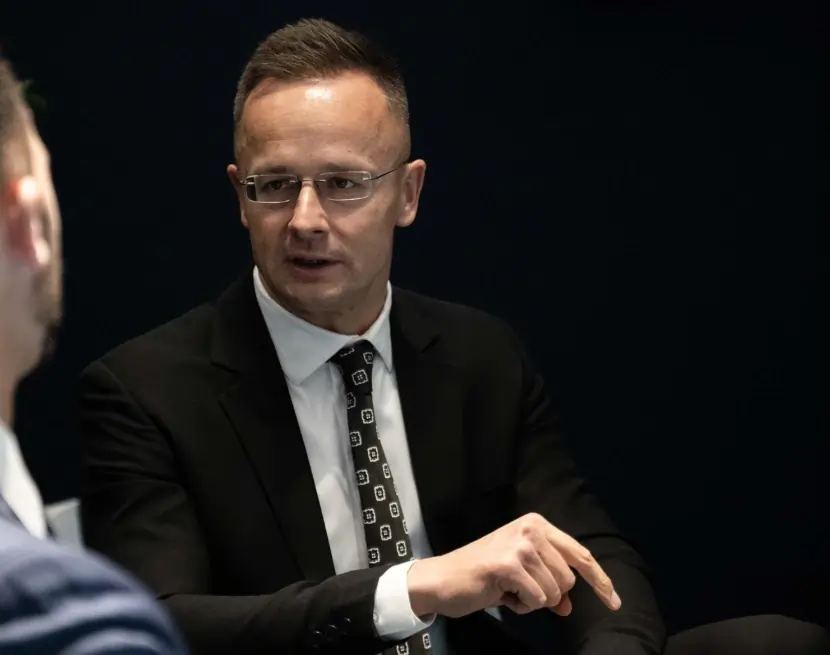
The meeting began with the Ukrainian foreign minister joining remotely, at which point Szijjártó outlined Hungary’s position first: Ukraine has blockaded Hungarian oil supplies for nearly 50 days, for purely political reasons. “Zelensky wants to form a government in Hungary too. They are interfering in our parliamentary elections, aiming to engineer an oil and petrol crisis, a 1,000-forint petrol price, to bolster the Tisza Party’s chances,” he cautioned.
“This is brazen, overt election meddling to install a Zelensky Government here. Yet Ukraine has been exposed: for anyone capable of rational thought, it is plain there is no technical or operational reason for halting flows on this pipeline. The Ukrainians are lying through their teeth on this matter,” he asserted.

Szijjártó noted that Ukraine’s pipeline operator first claimed three days were needed, then one or two more, repeatedly delaying before admitting it awaited political clearance. “Then on Saturday, the operator briefed ambassadors in Kyiv, citing a month’s delay. Today, however, the Ukrainian foreign minister spoke of 42 days at the council – a two-day discrepancy between the operator’s 30 and his 42,” he highlighted.
“We will not stomach Ukraine’s lies, its election interference or its oil blockade. Thus today I made clear we will not vote for the twentieth sanctions package, the €90 billion Ukrainian war loan, nor any future decisions funneling money to Ukraine or aiding its cause. It cannot be that while they blockade us, we in Brussels do them favours,” he emphasised.
The minister also addressed colleagues from the Brussels line, who deem cheap Russian oil undesirable and expect Hungary to buy dearer alternatives. Several criticised the US sanctions suspension on Russian energy imports; some viewed restarting Ukrainian oil flows as a favour, dismissing decisions safeguarding Hungarian and Slovak energy security as shabby excuses.
“Yet despite these threats and blackmail, Hungary cannot be bullied or coerced – not from Kyiv, Brussels or Berlin,” he concluded.
If you missed:
Featured image: Friedrich Merz, Germany’s chancellor.

 ZH
ZH IT
IT DE
DE


It’s always the same external enemies (the EU, the West, Brussels, and more recently Germany, etc.), but Russia never appears on the list!
Perhaps we should also let the other side have its say. As a reminder, the Europeans wanted to present a united front – and once again, they didn’t. Viktor Orbán initially blocked the European Union’s (EU) 20th sanctions package against Russia. Furthermore, the Hungarian Prime Minister is preventing €90 billion in financial aid for Ukraine from being disbursed.
The latter is particularly infuriating. Orbán had previously negotiated an exception for his country: Hungary was to be exempt from the joint borrowing. “I am not in a position to agree to any decision that is advantageous for Ukraine,” Orbán stated unequivocally in a letter to EU Council President Antonia Costa. The letter was circulated via Orbán’s social media profiles.
Since Russia’s attack on all of Ukraine in February 2022, Budapest has reliably delayed aid to the beleaguered country. Orbán also refuses to allow arms shipments to the Ukrainian armed forces through Hungarian territory – Hungary borders Ukraine. At the same time, Budapest maintains its ties with Moscow. Hungary continues to import raw materials from Russia, and Hungarian government officials, contrary to the stance of almost all other European governments, maintain close contacts with Moscow.
Until now, or so it seemed, the Europeans had come to terms with this policy of obstruction by Hungary – which has been joined by Slovakia since 2023. The EU was ultimately always able to find a way to support Ukraine – or to rely on Orbán eventually giving in.
But this time, the outrage over the Hungarian Prime Minister’s behavior is particularly intense. “It’s time this man’s funding was cut off – and his voting rights in the European Council were revoked,” Marie-Agnes Strack-Zimmermann, MEP for the FDP and Chair of the European Parliament’s Committee on Security and Defence, told WELT. Revoking a member state’s voting rights is possible under Article 7 of the EU Treaty if a serious and persistent breach of the EU’s fundamental values is established. In this case, the country in question would no longer be allowed to participate in decision-making, but would remain a member of the Union.
It is unacceptable that Hungary is blocking a decision to which it had previously agreed – “and on a day that commemorates four years of extensive Russian aggression. It truly makes me sick,” said Sweden’s EU Minister Jessica Rosencrantz.
Poland’s Foreign Minister, Radosław Sikorski, criticized: “This escalation effectively benefits Putin and undermines European unity at a time when we need it most.”
Orbán is likely also motivated by domestic political reasons for his actions. On April 12, Hungarians will elect a new parliament – and the Prime Minister’s governing coalition is trailing significantly in the polls against the opposition party Tisza (Respect and Freedom Party).
Four years ago, he surprised observers during the election campaign with an anti-Ukrainian campaign in the final stretch – and it was successful. The fear among many people that the war could spread to Hungary, coupled with the claim that Ukraine wanted to drag Hungary into a war with Russia, intensified the desire to vote for the familiar – namely, Orbán’s Fidesz party.
If Orbán manages to resolve the dispute before election day, he can also claim it as a victory. It is expected that the crude oil will not flow again until after the election – and also that Orbán, if still in office, will then lift his blockade. The Ukrainians claim to be repairing the pipeline, and the EU Commission is also advocating for its resumption.
But the political damage has been done – and the impression remains that Europe’s ability to act in times of geopolitical upheaval and crisis is limited or delayed.
And the Hungarian Foreign Minister also fails to answer one question: why are only Hungary and Russia allowed to issue threats? Others are apparently forbidden from doing so?
The answer is quite simple: the Hungarian government has no alternatives and must base its election campaign on the population’s fear, hoping that this will lead voters to rally behind Orbán. For this, they even need professional Russian propagandists and trolls, because they apparently don’t trust themselves to do it alone.
Karl Skum, you have been watching too much fake news fearporn and have become addicted to their kommie propaganda. Seek help.
🤣🤣🤣🤣
🇷🇺🤥🤣🤣🤣🤣
What was the last time Russia threatened Hungary with “long lasting, serious consequences” ?
🇷🇺🤥🤥🤣🤣
And you call others bots.
Amazing.
🤥😴😴😴
Nothing new from him, the same old Fidesz zealot!
😴😴😴
It is astonishing that this guy–who, by the way, is a totally nondescript nonentity–and all the other technocratic “leaders” (LOL!) like him are so zealous about fighting for Ukraine’s interests while selling the European future down the river of Net Zero, globalist, mass migration, socialist zealotry.
Absolute scumbags.
Zelensky is a puppet on a string who, on orders from his entourage, is literally throwing oil on the fire! Chancellor Merz had clear ties with the American asset manager BlackRock! He was Chairman of the Supervisory Board of the German branch (Aufsichtsratchef) BlackRock Asset Management Deutschland AG from 2016 to 2020. In addition to his supervisory role, he also acted as a lobbyist for BlackRock in Germany. In March 2020, he resigned from his positions to pursue his ambition to become Chancellor of Germany! You doesn’t have to be particularly smart to realize that there is a conflict of interest to be found between the financial sector and the public interest! BlackRock has also been closely involved in Ukraine, by the way! In 2023, Zelensky and BlackRock executive Larry Fink agreed that the company would advise the Ukrainian government “pro bono” on setting up the Ukraine Development Fund.Nothing is free in this world, and anyone who believes that is naive! Although active fundraising was paused, Larry Fink still participated in an American-Ukrainian working group in early 2026 to “talk” about long-term economic action plans! Ursula von der Leyen’s name is mentioned in the same breath as the asset manager due to decision-making by the European Commission under her leadership! The points of contact with VDL are: Controversial consultancy contract for a study into the integration of sustainability goals (ESG) into European banking regulations! BlackRock’s lobbying activities in Brussels! They are one of the active lobbyists and hold regular consultations with high-ranking officials of the European Commission regarding legislation that affects the financial sector! The digital euro and the will of 7 countries to introduce it more quickly? The President of the ECB, the European Central Bank, Lagarde, supposedly has no direct business ties with BlackRock? BlackRock is a huge player (shadow banking) and the company’s influence is (in)direct under the policy frameworks set by Lagarde and the ECB! A smoke screen is being put up here too! Moral of the story: The fish always rots from the head, and the EU citizen gets screwed!
🇷🇺🤥😴😴
Hugo Wils, well said
🤣🤣🤣🤣
Nearly all EU countries still buy Russian oil indirectly via an other country or directly.
Trump is the biggest joke. He buys oil himself in the open and made room to do so.
I truly wonder why Germany breaks itself down. First the pipeline, next closing the clean energy plants.
Europe, the EU will never be united it’s an expensive Epstein club for One World Order where people are raised by AI and are slaves with a brain chip, dragging everyone into war. Only the wealthy will survive.
If it comes to the elections: without any doubt other countries, and Brussel interferes. The EU gov is caught by doing so with at least 11 countries within the EU. This explains the aggression, threats and childish behaviour among European presidents, ministers and people and again the Epstein files.
Till today the EU does what Trump wants because? Sounds to me politicians have no courage at all and only care about their own wallet.
If it comes to Ukraine: 8+ years of genocide been committed by them, the president “lost” high amounts of money, bought 40+ villas abroad, his ministers are all corrupt, he lies and threats whomever he can and forces others to fight the war he started and could have end long ago.
Interesting how again this person is supported.
It’s not different from Trump in Afghanistan, Venezuela, threatening Cuba and attacking Iran. It’s all about oil and the lack or is it refuse of governments to be prepared for the future.
None of them cares about the people or wants peace it is simply good for business
Some facts here are accurate. Mr. Merz’s BlackRock board role, BlackRock’s advisory offer to Ukraine, and its lobbying in Brussels are all documented and raise legitimate questions about conflicts of interest and corporate influence on public policy. These deserve scrutiny and transparency.
However, the narrative stitches these separate facts into a grand coordinated conspiracy without sufficient evidence. Mr. Zelensky’s puppet narrative, implying Mr. Merz governs on BlackRock’s behalf, as well as suggesting Mrs. Lagarde, Mrs. von der Leyen, and others are all acting together in some shadowy network is a significant leap.
Proximity to power and conflicts of interest are real issues worth debating (our Politicians friends, family and toadies, anyone?) however your framing replaces that nuanced debate with a predetermined conclusion that everything is corrupt by design, which ultimately undermines the valid concerns buried within it.
Thank you Norbert, a contribution of high quality based on comprehensible logic and not a conspiracy narrative cobbled together from the end, riddled with insinuations, lies, distortions and half-truths.
The Fidesz disinformation isn’t judged by its content or scope—it’s far too pathetic for that—but rather by the emotional provocation level of the post. The more emotional reactions it elicits, the greater its perceived success. The goal is to shift the focus from objectivity to negative emotions in the other person, causing them to abandon their objective perspective and descend into emotional manipulation. They have nothing to offer in terms of facts and are essentially just making themselves look ridiculous.
‘Mr. Zelensky’s puppet narrative, implying Mr. Merz governs on BlackRock’s behalf, as well as suggesting Mrs. Lagarde, Mrs. von der Leyen, and others are all acting together in some shadowy network is a significant leap.’
And yet Blackrock has bought nearly half of all property in the Western Russian Region, known as ‘The Ukraine’, Dear Norbert – so, when Merz insists that Europeans give up their blood and treasure, to prevent Russia from retaking it, the motivations are nakedly bare.
Whether Zelensky, Von der Leyen, or Merz are conspiring directly with one another is ancillary to the reality that they are all acting as main organs in the Organism we know as The Western Elite, or, more specifically, The Rothshild Empire.
🇷🇺🤥🤥🤣🤣🤣
The biggest threat to “Energy Bills!” for “Hungarian Families” is a world war of choice, instigated by our Politicians BFFs Mr. Trump and Mr. Netanyahu, driving up commodity prices.
If you would listen to our Politicians, you would think nothing is happening in the Middle East, other than some unfortunate incident.
As Zelenskyy himself said:
“our people are being murdered every day, and we need to repair the oil pipeline because ‘poor Orban, cannot win the elections without oil’?”
I don’t think the word “friend” in politics means, what you think it does.
🇷🇺🤥🤥😴😴
You are determined to be boring enough to make us all go extinct via boredom by refusing to use any other insults, right?
🇷🇺🤥😴😴😴😴
‘I don’t think the word “friend” in politics means, what you think it does.’
That is correct, Dear Márk, many of Norbert’s definitions and evaluations arise from theoretical abstracts that are based upon philosophies that The Western Elite have fed our brightest children, this institutional and media indoctrination to make them soldiers in their centuries’ long quest to control The West, and, indeed, much of the world.
🤔🤔🤡🤣🤣🤣
@Mouton – thank you for your conspiratorial word salad.
What you are doing is propaganda framing. Blaming everything Western Elite indoctrination and the thirst for world domination is not an argument.
In politics, interests matter more than sentiment, however that doesn’t mean every institution, university, or media outlet is of some grand conspiracy.
Again – @Mouton – many of your posts fit the definition of активные мероприятия.
The playbook: pretend to be a local (or American, in your case), amplify division, erode trust, let the algorithm do the rest.
https://greydynamics.com/active-measures-russian-shadow-games-in-the-digital-age/
We see you, @mouton
You appear to be advocating “law of the jungle” – well … Be careful what you wish for.
Our key strategic assets: central location in the Carpathian Basin, fertile agricultural land, river access, industrial base, and role as a regional transport corridor.
However, our real strength comes from being a Member of the European Union, which drives our trade, investment, infrastructure funding, labor mobility, and access to the single market, and NATO, which provides our security umbrella.
Hungary has become a puppet state of Russia under the Fidesz government which to Hungary’s shame has been peddling hatred towards Ukraine to further Russia’s agenda of conquest and hatred towards the EU to further Russia’s agenda to divide and destroy Europe. Orban is a traitor.
I’ll humor you, and assume you are right. Then the election doesn’t matter. So convincing people doesn’t matter.
So you writing this doesn’t matter.
But you are writing this. So you act as you are convinced the vote matters. So you are convinced what you wrote is false.
Congrats, you proved, you are deliberatly lying.
🇷🇺🤥🤥😴😴😴
You are out of your mind.
He wants you to engage on an emotional level. Because on the level of facts and logical argumentation, he has absolutely nothing to offer. What he writes is simply ridiculous. Don’t fall for his nonsense. He’ll just try to provoke you with more nonsense, and in the end, he’ll come across as someone who stays cool and doesn’t understand why you’re getting so worked up. That’s his only chance to gain the upper hand.
Thanks. It doesn’t bother me. It’s a sick and twisted portion of society in Hungary that sides with a barbaric invader (Russia) and peddles hate towards the defender (Ukraine) which has suffered so many thousands of deaths and all of the destruction. Fidesz peddles this shameful narrative amplfied by Russian propaganda. It is a narrative of hate and degradation of what it means to be a civilized person.