Subscribe to our social channels to get the latest news about Hungary!


GLOBS Magazine – A country that suddenly turned from the world’s most hated country to the symbol of possible peace and renewal. We have been organizing a journey for nearly a year, in order to get into the most isolated and mysterious country in the contemporary world. In March 2017, we requested permission from North Korea’s Embassy in Vienna. And after waiting for months, the response came: I will be able to get a visa in April 2018 if I join the members of the Baptist Charity Service.
I can honestly say that there are very mixed feelings in a reporter when he or she travels to North Korea. In the weeks before the journey, I’ve read almost every article about the Korean peninsula. This is why I can say that I was really afraid when I left Budapest and set off to Pyongyang, the capital of North Korea. It is well known that an American student has been sentenced to 15 years of prison, because he raised the picture of the supreme leader from the wall. I have certainly promised to myself that I will comply with every courtesy rule in North Korea, if possible. This is exactly the country where you do not want to get into conflict with the authorities. North Korea is working under authoritarian cult and one party system. Therefore, the country is of also still very militaristic nature. Currently, there are 1.2 million people serving in the North Korean army. Compared to this, the size of the Hungarian Defense Forces makes up only 2% of theirs in number of soldiers. Unofficially, the North Korean secret service forces – about one million people – organizes the make the population report on each other on a daily basis. Considering this, I decided to be very careful, constantly keeping the local rules in mind, during the one-week-long journey.
To travel to Pyongyang by plane, you can do it via Beijing. From Budapest, the travel takes about a day to get there.
In the capital of China, there was an old Tupolev type of plane waiting for us. The flight which took us to North Korea was run by the Air Koryon airline. The flight attendants were nice, but they warned us several times that it was forbidden to take photos and film on board or out of the window. We also got some food. Burgers and grape juice were served to the passengers. This is funny in itself, as the American style sandwich does not really fit in the North Korean customs.
After two hours of easy flight, we landed at Pyongyang Airport. Grumpy and rigorous soldiers in green uniforms brought us to several X-ray and screening machines.
Everything was scanned. They wanted to find out what we will bring into the country. In fact, even our phones were taken away, and the border guard was looking at our photos. As it turned out later, they were looking for South Korean propaganda material and pornography. The possession of these would have meant a couple of years in prison or, in the worst case, years of forced labor. Fortunately, there was no such thing on my phone. At the airport, Mr. Lee and Mr. Pek were waiting for us. They were our guides during the time we spent in the country. According to the official explanation, their task was to keep us safe and help with the interpretation. In reality, they were watching us and listening to our conversations. Although it is true that they have helped many times to organize the programs.
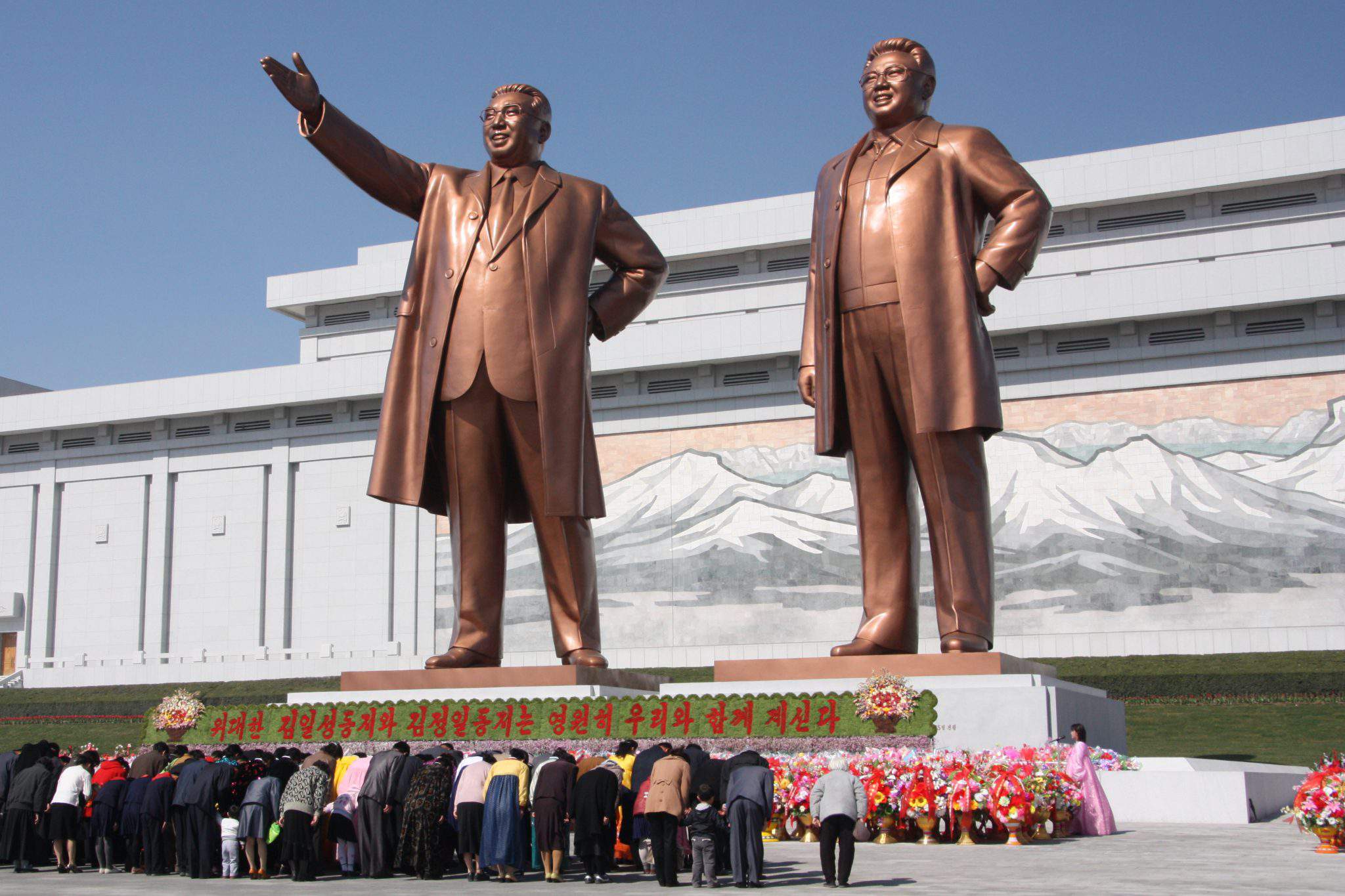
Foreigners coming to North Korea are definitely bound to participate in the so-called “must-see” cultural programs. Thanks to our guides, we participated such programs in the next few days. We went to see “voluntarily” the embalmed corpses of two former Supreme Leaders, Ki Mir Sen and Kim Jong Il. Photography and filming was forbidden. The Supreme Leaders lie in a glass coffin which were illuminated from above with red light. The coffin is set in a huge gray marble hall. After a one-hour-long procedure, you can get to the Supreme Leaders on moving sidewalks painted in red. Meanwhile, one can see thousands of paintings representing the successful meetings and programs of the leaders in the past few decades, while propaganda songs are audible in the background. In a rough description, the experience starts with the smiling pioneers, then continues with the examination of the excellent harvest and different military exercises, and ends with the portraits of the Supreme Leaders pointing at different directions.
After visiting the memorial, we headed to the main square in Pyongyang. It was warmly recommended to place a bunch of flowers on the 35-meter-tall bronze statutes of the two Supreme Leaders, Ki Mir Sen and Kim Jong Il. Flower placement was not mandatory, but it was highly recommended. However, we had to bow at the statues, just like it was obligatory to do so at the glass coffins of the Supreme Leaders. There were no exceptions. Everyone bowed in accordance with his/her own temperament. Foreigners were allowed to nod only, as a sign of respect towards the Supreme Leaders. However, the locals bow deeply and humbly at different memorial places.
In North Korea, nobody will ever forget that it is easy to get imprisoned in a labor camp if somebody does or says something wrong. It could also mean years of forced labor.
I received the visa only on the condition that I travel together with the Baptist Charity Service delegation. For many years, we have known each other with Sándor Szenczy, Head of the Charity Service, and Béla Szilágyi, vice-president of the organization. We have found ourselves in a special situation in the middle of our journey. At the request of Sándor Szenczy, our hosts took us to the only Protestant Church in Pyongyang, on the following day. We were all surprised, but they let Sándor to preach, although the Korean interpreter was apparently very much raised in an atheist environment. He clearly had some difficulties with the translation of the words “God, Bible, Pray”.
[button link=”https://dailynewshungary.com/budapest-in-korea-a-changing-country-through-hungarian-eyes/” color=”orange” newwindow=”yes”] BUDAPEST IN KOREA – A CHANGING COUNTRY THROUGH HUNGARIAN EYES[/button]
In North Korea, it is well-known that the churches can operate in a very narrow field. There are only three churches in Pyongyang, and there are just a few thousand Christians in the country. Considering this, it was even more surprising that Sándor Szenczy was officially invited to build a Baptist Temple in North Korea. The preacher said that he will do everything in his power to build a Hungarian Baptist Church in Pyongyang, with the help of the Baptist World Alliance. By the way, The Hungarian Baptist Charity Service did a fantastic job in North Korea. Although they use 90 percent of their budget in Hungary, they still consider it important to help those in need around the world. They have been present in North Korea for twenty years. The organization supports the orphans with clothing and food donations, and they regularly bring medical equipment to the hospitals. Furthermore, they train specialists who deal with disabled children, in order to provide better care. We also visited the hospital where the conditions were still very poor. There is only one anesthetic machine for five surgeries. During our visit, the hospital director complained that the machine often stops working between surgeries, but they can not get a new one. The members of the charity service have promised that they will try to include one or two anesthetic machines in the next medical container. What was even more astonishing is that infusions in the hospital are released from beer bottles because they simply do not have normal and sterile infusion bags. In such a poor country, it is always good to be Hungarian so I can travel with the members of the Baptist Charity Service. President Sándor Szenczy, Vice President Béla Szilágyi and International Director Anna Szenczy support the needy with great efforts and huge amount of work.
[button link=”https://dailynewshungary.com/hungary-was-asked-to-construct-a-baptist-house-of-prayer-in-north-korea/” color=”green” newwindow=”yes”] HUNGARY WAS ASKED TO CONSTRUCT A BAPTIST HOUSE OF PRAYER IN NORTH KOREA[/button]
Our team set off to Panmunjom afterwards. This is the famous border crossing point in the middle of the demilitarized zone for the meeting of the two Korean parties.
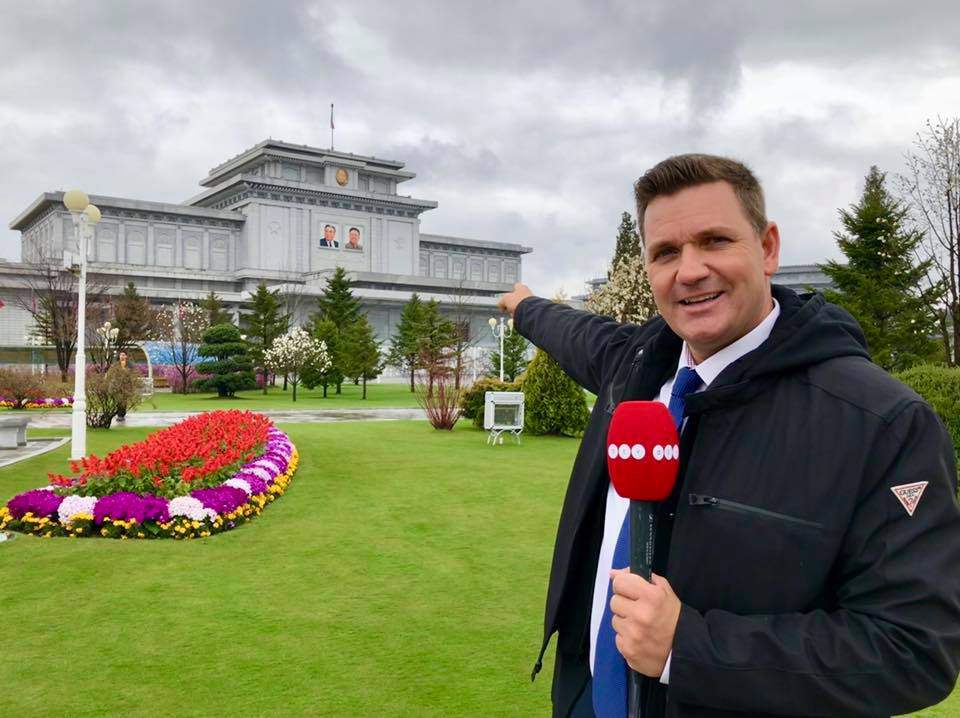
The way we arrived was very complicated and we were able to reach the border with very strict security measures. On the last few kilometers, there were plenty of soldiers on both sides of the road. Only a narrow, five-meter-wide road leads to the famous blue border. Tank traps were placed on both sides, and there was high-voltage current in the fences as well as the sandy soil was full of landmines. This is the place where North Korean soldiers are trying to escape- to desert- on a monthly basis. The North Korean guards always open fire, because it is a huge prestige loss if someone escapes from the North and goes to the South. Not to mention that escaped soldiers are being taken to the South Korean intelligence right away. These people are thoroughly interrogated and they have to report on various military developments. Here at the border crossing, we barely had ten minutes to take some photos and interviews, before we were being escorted back to the small buses. We got back to Pyongyang after about two hours of driving. our hosts organized a reception for us, because that was our last night. Our hosts served about eight courses in an excellent restaurant. In the middle of the table there is a grill grid, and everyone could make the various kinds of meat for himself. It was truly an exclusive ending for our journey.
North Korea has started a quick opening progress. Experts are still not sure about the intentions of Kim Jong Un. It is unclear whether he really initiates the denuclearization process of the Korean Peninsula, helps the artificially split families reunite, and establishes a policy towards the market economy in North Korea.
Meanwhile, North Korean leader Kim Jong Un held two historical meetings. It was already a leading news in the world press that he met South Korean President Moon Jae-in. However, North Korea came to the center of the stream of world news when Kim Jung Un met President Donald Trump in Singapore where they had a several-hour-long meeting. It will turn out in the coming months and years if radical change and development will truly take place in North Korea or not. Whether they really start the denuclearization of the peninsula, help the split families reunite, and open the gates of North Korea for international observers. I promise that in a year I will try to come back and report on the changes that have taken place in this special country after these historic summits.
If you would like to read more interesting articles on GLOBS Magazine, please click HERE
or you can buy online The GLOBS Magazine on DigitalStand
Source: by András NOVÁK, Journalist – GLOBS Magazine


