Subscribe to our social channels to get the latest news about Hungary!


According to szeretlekmagyarorszag.hu, a Hungarian video made a huge hit in the beginning of 2016. It shows the process of decorating a gingerbread, which becomes an artistic masterpiece in front of our eyes. Mézesmanna’s (~Honeyed manna) video spread super quickly on Facebook and it reached people all around the world, who were stunned by the artwork. 56 million people have seen the video since.
Bored Panda called the creator of the magically beautiful gingerbread, Judit Czinkné Poór, “the Leonardo da Vinci of the cookie world”. In fact, they recommend looking Mézesmanna up for anyone visiting Hungary. Today, the brand is not only known in Hungary, but abroad as well. Let’s find out about the process and the people behind the amazing work.
“It was a great honour that Enikő Győri, the Hungarian Ambassador to Madrid, was one of the first people to react to the video and congratulate. We got a lot of great feedback from even Hungarians living abroad” says Zsanett Odett Papp, the project manager of Mézesmanna. She was the one to take the first step towards the foundation of the brand.
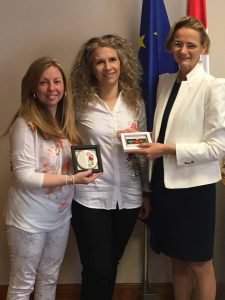
With Ambassador Enikő Győri
Her friend, Judit Czinkné Poór, had been baking gingerbread for years, but her original profession was porcelain painter. The first uniquely decorated cookies were made when Zsanett Odett Papp ordered a bigger dose from her friend for foreign business partners. Since they were a huge success, she asked her friend if she wanted to engage in a business together. Mézesmanna was founded in 2012, its Facebook page in 2013. The two friends have been working together ever since.
Many people are interested in how long it takes to create such a special gingerbread. “Since the creation of a decorated gingerbread is made up of several processes, you have to leave it to set a few times. After the baking and the base glazing, the decoration takes up about an hour” says Zsanett Odett Papp.
Concerning the pattern of the gingerbread they explained that older women always ask them whether these are patterns of Mezőkövesd, Matyó or Kalocsa. But they don’t only use one pattern exclusively as you would find on folkware artwork. They operate with the mixture of traditional Hungarian decorating patterns and embroidery.