Subscribe to our social channels to get the latest news about Hungary!


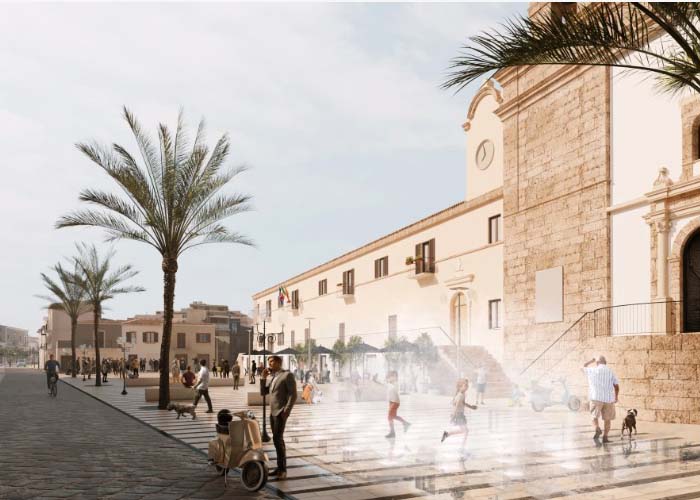
Hungarian architects have received significant recognition: a historic town far from Hungary has been redesigned. Bálint Kádár, a professor at the University of Technology, shares with Impress Magazin his experience of reimagining the centuries-old Baroque town centre of Mazzarino.
The Italian town of Mazzarino has selected a Hungarian design firm to redesign its historic centre. Bálint Kádár, Director of Architecture and Urbanism at DANU Engineering and Vice Dean of the Faculty of Architecture at BME, explains how the Hungarian architects managed to win a design competition in Sicily.
“First of all, there have been very few major design competitions funded by public money in Hungary for years—perhaps two or three annually at most—so we have to look abroad,” Kádár explained.
Winning such competitions is far from easy, even more so than gaining recognition. It is no coincidence that relatively few Hungarian companies seize such opportunities abroad, as success requires strong connections as well as expertise. In this case, it was crucial that Bálint Kádár has a deep familiarity with Italy—he speaks the language, studied architecture in Milan on an Erasmus scholarship, and maintains active projects with his department at Sapienza University in Rome, according to Impress Magazin.
Even so, it is quite an achievement for Hungarian architects to be selected, given that the competitors were culturally embedded locals. Kádár also noted that this recognition is a tribute to the Department of Urban Studies at ÉPK, whose accumulated knowledge is competitive worldwide. In response to our questions, he mentioned that the Hungarian architects’ links with the academic world, both domestically and internationally, are crucial: “The name of BME carries weight.” The involvement of Italian Erasmus students studying in Hungary was also a significant advantage, without which, as he added, “this would not have happened.”