Subscribe to our social channels to get the latest news about Hungary!


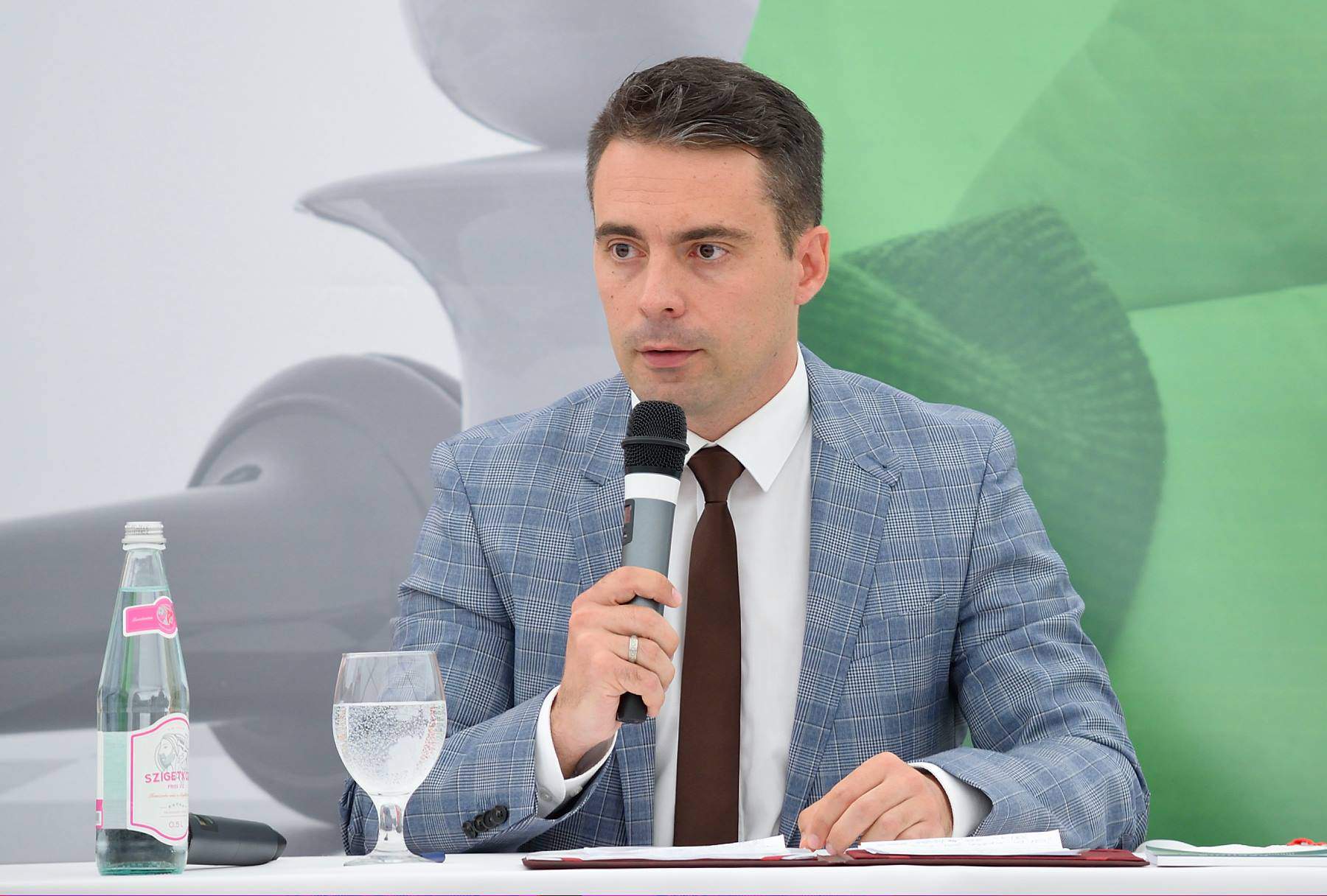
The opposition Jobbik party organized its meeting of intellectuals, the Disputa (Dispute), for the third time this year, which always begins with a presentation of Gábor Vona, whereafter the audience is free to ask questions and start conversations with the party leader. The Dispute of this year was organized in Soltvadkert again with a number of selected guests.
This time more than 200 guest were present, including union leaders, doctors, company leaders, leading sportsmen, lawyers, economists, artists, experts on education, healthcare and agriculture.
Gábor Vona stated that there seems to be a repressed expectation, a hidden will looking forward to change in the Hungarian society, which also shows itself in recent surveys. Still, there are many ongoing discussions about how a changing of the government should be supported by more media interfaces, a new electoral law, or the co-operation among opposition parties. According to him, the only possibility for a government-changing party is to show strength against strength, credibility against the lack of credibility.
Hereafter he spoke about the strong and the weak side of Fidesz. The strength of the ruling party lies in the designing of their political system and all the networking done in the last years. Besides them, the only one doing the same was Jobbik, since their founding in 2003. MSZP, on the contrary, only exhausted its options. As the weakness of Fidesz, Vona mentioned its lack of credibility. According to him, for credibility one needs an inspiring vision and a reasonable platform to reach it. Fidesz had an inspiring vision, the vision of Polgári Magyarország (a Civic Hungary), and they raised its flag, only to discard it thereafter together with the civic, conservative, Christian intelligentsia belonging to it. Fidesz’s slogan of before ‘the future has begun’ became a harsh reality of ‘the past came back’ – stated the Prime Minister candidate of Jobbik, according to whom Hungary became an obsessive, visceral country instead of becoming the Civic Hungary promised. He regards Orbán the last leader of the 20th century instead of being the first of the 21th century, whose biggest sin is that he holds the country in the 20th century with all his typical 20th-century-reflexes. What is really at stake in the elections of 2018 is not the choice between Putin and the EU, Orbán and Soros, but the choice to transgress finally into the 21th century.
There were more than 200 participants on the meeting of intellectuals – photo: Klaudia Kiriák
Hereafter he identified the diagnosis and the platform with which he plans to bring about a change.
The symptoms of Hungary being in the 20th century are as follows:
By contrast, the Hungarian society of the 21th century should be like this:
After the diagnosis he introduced Jobbik’s platform. According to him, politics always have a serious responsibility in ranking problems that need to be solved. He highlights migration as the most demanding problem. They have a plan to deal with this problem, namely the plan of the Union of Wages (Bérunió), which – as opposed to the rhetorics of the government – happens to be a Europe-plan that could help the Eastern and Central European countries to catch up with the rest.
According to Vona, Hungary has three main topics concerning the European Community, and these are the Union of Wages, migration, and the questions of autonomy. He highlighted that saying that only Orbán could save the country is a lie, because Jobbik is also able to do so, and he also denied that solving the autonomy of the areas torn off the country would come from grievance policy. Still, the longest part of his speech unveiled the his concept of the Union of Wages and the rehabilitation of Hungary. This part included a detailed introduction of the problem covering all sectors and a solution proposal, as well. He highlighted that any possible solution has to begin with an honest Anti-Corruption policy.
Of course, he knows that there are many who don’t trust any political powers and who think that Jobbik would be “just like the others”, but he assured that Jobbik would be already corrupt if they wanted to be. In fact, Jobbik is entirely free from the corrupt system that was built in the last 27 years.
During his presentation the party’s well-known slogan could be seen. He also referred to it, when he pointed out, using a ship metaphor, that it is the Hungarian hearth that is their compass, common sense that is their steer, and clean hands that is their sail.
According to him, it should be common sense that should define the politics in Hungary in the 21th century, which should be able to bring an end to division. It is the common sense that is able to find the golden mean between tradition and reformation, between experience and innovation in the field of economics, between social equality and performance, between rights and obligations. He highlighted the division coming from the choice made between solidarity and competition, where the Medgyessy government voted for solidarity, the Gyurcsány-Bajnai government for competition, while the Orbán government dismissed both of them. Jobbik, in this case, chooses both.
Finally, he also spoke about how this vision, where Hungarian people are self-conscious, free, critical (in a constructive way), not uninformed, and not dependent financially, is principally in opposition to the logics of party politics. Still, he doesn’t mind a society of such that poses a threat to political power, because he wants to live in a country like that and, on the other side, he considers power not an object of desire, but simply a device. His goal is to shape a country that motivates its residents. Losing our leading position in Central and Eastern Europe is definitely not motivating Hungarians, which he considers to be a basic problem.
Source: alfahir.hu


