Subscribe to our social channels to get the latest news about Hungary!


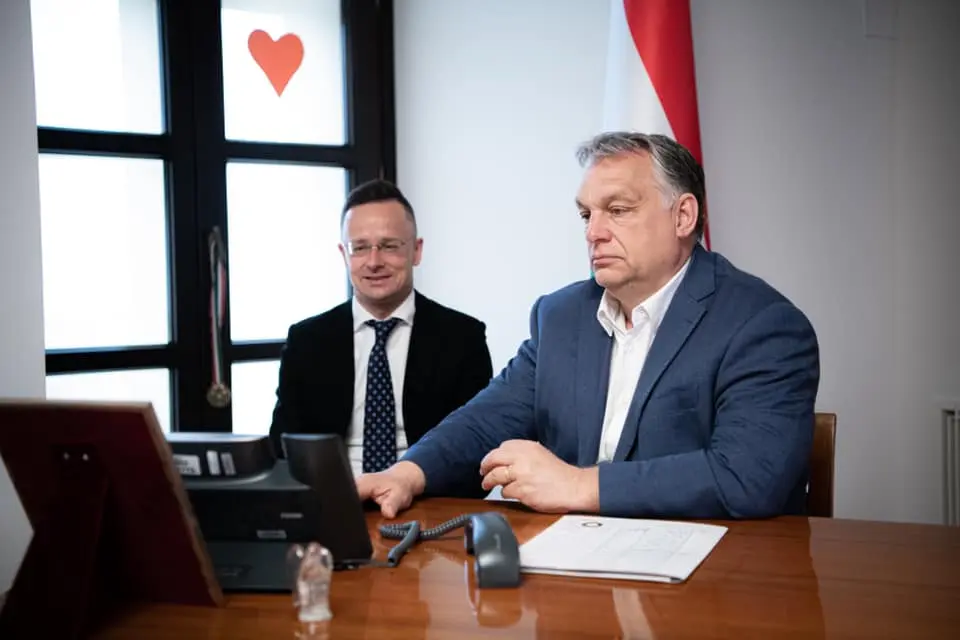
Addressing an event held by the Hungarian Foreign Affairs Institute (MKI) on Monday, Prime Minister Viktor Orbán said national interests formed the foundation of Hungarian foreign policies.
At the conference in Budapest celebrating the 50th anniversary of MKI’s foundation, Orbán said great powers with military and economic power earned respect and should not dish out warnings to their partners.
“We Hungarians are not a great power; nevertheless we claim the right to an independent foreign policy, and others who are larger than us must accept our demand,” he said.
A country of such ambition and size must maintain a strong stance, the prime minister said. It must not run scared in a tough situation but rather square up to the conflict, he added.
Orbán said Hungary was successful on the international stage precisely because notwithstanding its small population of ten million, it still resolutely pursued an independent foreign policy.
The prime minister said Hungary should not heed the “siren call” to “teach the country a lesson” in how to pursue a “well-behaved” foreign policy.
Orbán said that throughout its history, Hungary had always been capable of pursuing a sovereign and independent foreign policy centred around the prime minister. He said countries with more ambitious goals relative to their size and economic power had to “have a tight hold on the reins of foreign policy”, adding that in Hungary’s constitutional system this meant that
“it’s good to have the prime minister holding them”.
He insisted that a country with no relative advantages that wants to pursue an independent foreign policy must take a radical position. Such countries, he said, should have a broad vision and specific long-term goals and a strategy for becoming a strong country respected by the rest.
The prime minister noted that the previous government had had a “witty” argument against this by advising Hungary to “dare to be small”. He said Hungary should not want to be the “pupil” of another world power, but rather its own master.
Orbán said a radical position was necessary from a tactical standpoint so that the country could make certain concessions.
He said Hungary did not go into petty details such as the mechanism for distributing migrants, “because these are technical, not essential”. “The essential question for a Hungarian is whether migration is a good thing in any way whatsoever,” he said.
Orbán said Hungarian foreign policy asked questions not in a way that harmed Hungary’s prestige but enhanced it. The idea was not only to express Hungary’s standpoint but to defend it intellectually and politically, and fight for it, too, “turning it into something of a trademark”, he said. “This is, in effect, Hungarian soft power,” he added. Orbán said it was this that allowed Hungary to form a coalition with those who “aren’t able to say what we say” but had the same goals.


Orban said that to have an independent foreign policy as a smaller country Hungary needs to take a “radical” position. History is full of leaders who took “radical” positions: Lenin, Mao Tse Tung, Hitler, Pol Pot. Radicalism appeals to the ignorant who will gamble with the lives of their countrymen which virtually every time ends in some kind of disaster. Orban, however, talks out of both sides of his mouth by claiming that he is “conservative.” Conservatism is the antithesis of radicalism. The whole ideology of Fidesz is a mass of faulty contradictions designed in a Russian political laboratory.
How quaint. The Mouse that Roared – somebody wrote a book with this title: https://en.wikipedia.org/wiki/The_Mouse_That_Roared
Other radicais were:
Pericles; Augustus Caesar ; Henry the Eight ;Napoleon; Garibaldi ; Bismark ;
Jefferson ; De Gaulle; Churchill; Gorbachev; Margaret Thatcher;Ronald Reagan.
Unfortunately, Orban has not studied history. Hungary has not had an “independent” foreign policy in the past 200 years.