Subscribe to our social channels to get the latest news about Hungary!


One hundred and seventy years ago, the Hungarian revolution and freedom fight against the Habsburg Empire ended at the plateau of Világos. The longest-lasting revolution and freedom fight of 1848 was broken down by the combined forces of two superpowers in the continent: the Habsburg Empire and the Russian Empire. On 13th August, 29889 men, 9839 horses and 144 cannons were gathered at the plateau of Világos. Many soldiers were crying, kissing the Hungarian flags and hugging their horses in a distressing atmosphere.
In the 19th century, the Hungarian kingdom was part of the Habsburg Empire. In 1848 several revolutions broke out all over Europe for freedom against the tyrannical absolutist systems. One of these revolutions was in Hungary on 15th March 1848. The revolution was successful without blood in Pest, and it made Emperor Ferdinand V. accept the April Laws, so Hungary became a constitutional monarchy with a sovereign government of Pest – the Batthyány government.

The Habsburgs’ answer came quickly – Croatian troops attacked Hungary from the South with Austrian help, led by Josip Jelacic. The Croatian ban and Habsburg general was defeated by János Móga (commander in chief of the newly formed Hungarian army) at the battle of Pákozd 29th September 1848. After that, the third revolution of Vienna broke out on 6th October. The Hungarian army was chasing Jellacic but hesitated to cross the border or not – if they did, it would not be home defence anymore. Finally, they decided to help the revolutionaries of Vienna, but they were too late – general Windisch-Grätz broke down the revolution and repelled the Hungarian troops at the battle of Schwechat (30th October 1848). The uprising turned into a
freedom fight, to defend Hungarian liberty and independence.
What came next was troubling for the Hungarians. Revolts broke out among the ethnic minorities of the country (Serbs, Romanians) supported by the Empire. In the meantime, imperial troops launched a full-scale invasion of the country. The Hungarian army was greatly outnumbered, so it had to retreat and give up the capital, Pest-Buda (4th January 1849) – the government moved to Debrecen. Emperor Ferdinand V. resigned and the new emperor Francis Joseph I was crowned. After losing the battle of Kápolna (28th February) the new Constitution of Olmütz was introduced which declared Hungary to be an integrated, province of the Habsburg Empire.

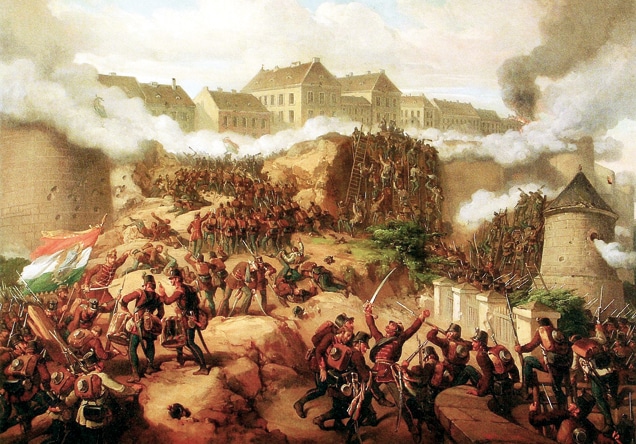
Artúr Görgei reorganised the main part of the Hungarian army during its retreat, and then it was concentrated on the Eastern side of the river Tisza, preparing for the counter-attack. General Józef Bem (of Polish origin) managed to liberate Transylvania and defeat the Austrian troops (9th February – decisive battle at Piski), and in the meantime, the Serbian rebels were also defeated in the South. General Görgei (the new commander in chief) launched a full-scale counter-attack called, the Spring campaign, against the Austrian troops. This campaign was one of the most glorious ones in the entire Hungarian history. The Hungarian army achieved a series of victories (Hatvan, Tápióbicske, Isaszeg, Vác) over one of the strongest and largest armies of Europe. At the end of the campaign Pest-Buda was liberated (21st May 1849), and the Austrian army retreated. The Habsburg dynasty was officially dethroned, and Hungary was declared an independent kingdom on 14th April. Lajos Kossuth became the governor of the country.