
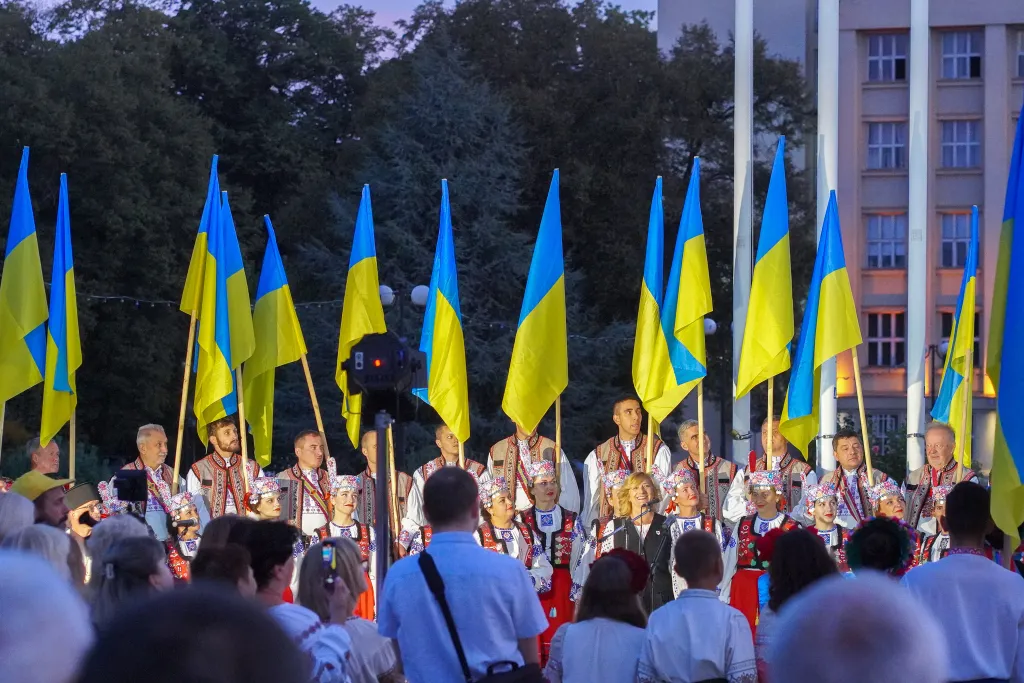
Transcarpathia was part of the Kingdom of Hungary for over a thousand years. However, the tragic twists of 20th-century Hungarian history saw it pass first to Czechoslovakia, then the Soviet Union, and today it is Ukraine’s westernmost region, home to a significant indigenous Hungarian minority. When asked about the possibility of rejoining Hungary, the responses were unexpectedly revealing.
Transcarpathia once supported autonomy
A stark fact of 20th-century Hungarian tragedy is that someone born in Transcarpathia before 1918 and dying after 1991 could have held citizenship in five different countries without ever leaving their village. The region was swept from the Kingdom of Hungary to Czechoslovakia, later to the Soviet Union (with a brief Hungarian interlude from 1939 to 1944), and finally became Ukraine’s westernmost province following Ukraine’s independence in August 1991. In a referendum held on December 1, over 90% of residents voted, and 78% supported autonomy for Transcarpathia. In the Berehove district, 81.4% endorsed the creation of a Hungarian Autonomous District centred on Berehove. None of these plans came to fruition.
Since the large-scale Russian invasion began in February 2022, rumours have circulated regularly that Hungarian Prime Minister Viktor Orbán struck a deal with Putin for Transcarpathia to be returned to Hungary. This is partly why Budapest takes a critical stance towards Kyiv while backing Moscow in many respects, promoting itself as a so-called “peace party.” Russian officials often reinforce these narratives. For instance, former president Dmitry Medvedev, a close Putin ally, made statements to that effect.
- Medvedev’s new map practically shows Russia bordering Hungary

What do the locals think?
Despite often distorted and sensationalised media reports, the true opinions of those living there—especially the Transcarpathian Hungarians—are arguably more important. The Hungarian community in Transcarpathia is steadily shrinking due to war, conscription, and economic hardships, forcing many, especially men and young families, to flee. As a result, the population has dropped by tens of thousands, even as refugees from eastern Ukraine continue to settle there, gradually changing the demographic landscape.
Against this backdrop, a representative opinion poll by the Central European Strategic Institute in Uzhhorod delivered surprising results concerning independence, autonomy, and possible annexation.
- Video: Former Hungarian politician fled Ukraine by smashing through the border barrier

Hungarians also weighed in
According to research also noted by Infostart, which included 300 Hungarian respondents, only 0.4% of Transcarpathians would support the region joining another state. Even among national minorities, this figure rises only slightly to 2%. (The survey doesn’t break down minorities further, likely due to small sample sizes.)
Less than 0.8% believe in separating from Ukraine to continue as an independent entity. Once at 78%, support for autonomy has now dropped to a mere 6%, with national minorities showing only slightly higher backing at 13.8%.

Is there a Putin-Orbán deal?
Meanwhile, 45.8% of locals do not believe any Russian-Hungarian deal exists regarding Transcarpathia’s fate; the figure among national minorities is 38.8%. About one-third (33.7%) and 42.2% of respondents, respectively, could not decide conclusively. Additionally, 42.8% feel there was no agreement between Putin and Orbán to pause missile strikes in Transcarpathia.
The Hungarian government supports Hungarians staying in the region with significant funding covering education, culture, economic aid, and grants. Only 5.2% believe this is a covert preparation for some kind of occupation. Meanwhile, 38.6% welcome the support, believing Budapest is helping the entire region, and 21.1% even describe the funds as a friendly gesture towards the Hungarian minority.

Click for more Transcarpathia-related articles.



Orban knows all about the joy of taking free money. So do the Transcarpatians. It’s bizarre that Orban complains about the EU “giving the money of Hungarians” to Ukraine when he is actively doing it himself. The money the EU gives to Ukraine isn’t even Hungarian money so the only one giving Hungarian money to Ukraine is the fat man with the big mouth.
Tell me you know NOTHING about E.U.’s finances without telling me you know nothing about E.U.’s finances.
None a single red cent of “E.U.’s” money is actually E.U.’s. It all comes from the taxpayers resident in the E.U.’s member states, including Hungary. The E.U. takes a huge chunk of that money to fund its massive bureaucracy and pet projects (including very many outside the E.U.), and then oh-so graciously gives some of what’s left back to the member states. In doing so, it redistributes the original contributions so that some member states get much less than they put in while some, including Hungary, get more. Hungary gets an annual “top up” of less than 400 euros per capita. Hardly a princely sum.
It is very important to note that the money that is “given” to the member states by the E.U., a lot or all of which is that state’s own money to begin with, may only be spent in accordance with the E.U.’s astringent diktats.
So yeah, the E.U. very much IS sending some of Hungary’s own money to Ukraine, without Hungary’s consent.
Meanwhile, Hungary is free to do with its own money as it pleases.
What a twisted way of thinking, but it suits perfectly for anti-EU propaganda.
Hungary gets massive support from EU.
400 € x 9 600 000 (population) = 3 840 000 000 € = 1 474 913 280 000 HUF.
Maybe its not big money for this propagandist but for me and my fellow Hungarians, its big money. Thank you EU.
And when you join a club, you need follow rules or there will be consequences. Just like now EU support money is being withheld due to breaking club rules.
So no, Hungary cannot do completely whatever it wants whit its own money as long as it is a member or EU. With EU we have at least some supervision of how public money is being used. Without EU supervision, even more would go into the pockets of government close oligarchs and situation here would be much worse.