Subscribe to our social channels to get the latest news about Hungary!


A country is characterised not only by its coat of arms, anthem and language but also by its money. The illustrations on coins and banknotes can tell a lot about a particular country. In our article, we present the Forint banknotes in Hungary and the pictures on them.
In Hungary, the banknote paper is produced Diósgyőr Papírgyár Zrt. and printed by Pénzjegynyomda Zrt. Graphic artist György Pálinkás created the graphic designs of the banknote series in circulation. You can read about the symbols on the coins here, and now let’s look at the symbols on the banknotes.
500 Forint
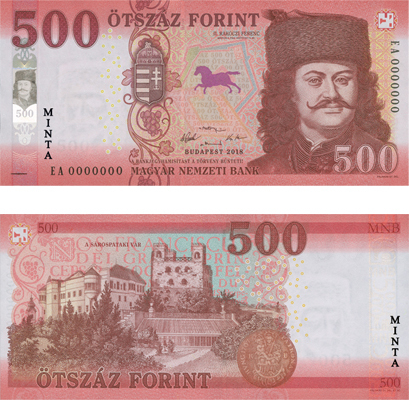
On one side of the least-value Hungarian banknote is Ádám Mányoki Baroque portrait painter’s II. Ferenc Rákóczi picture, while on the other side you can see the Sárospatak castle owned by Rákóczi and named after him at the beginning of the 18th century. His war of freedom against Habsburg oppression failed militarily, but the Habsburg revoked provisions harmful to Hungary. The Sárospatak Castle is part of the Hungarian National heritage, one of the most valuable Renaissance architectural works in the country.
1000 Forint
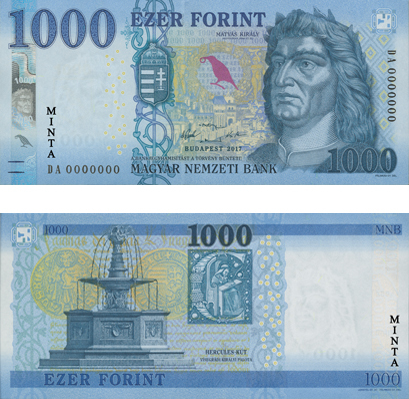
The 1000 Forint banknote depicts King Matthias Hunyadi and the fountain of Hercules in the Visegrád Castle. King Matthias was the king of Hungary and Croatia in the 15th century for almost 50 years. Nicknamed Matthias, the Native played a considerable role in establishing Renaissance and Humanism in Hungary. The legendary fountain of King Matthias was destroyed during the Turkish occupation, and its remains were found in 1941. Hercules, the invincible, referred to the extramarital child of Matthias, János Corvin, for whom Matthias hoped for a serious future.
2000 Forint
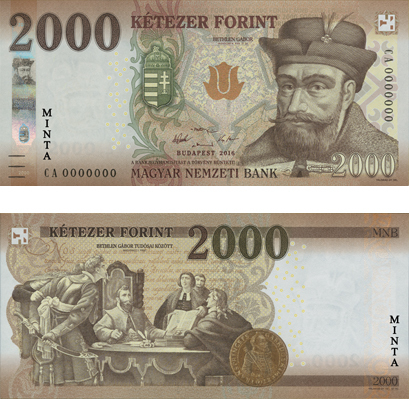
This banknote shows Gábor Bethlen, Prince of Transylvania, a significant figure in 17th-century Hungarian history. His reign is considered to be the golden age of Transylvania, as both economic and cultural recovery was observed. The other side of the paper money is decorated with a work by the Hungarian Historical painter Viktor Madarász. The title of his work on the banknote is “Among the Scientists of Gábor Bethlen”.