Subscribe to our social channels to get the latest news about Hungary!


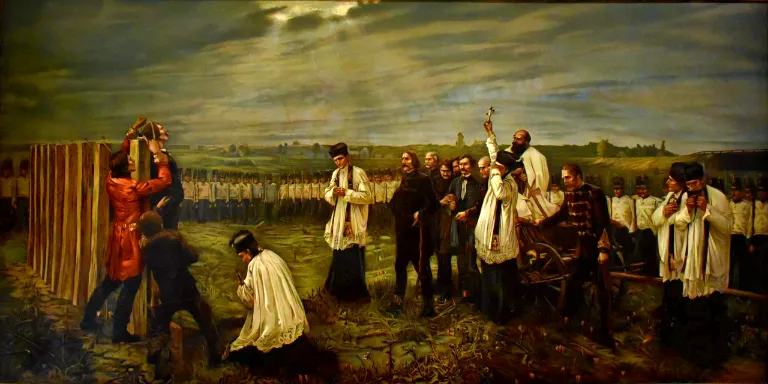
Today, we chiefly remember the heroic generals who were executed, Prime Minister Lajos Batthyány, and the many victims of the War of Independence who suffered imprisonment and hardship. But why did we lose in 1849? Could we have won? From the perspective of history, such questions may seem misplaced, yet they are worth asking — especially in light of the successes of earlier struggles for freedom.
In 1606, István Bocskai led the Hajduks to victory over Vienna and forced a favourable peace. A century later, the Rákóczi War of Independence achieved full amnesty and the enforcement of noble rights, cementing the Hungarian constitution in the Treaty of Szatmár. This treaty laid the foundations for the reform era that began in the 1820s.
In 1849, there was no peace treaty or even a truce. At Világos, the Hungarian forces laid down their arms unconditionally, in accordance with Habsburg interests. This was a stark contrast to previous uprisings and left the imprisoned generals with little hope.

Although Rákóczi’s Kuruc forces had retreated to north-eastern Hungary by early 1711, voices favouring negotiation prevailed at the Habsburg court—particularly those influenced by London. Their chief negotiator was a Hungarian nobleman, Count János Pálffy, who defeated Rákóczi’s forces at Trencsén and reached an agreement with Count Sándor Károlyi.
In the summer of 1849, no negotiations took place. The Russian troops invading Hungary at Vienna’s request numbered 200,000 well-equipped soldiers, supported by reinforcements from nearby provinces. Haynau’s western forces comprised around 160,000 to 170,000 men. Opposing them were only 150,000 Hungarian honvéd soldiers, and no talks were held.
The Habsburg leadership envisioned a centralised empire capable of uniting all Central European states—from restless Germany to the Serbian and Romanian lands—thus establishing European hegemony, even absorbing the great Prussian power. Consequently, there was no peace party in Vienna; no one suggested negotiating with Kossuth. Instead, the regime chose to crush the Hungarians.

Thus, Emperor Franz Joseph, who ascended the throne in December 1848, decisively called in the Tsar’s troops, fully aware of the humiliation this would bring upon the Habsburg Empire.
Hungary’s only real chance lay in securing effective foreign support and recognition. This was the purpose of the Declaration of Independence and the dethronement of the Habsburg dynasty. Yet both Paris and London remained silent—offering only words and sympathy, but no meaningful aid. In fact, they sought the swift restoration of Habsburg authority to block Moscow’s expansion among the Slavs and in the Balkans.
Smaller states such as Venice voiced support, but it carried little weight. Even recognition from the United States was delayed until after the surrender.
Few realise that Hungarian forces were not only fighting the invading Austrian and Russian armies but were also facing ethnic rebellions within the country. The most significant of these was the Serb uprising, supplied from Serbia and supported by Vienna and imperial troops, which tied down considerable Hungarian forces.

The government believed that granting full civil liberties to the nationalities would suffice, allowing them to compete politically and economically. Territorial autonomy, however, was an unfamiliar concept to the Hungarian ruling class, while Romanian-Hungarian relations were poisoned by the lack of full serf emancipation in Transylvania.
Although in July 1849 Kossuth reached an agreement with Nicolae Bălcescu granting basic linguistic and religious rights to Romanians, it came too late to save the revolution.
While the Russians favoured a more lenient treatment for the surrendered Hungarian officers, the imperial authorities—pursuing their centralised European hegemony—decided to eliminate the entire Hungarian leadership. Only Artúr Görgei, the successful general of the revolution, was spared, though Kossuth later unjustly made him a scapegoat.

On 6 October 1849, the first anniversary of the Vienna revolution, the thirteen martyrs of Arad, Lajos Kazinczy (son of the language reformer Ferenc Kazinczy), and Hungary’s first responsible prime minister, Lajos Batthyány, all met heroic deaths by rope and bullet. Hundreds more were executed, and countless others were imprisoned or forced into exile.
It took two more decades and numerous military and political defeats for the Habsburgs to realise that they could not secure hegemony in Europe. Their only chance of maintaining great power status was to transform their empire into a dual monarchy and reconcile with the nation most capable of state-building—the Hungarians. This came to pass in 1867, when Count Gyula Andrássy, once sentenced to death in absentia in 1849, as prime minister crowned Emperor Franz Joseph—the very man who had signed his death sentence.


