5 surprising secrets that you didn’t know about the Hungarian State Opera

Change language:
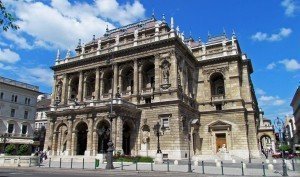
After the compromise between Hungary and Austria in 1867, the development of the capital boosted along with the increase of cultural institutions. One year after the union of Pest, Buda and Óbuda, the capital city invited applications to design the Opera House. It was Miklós Ybl who won the application. His neo-renaissance building wasn’t only one of the most beautiful buildings of the time, but also one of the most modern theatres. Szeretlekmagyarorszag.hu collected 5 hidden fun facts about the construction of the Hungarian State Opera.
The condition of the construction:
The approval of the ruler was needed even before inviting applications. Franz Joseph approved the construction on the 25th of July, 1873, but he had one condition. His condition stated that our Opera House couldn’t be bigger than the Vienna State Opera. Luckily, he didn’t set a condition that it couldn’t be more beautiful. After the Opera had been constructed, even the ruler himself admitted that the auditorium decorated with 24 carat gold was more beautiful than the one in Vienna.
Modern fire-protection regulations:
The Opera House was already half done when the Ringtheater burnt down and 400 people died in Vienna after a catastrophic firestorm. After this, many fire-protection regulations were ordered and since our Opera House was being built then, these innovations came to fruition there. Fire-curtains and fire departments were built, and they even put pools that contained water for the shower apparat to the attic. The problem of heating was solved with the help of steam and furnaces, and a modern ventilating apparat was built in the auditorium.
Hydraulic stage technique:
The world’s first hydraulic stage technique was built in the Hungarian State Opera which was an absolute innovation in the 19th century. The circle-horizon curtains were moved by water pressure, and in two corners of the stage a hydraulic service-hoist connected the slote and the 4th flour which made the transfer of the props easier. Hereafter the technique was used in different parts of Europe and even in the United States. It is an interesting fact that the Hungarian exemplar functioned for the longest time, 80 years.