Subscribe to our social channels to get the latest news about Hungary!


Dubai, March 2 (MTI) – Hungarian companies and their counterparts in the United Arab Emirates concluded nuclear, food industry and aviatic agreements during a visit by Foreign Minister Péter Szijjártó to Dubai, which ended on Wednesday.
Related article:
HUNGARY IN THE LIMELIGHT IN DUBAI – UPDATE
Szijjártó told MTI by phone that Hungary would contribute to the training of nuclear engineers of the UAE. The Hungarian government has also applied for an export licence of poultry and beef to that country, while one Hungarian dairy firm signed a supplier agreement worth 22 million dollars.
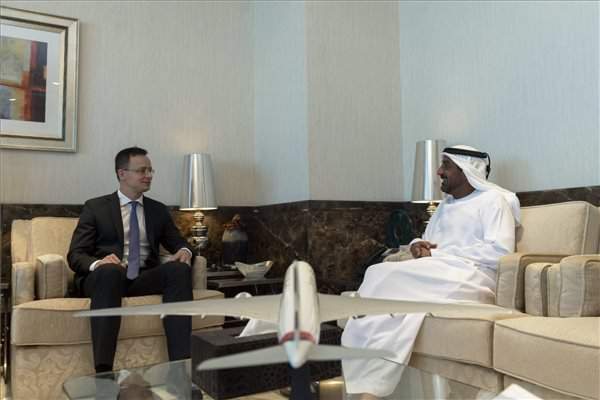
The government of the UEA has asked that its airline companies be licensed to operate flights from Budapest to destinations other than domestic ones, Szijjártó said.
Source: kormany.hu
Szijjártó also noted that the United Arab Emirates is in the process of building a four-reactor nuclear power station and has come to an agreement with Hungary on training nuclear engineers and experts. In addition, technological solutions provided by Hungarian enterprises could also play a role in the UAE within the field of renewable energies, he said, adding that genetically manipulated imported foods are often a problem in the Emirates, and since Hungary’s constitution only allows for the production of GMO-free foodstuffs, Hungarian companies are enjoying major export opportunities. Budapest has requested permission from Dubai for the import of Hungarian poultry and beef, and has been promised a rapid procedure, in addition to which a Hungarian company, Kőröstej, had already signed import agreements with a total value of 22 million US Dollars for their milk products with three clients from the UAE. Accordingly, Hungarian food industry exports to the Emirates, which grew by 14 percent last year, could produce a further significant increase this year.
“Within the field of water management, we will have major opportunities in the areas of Hungarian irrigation, water use reduction, and wastewater treatment technologies”, the Minister announced. “Achieving success in this field requires putting into order the contractual and financial background. Accordingly, we have agreed to conclude an investment protection agreement by mid-summer. In view of the fact that we are already represented by a Trading House in Dubai, Eximbank has opened a 406 million US Dollar credit line to facilitate cooperation between enterprises from Hungary and the UAE”, he said. The most important task in this area is for small and medium sized Hungarian enterprises (SMEs) to play as large a role as possible in bilateral economic cooperation, because bilateral trade has so far significantly depended on multinational companies. “For instance, when Nokia closed its Hungarian subsidiary, it led to a 75% decrease in Hungarian exports to the Emirates. Economic and trade cooperation must be diversified, which requires the involvement of SMEs, who in turn require a financing background, which Eximbank is providing”, he added.


Hungary is showing that it can work well with many Islamic states, and that it does not have to turn into one like the EC would have you believe.