Subscribe to our social channels to get the latest news about Hungary!


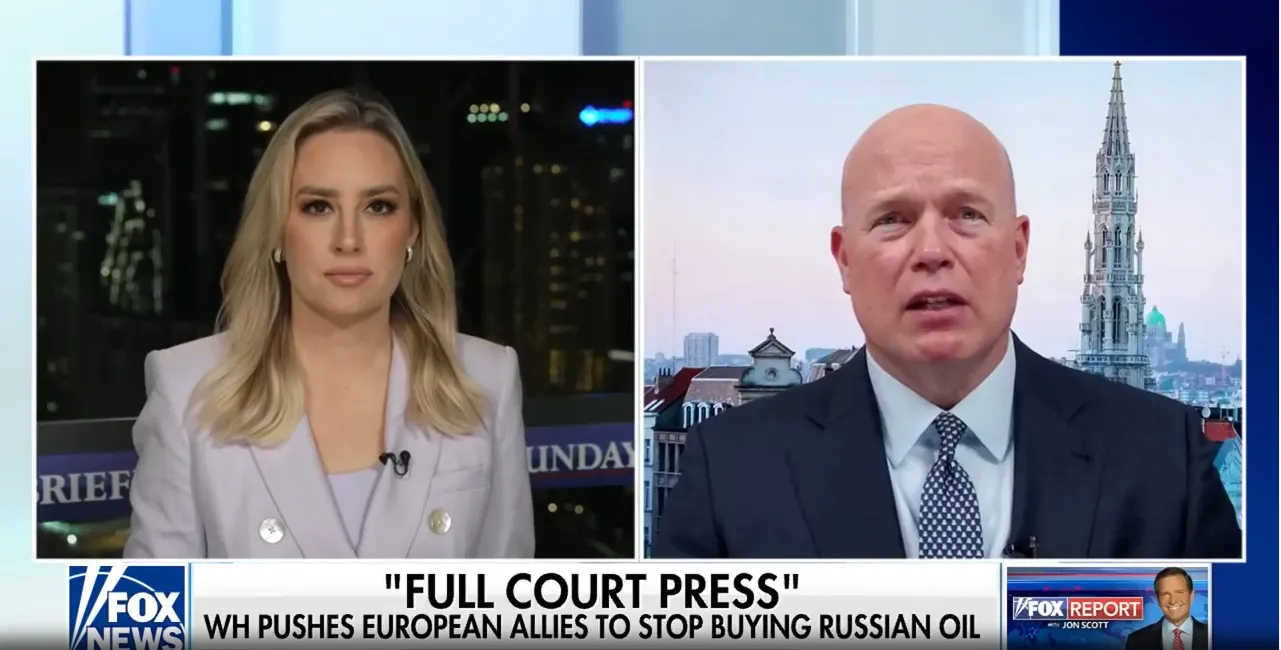
The United States has intensified pressure on Hungary to reduce its reliance on Russian oil and gas, urging Budapest to present a concrete plan for energy diversification. While Washington calls for decisive steps, Hungary’s government maintains that its geography and energy security needs make a swift shift away from Moscow “unrealistic”.
The United States expects tangible progress from Hungary, Slovakia, and Turkey towards reducing their dependence on Russian energy supplies — said Matt Whitaker, the U.S. Ambassador to NATO, in an interview with Fox News.
According to Whitaker, while other Central European countries have already outlined their exit strategies, “Budapest has not yet presented any concrete plan or shown active initiative in this direction.”
.@USAmbNATO Matt Whitaker says Russia is feeling pressure from POTUS – despite Kremlin press campaign suggesting otherwise.
— Jacqui Heinrich (@JacquiHeinrich) October 26, 2025
WHITAKER: "President Trump holds all the cards. The Russians should end this senseless war as soon as they possibly can. It's not going to get better for… pic.twitter.com/ywWwE66lBj
At the same time, the ambassador emphasised that Washington seeks continued cooperation with Hungary and its neighbours, such as Croatia, which could play an important role in supporting the transition away from Russian energy.
Foreign Minister Péter Szijjártó responded to Whitaker’s remarks by reaffirming Hungary’s pragmatic and geography-driven approach to energy policy.
“Energy supply must be treated as a physical issue. You cannot heat or cool homes with political intentions,” Szijjártó told Fox News, explaining that Hungary, as a landlocked country, simply cannot abandon Russian oil and gas in the short term.
He also discussed the issue with U.S. Secretary of State Marco Rubio, who — according to Szijjártó — was “the first Western politician to acknowledge that geographical realities must be taken into account”.
The Hungarian government frequently emphasises its independence and often diverges from EU policy lines. However, it appears to consistently fulfil the requests of the Trump administration and stands firmly with the United States. The American energy lobby is also growing stronger — as illustrated by one of the latest developments: American small modular nuclear reactors may power Hungarian cities soon
Despite the ongoing war in Ukraine, Hungary has increased its Russian gas imports over the past four years, diverging from the general European trend.
Between 2021 and 2025, the following data illustrate Hungary’s growing dependence:
These figures confirm that Hungary has not only maintained but expanded its energy dependence on Russia — in stark contrast with most EU member states.
read also: Hungary’s new energy plan quietly redefines Russia as a risk
In a recent interview shared on his social media page, Szijjártó underlined that Hungary remains a committed NATO ally, even as it pursues an independent foreign policy.
“We are the only NATO country that has not delivered a single shipment of weapons to Ukraine since the war began,” he said, stressing that Hungary avoids any steps that could risk escalation.
When asked about repeated Russian airspace violations, the minister responded:
“We are in solidarity with our European and NATO partners and condemn any violation of NATO airspace. Hungary currently carries out air policing missions over the Baltic region — we do everything to prevent escalation.”
He concluded by reaffirming Hungary’s long-standing alliance commitment:
“It was a great decision to join NATO. It remains the strongest defence alliance in world history.”
In parallel with diplomatic pressure, Washington announced new sanctions this week against two major Russian oil companies — Rosneft and Lukoil.
According to U.S. Treasury Secretary Scott Bessent, the move comes in response to Moscow’s continued refusal to engage in peace talks. Bessent called for an “immediate ceasefire and an end to the killing”.
Read also: Peace in business? Russians and Americans unite to supply Paks with nuclear fuel
A potential regional solution may come from Croatia, which is significantly expanding its gas infrastructure.
In 2024, Zagreb approved the construction of two new gas pipelines, increasing capacity to 3.5 billion cubic metres per year, and began extending the Zlobin–Bosiljevo network that could directly supply Hungary.
Croatia’s plan to double the capacity of its LNG terminal could also boost energy diversification in Central Europe, improving import flexibility and supply security for Hungary and its neighbours — while creating new export opportunities for U.S. LNG suppliers.
However, progress remains uneven.
Political and commercial tensions between Budapest and Zagreb occasionally slow cooperation, as Hungary maintains long-term contracts with Russia, while Croatia seeks to profit from regional energy redistribution. As we wrote earlier, MOL’s pipeline dream hits a wall in Croatia
Ongoing or delayed Hungarian infrastructure investments also hinder diversification.
Read more news about energy in Hungary
The United States is urging Hungary to take decisive action to reduce its reliance on Russian energy, while the Hungarian government insists that geographical and physical realities prevent a rapid shift.
With record-high Russian gas imports, a growing Croatian alternative, and fresh U.S. sanctions reshaping the energy landscape, the question remains:
Will Hungary remain one of Moscow’s most loyal energy partners in Europe — or gradually turn towards diversification under allied pressure?
Read also: “Budapest will be ours too”, says Russian propagandist after anniversary of Hungarian revolution

 IT
IT HR
HR NL
NL FR
FR JA
JA RO
RO RU
RU ES
ES TR
TR


I never ever thought to support Trump for once in my life. But on this time i can only say, GO MAGA GO! 💪
Notice that in his condemnation of airspace violations Szijjarto would not name Russia. They never do. Not the defence minister, not Orban, not Szijjarto or anyone else in the Fidesz government. That is your proof that this government has deep ties with Russia that betray Hungary’s supposed alliance with NATO or the EU. Membership in the EU has become an absolute joke as not a day goes by as the government condemns the organization it remains in for free money it does not at all deserve. As the old expression goes “the chickens are coming home to roost” for Fidesz now on energy and other things as its’ constant betrayal of the Western Alliance must inevitably be dealt with and the consequences will be negative and painful for the Hungarian people.