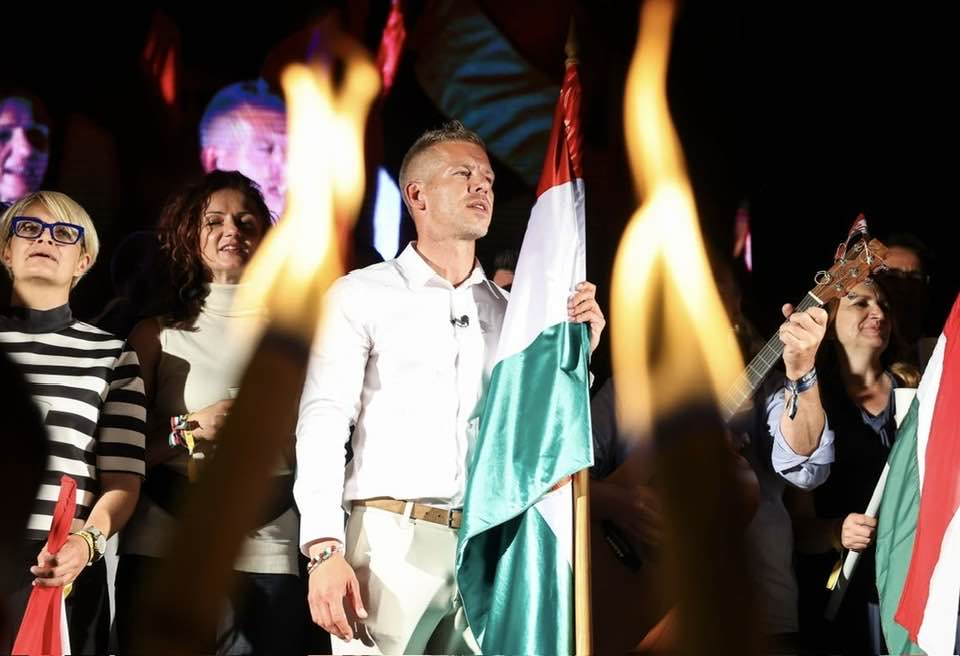
Péter Magyar’s Tisza leads Fidesz by 15%: Magyar may secure supermajority next April; Orbán’s grip could be broken – UPDATED: reaction

Change language:
Hungary’s next general election is scheduled for April next year, following Prime Minister Viktor Orbán’s 2022 supermajority victory against the united opposition and their prime ministerial candidate, Péter Márki-Zay. At that time, Fidesz held a 15% lead over the six-party opposition alliance.
Now, a new Medián poll indicates that Péter Magyar’s Tisza Party is ahead of Fidesz by the same 15%. In 2022, such a margin translated into a supermajority for Orbán’s Fidesz. Could voters now grant a two-thirds majority to Péter Magyar?
Tisza may be on course for a supermajority in the next parliamentary election
Just 18 months ago, almost no one had heard of Péter Magyar, who had served for years as the head of the Diákhitel Központ (Student Loan Centre) and was the husband of Judit Varga, Hungary’s former Minister of Justice. He came into the spotlight with a Partizán interview following the presidential clemency scandal involving President Katalin Novák, which ultimately led to the downfall of both Varga and Novák in February 2024.
In the European Parliamentary elections held just months later, Magyar’s Tisza Party captured nearly 30% of the popular vote, emerging as a viable alternative for those opposed to Orbán’s regime.
According to the latest Medián poll conducted by Endre Hann, Tisza is now 15 percentage points ahead of Orbán’s Fidesz among committed voters. One year ago, Fidesz had a 14-point lead—now reversed into a 15-point lead for Tisza. That 15-point lead mirrors the margin Fidesz enjoyed over the opposition in the 2022 parliamentary election.
Moreover, Medián reports that more voters now believe Tisza will win the next election than those who think Orbán will remain in power—an unprecedented shift in Hungarian politics over the past two decades. In addition, 70% of respondents believe that the country is heading in the wrong direction, a figure not seen since January 2013 during the crisis management phase of Orbán’s second cabinet following the 2008 global financial crisis.