Subscribe to our social channels to get the latest news about Hungary!


The Hungarian folk costume is the traditional way of dressing up in the country. Similarly to other nations, it represents the country and is much-valued. Our folk costumes vary by region, but you’ve probably heard about either the Matyó or the Kalocsa embroidery that have conquered the world. In this article, we want to give you an overview of the precious Hungarian folk costumes, so without further ado, let’s get started 😉
The concept used in ethnography includes everyday and festive costumes, and basically the whole system of dressing. This system varies by smaller and larger regions, which all have local folk costumes that characterise the given area.
When talking about Hungarian folk costume, we distinguish four main regions: Transdanubia, Uplands, Great Hungarian Plain and Transylvania. Some of the lands with characteristic dresses are found along the Galga, in Kalotaszeg, Kalocsa, Lóc, Matyó Land, Hosszúhetény, Hollókő, Kazár, Ormánság, Sárköz, Szekler Land, Torockó and Püspökbogád.


The costume was usually regulated by “laws”. For instance, nobles, civilians and serves dressed differently. The inhabitants of different regions differentiated themselves from the inhabitants and nationalities of other areas with their way of dressing.
Back in the day, the costumes were handmade from durable materials so that they could serve several generations. However, from the end of the 19th century, more and more clothing items were sewn from manufactured materials.
Nowadays, folk costumes are mostly worn on special occasions and holidays.
Although, the culture lived on from the middle of the 20th century in regions such as Transylvania, Kalocsa, Matyó Land and Palóc Land.
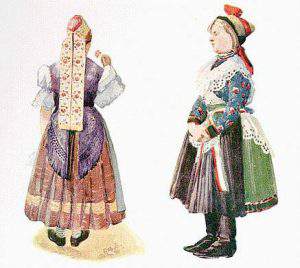
According to mek.niif.hu (Hungarian Ethnographic Encyclopaedia), the basic items of Hungarian folk costumes were mainly simple, handmade and versatile so that they could be combined in many ways. These included shirts, trousers, pendely (linen underskirt), skirts, different types of aprons, belts, elejbőr (an item made from sheepskin to keep the chest area warm), kacagány (furred animal skin worn on the back), vests, ködmön (a type of coat made from sheepskin), fur coats, different underpants, jerkins. The final look was complete with headpieces (hats, caps, wreaths, corolla, coifs and headscarves), scarves, shoes, jewellery, ribbons and hat ornaments.
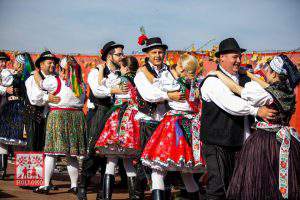
But the selection and combination of items were restricted: some could be only worn by brides-to-be, just-married women or housewives, while others were adequate on certain holidays. The way of putting together and wearing the outfits also served the goal of achieving the locally admired ideal of beauty.
Regarding women’s wear, there are three typical structures. The first and most common is centred around layered short skirts and under-blouse combinations. It is characterised by different headwear, especially the combination of coifs. Baggy, short-sleeved under-blouses were worn on the waist with a bodice and fringy humerale over. The loose sleeves of the blouse were decorated with ribbons. The look was complete with pearl necklaces or lázsiás (necklace made from silver coins).
They wore 4-10 or even more baggy skirts over the pendely, with which they “shaped” their hip.
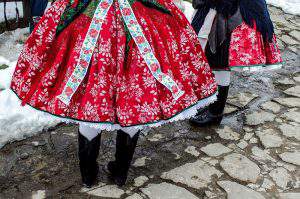
Aprons were added on top of the skirts. For footwear, the options included boots, leather shoes and slippers with thick stockings.
The second structure was made up of a few but long skirts combined with under-blouses and bodice. Civilian, urban features characterised the third combination, but not everyone considers it a folk costume.
Regarding men’s wear, the grouping is harder due to the lack of research (compared to women’s wear). During the flourishing of the aforementioned female combinations, men also wore linen on the upper bodies. Based on the forms of linen trousers, we can distinguish regions wearing long and baggy pants (Transdanubia, Danube-Tisza Interfluve, Matyós etc.), regions preferring short and baggy trousers (Transtisza) and areas characterised by tight trousers (Transylvania, Moldavia, Bukovina etc.).
According to the Hungarian Ethnographic Encyclopaedia, in the summer, most men only wore shirts, while vests were also added to the outfit in some places. A very original item was the suba on the Great Hungarian Plain, which is a long, sleeveless overgarment usually made from sheepskin. It’s much more common pair was the szűr, a coat-like overgarment.
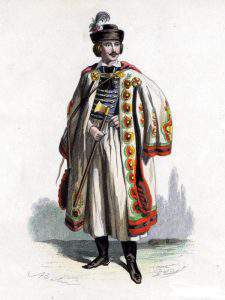
Folk costumes can also be perceived from a semiologic point of view because people who knew what the different clothing items, colours, decorations meant could find out a lot about the person wearing them: the person’s age, class, state, occupation and the festivity he/she dressed up for. Specific clothing items and combinations had the same meaning all over the country, while regional shades of meaning were also present.
Many times, it was enough to look at the headwear of the person, because it said the most about someone. For instance, you could tell that a man was a child, bachelor, husband, taken or single by the feather, plume pined to their hats.
And if someone’s hat wasn’t decorated, it meant that “the time of its wearer was over”.
Girls wore corolla, wreath or ribbons on their head, while housewives wore coifs. Women changed their coif many times during their life based on their age and whether or not their children were married. The coifs got plainer and fainter with time. Young, childless women wore a veil-piece over their coif.
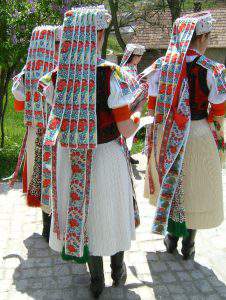
Concerning the whole of the costume, the material, amount of decoration, shape and primarily the colours said everything about the age and occasion. White and red with golden ornaments were the colours of youth. After the age of 35-40, women started wearing darker colours, like green, blue, purple and brown. Black was the colour of the elderly.
In the heyday of folk costumes, women had many festive sets. They had around five everyday skirts and thirty for different holidays. The main events to showcase these creations were connected to the church and the cemetery. Respecting the holidays by dressing up nicely was essential. Men’s costumes weren’t so diverse when it comes to festive items. Their clothing was more so the sign of class and prestige.
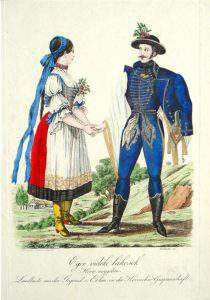
We’d like to finish this article with a quote from Matyó Land which demonstrates the importance of folk costumes:
“Someone is a Matyó, if he/she dresses like a Matyó”
Featured image: www.facebook.com/Hollókő, az élő falu
Source: Daily News Hungary


My mother was Hungarian /family from Devescer/ we can be dated back 7 or so generations or more. She told me that unmarried girls wore the underskirt a little longer than the top skirt, which indicated ‘so talk to my father for my hand in marriage’ and were permitted to wear their hair uncovered. Married women had the underskirt and top skirt the same length but had to cover their hair, some even adopting a matron’s cap. Married men wore black trousers, single men white trousers, so there was no cheating hiding a ring. The wife knew what trousers he was wearing!