Subscribe to our social channels to get the latest news about Hungary!


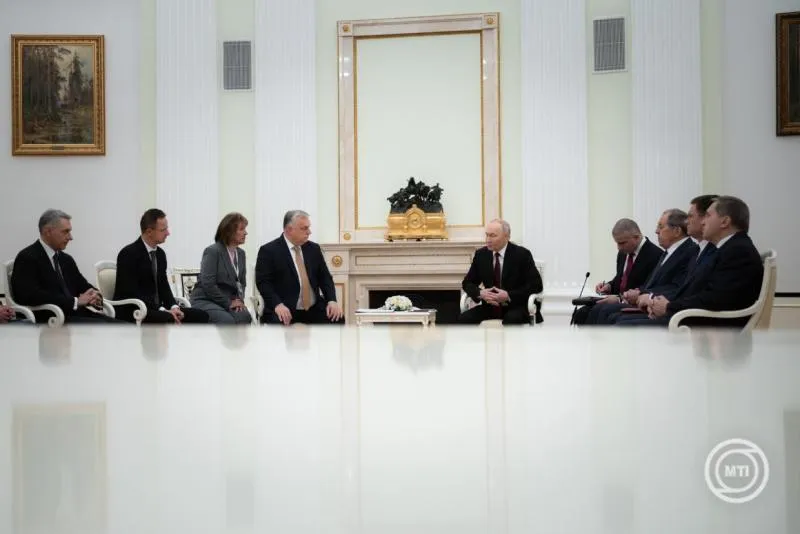
When Hungarian Prime Minister Viktor Orbán met Russian President Vladimir Putin in Moscow on Friday, the usual choreography of diplomatic greetings was briefly overshadowed by an unexpected player: the interpreter. While interpreters are typically invisible yet indispensable participants in high-level talks, the Hungarian interpreter’s performance drew unusual public attention due to a series of striking mistranslations during the televised portion of the meeting.
According to protocol, each delegation brings its own interpreter, a matter of both professionalism and trust. Yet during the short exchange in front of the cameras, the Hungarian interpreter’s rendering of Putin’s Russian statements into Hungarian diverged significantly from the original meaning: at times softening, reframing, or omitting key elements. Telex gathered these mistranslations in an article.
Telex compared the verbatim Russian statements with the Hungarian interpretation, revealing discrepancies that could colour how the Prime Minister perceived the tone before closed-door talks began.
For example, when Putin stated:
“Our views on certain issues, including international affairs, do not necessarily converge,”
the interpreter instead conveyed:
“Our cooperation at the international level is also good.”
Similarly, Putin’s reference to a 23% drop in bilateral trade (explicitly linked to external restrictions) was replaced with a vague remark about last year being “not so easy” for Russia either. Other statements were rephrased to sound more complimentary or cooperative than the original Russian phrasing. Here’s the full list by Telex:
I am pleased to note that, regardless of the complexity of the current situation, our relations have been preserved and are developing.
I am very happy to be able to highlight that our relations are continuing to develop.
We are both aware that there have been different periods in our history, but the current relations are based on the best aspects of those periods and on pragmatism in the practical development of bilateral relations.
In fact, they are moving forward progressively, despite the difficult situation, and we are maintaining our friendly relations and ties.
We have known each other for a long time…
I am glad that you have come to visit us…
I know that in your work, you primarily have the interests of Hungary and the Hungarian people in mind.
I hope that we will now discuss further opportunities for cooperation and move forward with them.
Our views on certain issues, including international affairs, do not necessarily converge…
Our cooperation at the international level is also good…
But there is an atmosphere between us that allows us to discuss any issue openly.
So here we are cooperating and we are continuing to develop cooperation and work in all kinds of sectors.
This allows us not only to talk, but also to find solutions to any problems.
We don’t just talk, but in fact we act on what we promise.
We are aware of your balanced opinion on the problems surrounding Ukraine (he repeated this a bit differently: “on the issue of Ukraine” – author’s note).
And I know that international politics of course have an impact on you.
As far as bilateral relations are concerned, I regret to see that trade has declined compared to last year, mainly due to external restrictions, but still to a significant degree, by 23 percent.
Last year also brought changes, and it was not so easy for us either.
But there are also good prospects; this year we have already seen some growth, it is modest, but still more than 7 percent.
This year we are seeing a small increase, not too high, but still visible …
Of course, we have deep cooperation in the field of energy,…
in energy and other sectors.
And there are issues and problems that we need to discuss.
And that is how we can further develop our economy.
While the polite greetings and concluding remarks were interpreted correctly, large parts of Putin’s message were shifted towards a more favourable framing. These ranged from minimising differences in international positions to glossing over critical assessments of economic trends.
Although such introductory remarks are largely symbolic, they help set the tone for negotiations. Analysts suggest that superficial or inaccurate interpretation might hinder the Hungarian delegation’s ability to respond to nuances in Putin’s positioning.
The incident has also triggered questions about Hungary’s interpreter selection process. Telex reported that they contacted the Ministry of Foreign Affairs and Trade, the Prime Minister’s Office, and the Government Information Centre to clarify how interpreters are chosen for top-level international meetings. None had responded at the time of writing.
Interpreter mistakes are not usually scrutinised so closely, as most diplomatic discussions happen behind closed doors. But Friday’s missteps were broadcast live, offering viewers an unusual look at how much trust governments must place in the professionals who bridge language gaps, and how quickly mistranslations can change the tone of an international exchange.
Orbán later spoke as usual through the Russian side’s interpreter, who delivered a precise and protocol-appropriate translation of the Hungarian prime minister’s remarks.
What’s your take: was the interpreter simply not qualified for such a high-level meeting, or were these mistranslations intentional? Let us know in the comments.

 ZH
ZH IT
IT DE
DE HR
HR NL
NL FR
FR JA
JA RO
RO RU
RU ES
ES TR
TR


That’s what happens when you hire people based on how faithful they are to the party in their social media activity rather than on ability. I suspect Hungary is full of people put in positions where they don’t know what they are doing because everything is based on favouratism. Businesses are taken over by connected party men who don’t have a clue such as the gas fitter who owns half of the country. That is the “Eastern” Russian way. In the West which Hungary hopefully will join some day we exercise hiring based on merit because that drives efficiency and profitability which again is something lacking in Hungary.
Amen to that, Larry! Instead of the misspelled favoritism, I’d use cronyism (cimboraság).
Ungaro I misspell more and more, make typos, gramattical errors, etc. as I get older and the font keeps getting harder to see. On top of that you have too much internet usage making your brain prefer reading things requiring a shorter attention span as you multi-task.
You do not need to worry about an occasional typo, Dear Larry.
After all, you are not even writing in your native language, nor is commenting here a P.H.D. dissertation.
If you want to make a tweak in yourself, tweak having less emnity for people and peoples.
Other than that I think you look just fine.
Interesting, coming from someone using the Confederate flag as an avatar. I used to work in the US (H1B, baby!) and it almost always provoked strong reactions – well – other than certain places South.
In fact, many platforms even ban images of said flag as because it is seen as a hate symbol. At any rate, it is very popular with extremist or racist groups. Anything you are trying to signal to us, @Mouton ?
Apparently this interpreter is one of the best in Hungary and has been doing this very well for years. Something was wrong with her at the meeting.
As for Mouton. Look at his post on the flight to Banja Luka story. He’s a proud Whitey, proud of his white skin. Make sure you moisturize that pure white skin boy to keep it pretty.