
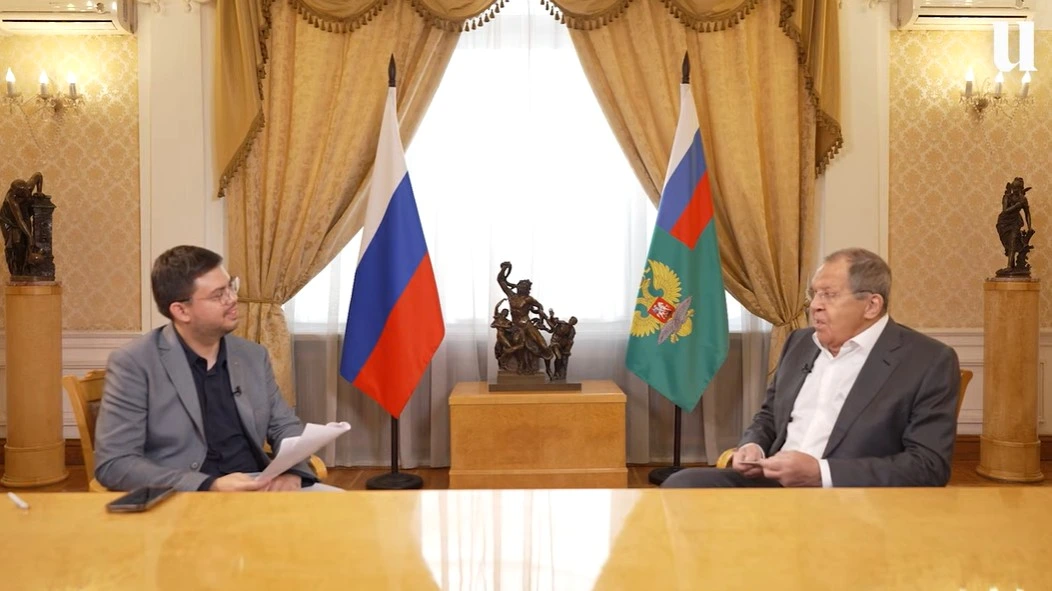
The interview with Russian Foreign Minister Sergey Lavrov was arranged through the mediation of Hungary’s Foreign Minister Péter Szijjártó, and covered topics such as the war in Ukraine, Hungary’s position in the EU, and Finland’s NATO membership.
A meeting born from a joke
The idea first came up in September, when Tamás Cs. Király, host of the Ultrahang YouTube channel, interviewed Szijjártó from New York during the UN General Assembly. At the end of their conversation, he jokingly asked:
“Could you arrange an interview with Lavrov?”
The minister replied: “I’ll ask.”
What started as a joke soon became reality. A few weeks later, Szijjártó contacted his Russian counterpart, and the Ultrahang team received confirmation that Sergei Lavrov had agreed to the interview. Preparations began shortly afterward, and about a month later, the Hungarian crew was already filming in Moscow.
They paid their own way to Moscow
According to Ultrahang’s official statement, the trip was not financed by either the Hungarian or the Russian state.
“The flight, visa, and accommodation were all paid from our own pocket,” Cs. Király wrote, adding:
“Since Google pays well for views — and our channel performs quite decently — we have no reason to complain.”
The crew travelled from Vienna via Istanbul and stayed in a rented apartment. At Moscow airport, they were held at border control for an hour and a half before being allowed to enter the country.
Lavrov: Ukraine violated the Budapest Memorandum
During the nearly hour-long conversation, Lavrov spoke extensively about Ukraine, the 1994 Budapest Memorandum, and the role of Western countries.
According to the minister, it was not Russia but Ukraine that breached the agreement by failing to respect minority rights. He also argued that the document only guaranteed protection against nuclear attacks, not the inviolability of borders.
In reality, however, the Budapest Memorandum — in line with the principles of the 1975 Helsinki Final Act — explicitly calls for the respect of sovereignty and territorial integrity. Lavrov did not mention this aspect.
The foreign minister said that Russia is “not interested in territories, but in people,” and claimed that Russian troops were welcomed in the occupied Ukrainian regions. He referred to Crimea and other occupied territories as “historically Russian lands” and stated that further territorial expansion was “necessary” as long as, in his words, “the Nazi regime remains in power in Kyiv.”
One of the most striking moments, according to HVG’s review, came when Lavrov quoted former U.S. national security adviser Zbigniew Brzezinski:
“Russia with Ukraine is a great power; without Ukraine, it is only a regional one.”
The remark suggested that controlling Ukraine remains a strategic goal for Moscow — a prerequisite for maintaining Russia’s great-power status.
Praise for Hungary, criticism for Finland
At the end of the interview, Lavrov described Hungary as one of the “voices of reason” within the European Union. He said that relations between Moscow and Budapest remain balanced and warned against “emotion-driven debates” or external pressure damaging bilateral ties.
Lavrov also recalled that President Vladimir Putin laid a wreath in 2006 at the memorial to the victims of the 1956 Hungarian Revolution, which he cited as evidence of Russia’s “respect for Hungarian history.”
In contrast, his comments on Finland were sharply critical. He called Helsinki’s NATO membership a mistake and claimed that “a nostalgia for World War II” had re-emerged in Finnish society, referring to the period when Finnish troops fought alongside Nazi Germany against the Soviet Union. According to Lavrov, Finland has now “unnecessarily become a military adversary in the eyes of Moscow.”
Criticism of the interview
The interview triggered strong reactions in Hungary’s media and expert circles. Several analysts described it as poorly prepared and overly deferential to Lavrov, allowing the Russian foreign minister to steer the conversation without challenge.
Foreign policy expert András Rácz published a ten-point critique highlighting what he called “a mixture of amateurism and secondary embarrassment.” Among his main concerns were the interviewer’s poor command of English, which led to several misunderstandings, and the lack of fact-checking or follow-up questions when Lavrov made historically questionable claims — particularly regarding the Budapest Memorandum and the war in Ukraine.
Rácz also criticised the absence of basic diplomatic protocol (such as formal dress and professional tone) and noted that the interviewer failed to raise obvious counterpoints, for example, about Ukraine’s minority rights or the composition of its government after Lavrov repeatedly referred to it as a “Nazi regime.”
Despite the backlash, Ultrahang’s host later said he intends to continue the interview format and hopes to speak with Ukraine’s foreign minister next.



