Subscribe to our social channels to get the latest news about Hungary!


NATO 75—Hungary and the Future of NATO was the title of an international conference organised by the Hungarian Institute of Foreign Affairs (HIIA) on 19 September 2024 at Matild Palace in Budapest.
Dr. Gladden Pappin, President of HIIA, delivered the opening speech. He said, “The NATO Alliance must prepare for the future by strengthening its defence capabilities and strategic autonomy while promoting peace and connectivity wherever possible. We are not interested in completely severing ties with the world’s great powers.”
Benedetta Berti, Head of the Strategic Planning Unit of the NATO Secretary General, continued the opening remarks, taking part in the conference online. “We live in an increasingly interdependent world, where instability can rear its head in our neighbourhood. As we face an increasingly complex war, we need to maintain security while at the same time dealing with non-military threats, from disinformation to cyber-attacks. NATO is working to build strong resilience in all areas.” – she stressed.
The conference’s first session, “Can NATO keep the peace?” was a panel discussion on NATO’s role in the next decade. Elizabeta Chupovska Ristova, Minister of State for Defence of North Macedonia, pointed out, “We need to work together to develop the capacity of our personnel, as well as to build new partnerships and strengthen regional cooperation.”
Péter Sztáray, State Secretary for Security Policy, said:
“If we do not invest in developing the military awareness of the new generations, we could face serious problems in peacetime because there will not be enough people joining the army. And in times of conflict, this is an even more serious problem, as young people will not be adequately prepared to defend their country.”
Retired Lieutenant General Bertrand de La Chesnais, former Deputy Chief of Staff of the French Army, stressed that “France’s historic position is that NATO must remain a purely defensive influence and not become an organisation for peace restoration.”
Walter Feichtinger, President of the Austrian Center for Strategic Analysis, stressed that “NATO must have a global perspective, and in today’s strategic environment, it needs one. But the Alliance was created primarily to guarantee the security of the Euro-Atlantic area.”
In a discussion on the past, present, and future of Hungarian defence, Márton Ugrósdy, Deputy State Secretary of the Prime Minister’s Office, said,
“It is difficult to find the right people to defend our country, to operate the various vehicles, equipment, and weapons, but the most daunting and difficult question is how to take care of the injured. How do we reintegrate them back into society with their lifelong injuries? How do we help them find work, and most importantly, how do we help them process their trauma?”
According to Tamás Csiki Varga, senior researcher at the John Lukács Institute of the National Academy of Sciences, “At least until 2028, all defence-related production in Hungary will be exclusively for the Hungarian Defence Forces. We still have a lot of work to do. We need to be involved in the production process, provide the workforce, and cooperate with test and research centres to achieve our further goals.”
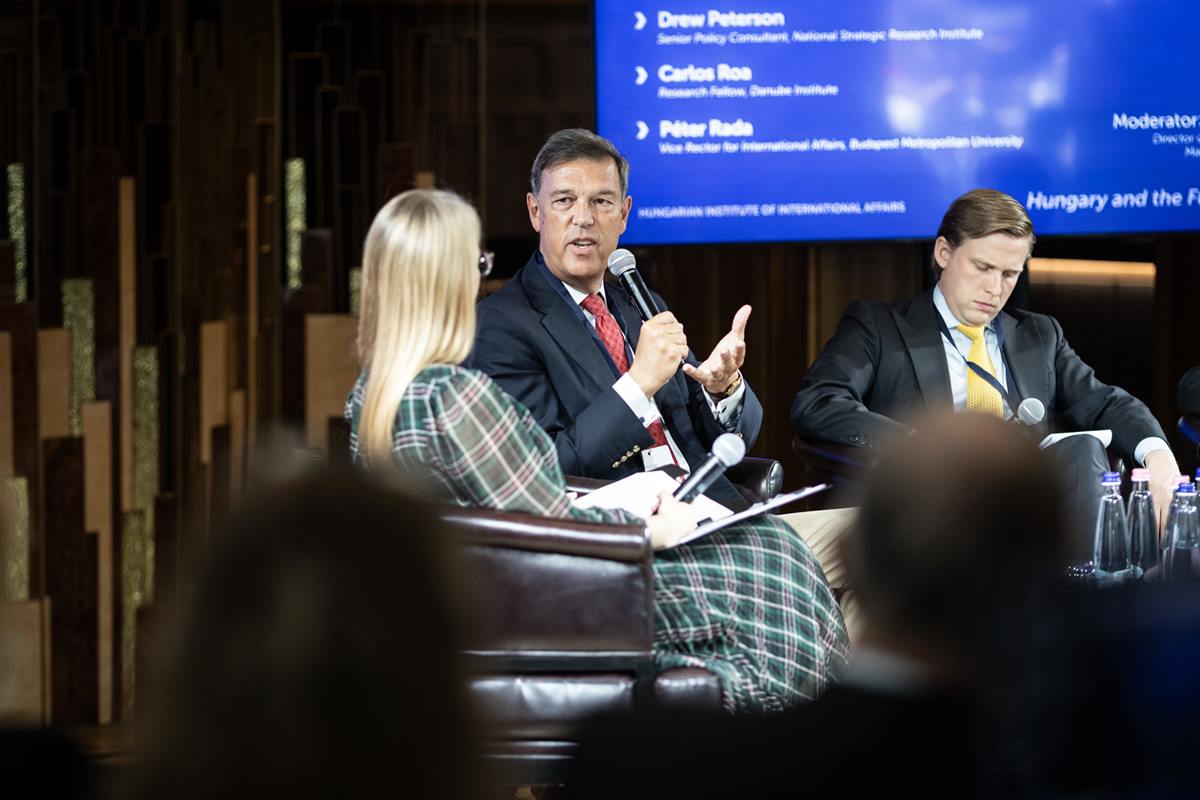
During the roundtable discussion “How is America’s Role in NATO Evolving?” , George Beebe, Director of the Grand Strategy Program at the Quincy Institute, said, “There is too much instability in Europe and the world. The conflict in Ukraine has had significant consequences for the relationship between the United States and Europe. Either we find a solution that guarantees Ukraine’s security, or it will remain an open wound in Europe for a long time.”
Drew Peterson, a strategic adviser at the National Strategic Research Institute, said: “In a sense, the Ukraine crisis has been a long-term strategic disaster for European stability and US policy. An early solution is needed, although it raises very difficult political questions for all concerned.”
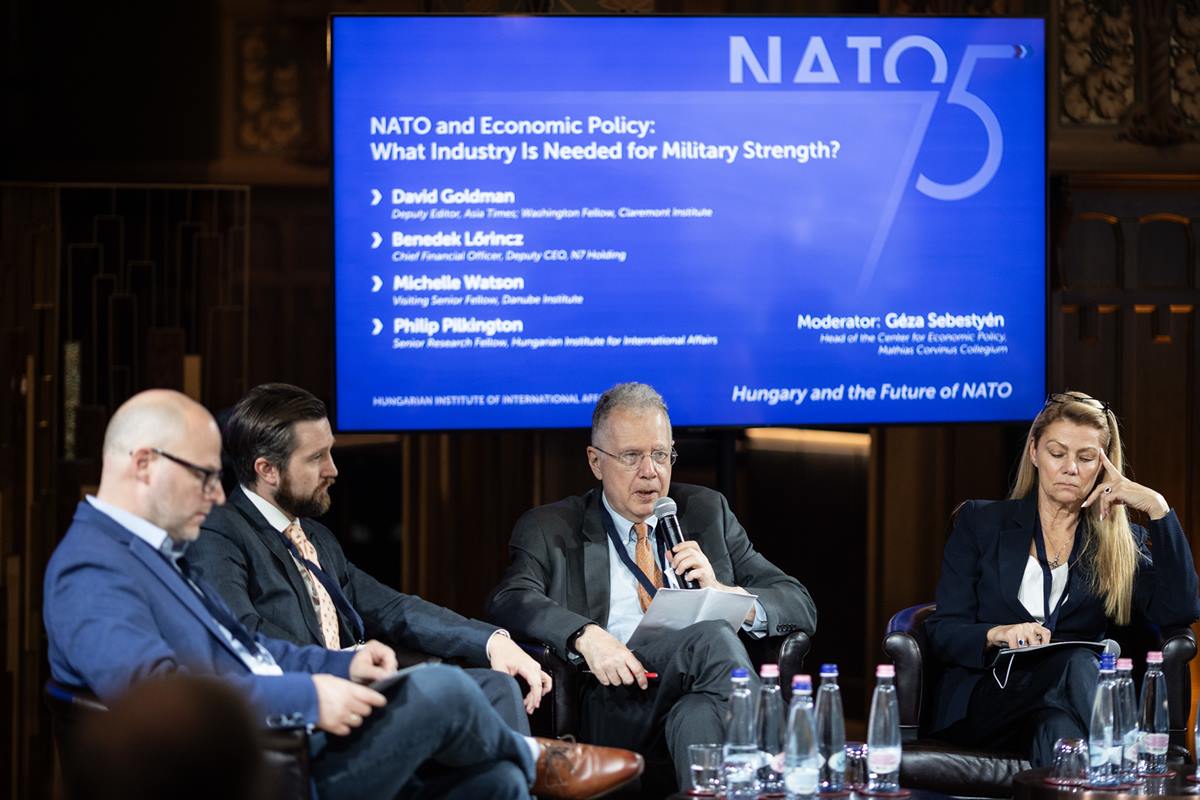
Speaking at NATO and Economics: What Industry Needs Military Power, David P. Goldman, deputy editor of the Asia Times and a research fellow at the Claremont Institute in Washington, D.C., stressed, “In the West, especially in the United States, we need visionary leaders who demand technological breakthroughs from the military like those we achieved in the past when we won the Cold War against what seemed then impossible odds. And we need corporate leaders who can take up the challenge and use the funding effectively; and venture capitalists who will commercialise the technologies.”
Michelle Watson, a Visiting Fellow at the Danube Institute, pointed out, “NATO has fully embraced not only new platforms, technologies, and innovations but also many start-up companies that are pushing the boundaries to develop new processes for NATO to provide the necessary military power and hybrid warfare capabilities that today’s modern theatre of war demands. Ukraine is a perfect example.”
In the conference’s closing panel, entitled Strengthening Central Europe: Challenges and Threats, Robert Bestro, Director of Defence Policy at the Slovak Ministry of Defence, said, “No NATO member state is at war at the moment. We support Ukraine, that is true, but NATO is not involved in the war.”
Anthony Tata, a retired US Army Lieutenant General, said, “There’s a lot of talk about North Africa and expanding eastwards, and there’s also a lot of potential in cyberspace and digital, technological developments that NATO can invest in.”
Read also:


