Subscribe to our social channels to get the latest news about Hungary!


Mákos guba (poppy seed bread & butter pudding) is one of the most important Hungarian Christmastime meals. However, it makes a delicious and filling dessert at any time of the year. The combination of soft poppy seed bread with vanilla custard is simply phenomenal. Keep on reading to find out about its history and how you can make it at home 🙂
Let’s start with the origin of the word guba. According to falatozz.hu, it is an onomatopoeic word of Finno-Ugric origin, and is closely connected to words like gubacs (nutgall), gubó (seedpod), göb (knot), gömbölyű (rounded). Guba doesn’t only mean a meal made from a type of dough or pastry, but also the fruit of a plant and an old clothing item, although these conformities are based on similarities in appearance.
Our ancestors called this dessert lőnye, while the traditional version made with raised batter was called bobajka in certain regions. The first printed Hungarian cookbook (1695) contained the recipe of mákos guba, and it was quite similar to how we make it today.
Based on the recipe mentioned in the cookbook, the dessert was made from both pretzel and bread, which they softened with water instead of milk due to economic and financial reasons. The reasons are similar behind the spread of dry crescent roll as the main ingredient, because it was hard to get hold of fresh bread after WWII.
A lot of folk beliefs can be connected to poppy seeds. It was believed that the seeds will bring money to the house. Just like lentils, it is the symbol of wealth. Moreover, mákos guba was traditionally served at the time of fasts, before Christmas, or on Good Friday as part of the meat and fat free diet. Since then, the dessert has become a very popular dish that can be eaten at any time.
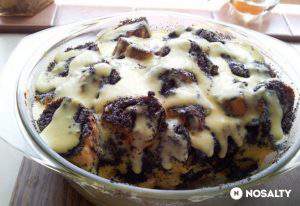
Photo: www.nosalty.hu – szepucs_ka
And now for the recipe. The main ingredients are the crescent rolls, milk, sugar and poppy seeds. The crescent rolls can be dry, but they should be of good quality, just like the milk, with at least 2.8% or 3.5% fat. Some people use bread or milk-loafs instead of crescent rolls. You should flavour the milk with real vanilla, because it makes a big difference. You can also spice up the milk with cinnamon, cloves, lemon zest, orange zest or even dried fruits if you want to make something special.
Start by cutting up the crescent rolls to small circles. Then bring the milk to a boil with the vanilla seeds or the vanilla sugar. Pour the milk over the rolls, let it soak for some time and then sieve the excess milk. Put one layer of rolls into a bigger glass bowl, sprinkle it with the mixture of poppy seeds and powdered sugar and keep on layering until you run out of ingredients. If you’d like, you could bake it for a few minutes, but it is not necessary. Serve it with vanilla custard or pudding.
Enjoy your meal!
Featured image: www.nosalty.hu – Gréti
Ce: bm
Source: Daily News Hungary


