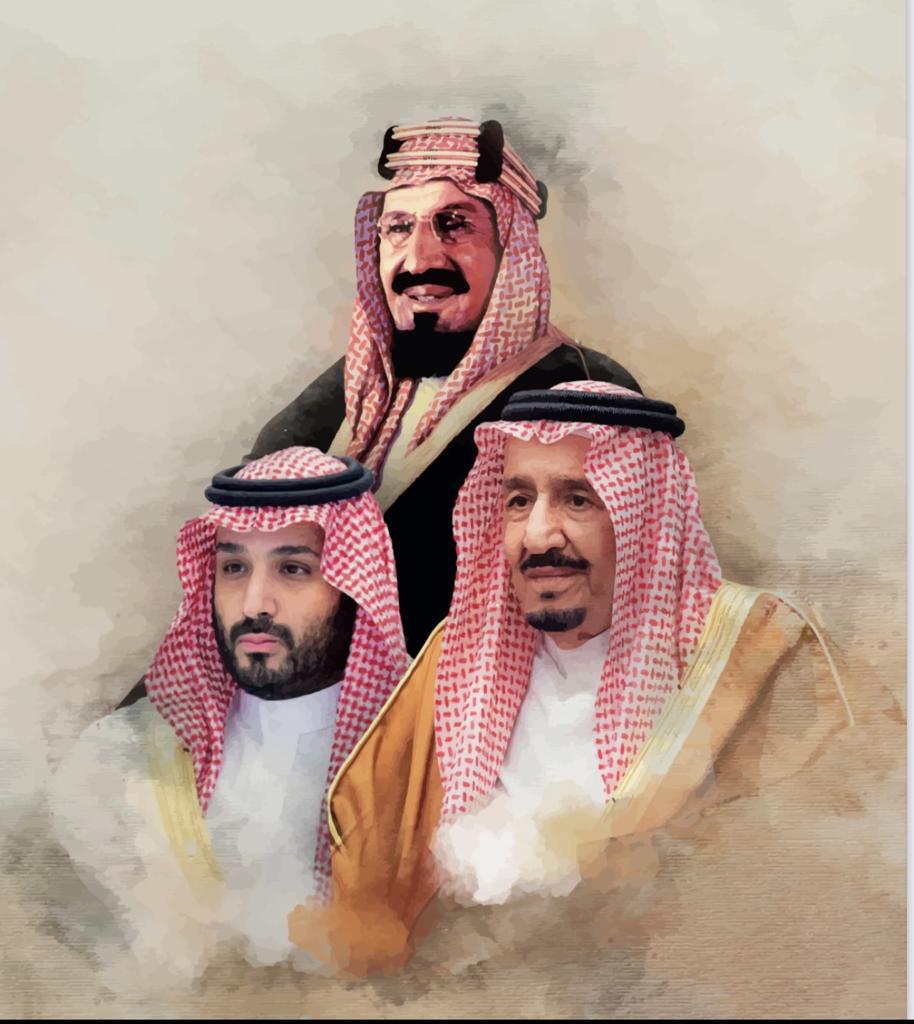
We dream and we achieve: the slogan of the 93rd Saudi National Day

Change language:
On September 23 of each year, Saudi citizens in the Kingdom of Saudi Arabia and abroad celebrate their country’s National Day, to commemorate the anniversary of the unification of the Kingdom by King Abdulaziz Al Saud in 1932.
The founder and unifier of the Kingdom of Saudi Arabia was born in Riyadh in 1876, the son of King Saud bin Faisal Al Saud, who was the ruler of the region at the time. Prince Abdulaziz began his career in public life in 1899 after the death of his father. In 1902, he led a military campaign to reclaim his hometown of Riyadh from foreign occupation, and then led other campaigns to liberate other regions of Saudi Arabia.
In 1932, Prince Abdulaziz announced the unification of the Kingdom of Saudi Arabia, becoming the first king of the Kingdom, and the name of the state was then changed from the Kingdom of Hijaz and Najd to the new name that continues until the present day, which is the Kingdom of Saudi Arabia.
King Abdulaziz Al Saud formed a new political and social system based on Islamic law. King Abdulaziz died in 1953, but thanks to him the Kingdom of Saudi Arabia had entered an era of social, economic and political prosperity, becoming one of the largest countries in the Arab world in terms of economic, political and cultural size.
The Kingdom of Saudi Arabia has reached an era of developmental, cultural and tourism modernity, thanks to the initiatives and changes that the country is currently witnessing within the framework of the ambitious “Vision 2030” plan, which was launched by His Royal Highness Crown Prince Mohammed bin Salman bin Abdulaziz Al Saud, Prime Minister, in 2016, and which was blessed by the Custodian of the Two Holy Mosques, King Salman bin Abdulaziz Al Saud, so that it became a road map that enhances the Kingdom’s strengths, which are its strategic location, its investment strength, and its position in the Arab and Islamic worlds.
This transformation journey first began, passing through 3 stages. The first one focused on changing the mental image, enhancing efficiency, and laying the foundations with an empowerment from the government, and playing a major role in policies and their implementation. The Kingdom reaped many of the fruits of that stage, and now it is in the second stage, maximising the impact of the vision to move to the third stage, which will focus on continuity and on achieving sustainable results.
Anyone who follows with interest the development and cultural renewal that the Kingdom of Saudi Arabia is currently witnessing, especially in light of the “Vision 2030” plan, realises that the Kingdom and its people are living in an unprecedented period, competing against time towards development, growth and progress in all areas of life.
Saudi Vision 2030 has laid strong foundations for success. It began implementing unprecedented reforms that included the public sector and all social and economic aspects. Its results are clear in empowering Saudi women, as the annual report of Saudi Vision 2030 for the year 2022 revealed an increase in the economic participation rate of Saudi females from 17% in 2017 to 36% in 2022. Furthermore, the results are clearly shown in strengthening the Kingdom’s role in the group of twenty of the world’s largest economies (G20), and launching investment projects aimed at diversifying the Saudi economy and preparing for the post-oil era, foremost of which is the implementation of huge urban projects, such as the unique future city of NEOM, which aims to facilitate the life of the Saudi citizen while preserving the environment at the same time, by relying on green energy and eliminating harmful carbon emissions.