Subscribe to our social channels to get the latest news about Hungary!


What would be more pleasing in the cold weather than going to a thermal bath that provides recreation for both soul and body? Thermal baths have a long-standing history in Hungary, especially in Budapest where we have a lot to choose from, reports Origo.hu. Let’s meet one of the most exceptional and largest Turkish baths of the capital! 🙂
The most challenging part of the year for hotels and baths is around January-February when it is a bit more difficult to attract the visitors. For this reason, the Hungarian Tourism Agency launched a 1-month long winter campaign to show that Hungary has a lot to offer in the cold winter season, too. Medical tourism and thermal baths are in the focus of the campaign for a good reason. In fact, Hungary has around 1,500 thermal water resources and more than 270 medicinal waters that are recognised in the country.
Therefore, Hungary is a water superpower and is among the top 5 countries possessing the largest thermal water supply.
However, there are still baths, like the Veli Bej Bath, one of the most beautiful hidden baths of Budapest, that rest unknown for many. This bath is also unique in the respect that it is most probably the only Turkish bath that looks like as when it was constructed. Although it is located in the centre of Budapest, not many people are aware of its existence.
It is in quite a hidden area encompassed by the soc-real styled building of the Buda Hospital of the Hospitaller Order of Saint John of God and the classicistic building of the Császár Bath designed by József Hild.
The bath is located at the foot of Rózsadomb, in the 2nd district which is named Budapest Felhévíz. This name refers to the hot springs found in the area. The beneficial effect of the waters was already known in the Árpád era. Evlija Cselebi, a Turkish traveller reported it in the following way:
“When the inhabitants of Buda lose a family member, they dip the barrels into the water and wash the body of the deceased with this holy water. This pious activity is one of the moral values of Buda.”
The bath was built in the 16th century, between 1574-75, during the Turkish era. It was commissioned by pasha Szokullu Musztafa and the plate commemorating the construction of the complex is still on the wall of the establishment. The Veli Bej Bath, part of the Császár Bath, was given to the Order of Hospitallers, who among others, constructed the 1st swimming pool of standard length where the 1st European Aquatics Championships was also organised in 1927.

Later, in 1842, the bath was reconstructed based on the plans of József Hild that gave the bath a classicistic style. Today, not many of the old buildings stand where they were. Instead, the building of the neighbouring hospital was built up in the 70s which, with its modern wing, totally encompasses the small Turkish bath. Therefore, it is hardly visible from outside.

The Order of Hospitallers restored the bath to its past glory when they started the renovation of the complex. During it, the bath was closed to the public and was only reopened in 2012. It has a lot to offer to the visitors. It has a large octagonal, hot-water thermal pool and another 4 smaller pools of different temperature, reports Csaszarhotel.hu.

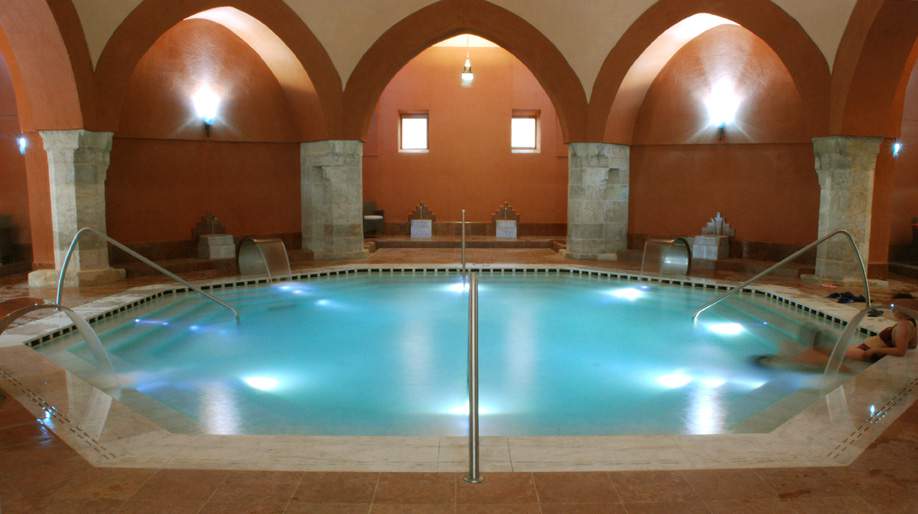

During the renovation, they set up roof windows to illuminate the interior with natural light where besides the wellness & spa, a small display section is also found. In fact, during the renovation, they discovered some very precious archaeological finds like floor coverings, dishes, grindstones and a part of the water pipe, too.
These are exhibited to the visitors providing an insight into the rich history of the Veli Bej Bath.
You can watch a video about the beautiful bath!
The bath offers a great opportunity for relaxation and recreation with various wellness services from Finnish sauna, through infrared sauna to the jacuzzi. However, most probably, the octagonal pool under the Turkish dome will amaze you the most. So, if you would like to enjoy the healing powers of medicinal waters and tackle wintertime colds, take into consideration this small, hidden bath in the centre, too, that is a gem of Budapest.
Featured image: www.csaszarhotel.hu
Source: origo.hu; csaszarhotel.hu


