
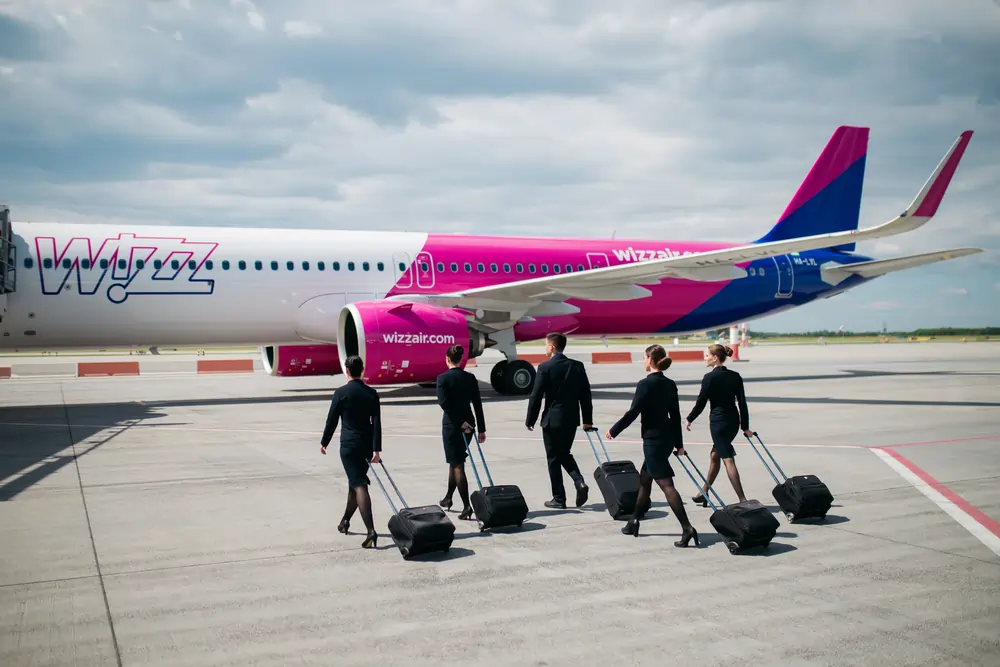
Wizz Air is facing two separate lawsuits brought by its pilots and cabin crew over the calculation of their pay during annual leave and sick leave. The cases have now reached Hungary’s Constitutional Court, as the Budapest Court of Appeal has raised concerns that the relevant labour legislation itself may violate the Constitution or international agreements.
According to documents obtained by 24.hu, the Budapest-Capital Regional Court ruled in favour of the employees in both cases at first instance, ordering the airline to pay the outstanding amounts and late-payment interest. Wizz Air appealed both decisions. The Court of Appeal subsequently suspended the proceedings and referred the legal questions to the Constitutional Court.
The stakes extend beyond the airline, as a ruling could have implications for employers and employees across Hungary.
Don’t miss this: Could this be the end of night flights at Budapest Airport? Residents demand stricter limits
HUF 73.5 million in disputed payments
The first lawsuit was brought by 12 Wizz Air pilots, who are seeking nearly HUF 67 million (approx. EUR 184,600) in gross outstanding absence pay, plus interest. They argue that between 1 August 2021 and 31 December 2023, the airline calculated their holiday pay at a significantly lower rate than their remuneration for days actually worked.
A separate case involves seven cabin crew members, who are claiming approximately HUF 6.5 million (approx. EUR 17,900) in gross outstanding payments, plus interest, over the calculation of their pay during annual and sick leave.
The disputes concern távolléti díj, the Hungarian legal concept of absence pay. It is intended to ensure that employees receive appropriate remuneration when they are away from work for legally recognised reasons. However, the calculation of this payment under the current rules may exclude certain components of an employee’s usual earnings.
The cases cover the period from 2021 to 2023 because, according to court documents cited by HVG, Wizz Air changed its calculation practice from 1 January 2024, when it began including the disputed pay components for both groups of employees.
Make things easier with professional support in English. Explore Daily News Hungary’s Services in English and find the help you need.
Why the Constitutional Court’s decision matters
The Budapest Court of Appeal believes the issue may not be limited to Wizz Air employees. Under the current Labour Code, certain elements of a worker’s remuneration may not be taken into account when calculating absence pay, even if they make up a substantial part of their usual earnings.
This could mean that employees receive considerably less money when they take their legally protected time off. The court has therefore questioned whether the relevant provisions are compatible with constitutional requirements and international agreements.
If the Constitutional Court finds that the rules are unlawful, the consequences could extend to the wider Hungarian labour market, potentially affecting how employers calculate holiday and sick-leave payments.



