

Berlin is taking an increasingly tough line against Budapest. Putting economic interests aside, Germany’s government now views Hungary’s anti-Ukraine policy as a security threat and is prepared to take stronger measures. According to sources, if Prime Minister Viktor Orbán continues to block a unified EU stance on the Russia–Ukraine war, repercussions could include a deterioration in bilateral relations and tougher EU sanctions—potentially suspending Hungary’s voting rights and freezing €43 billion in funding.
Germany’s message to Budapest
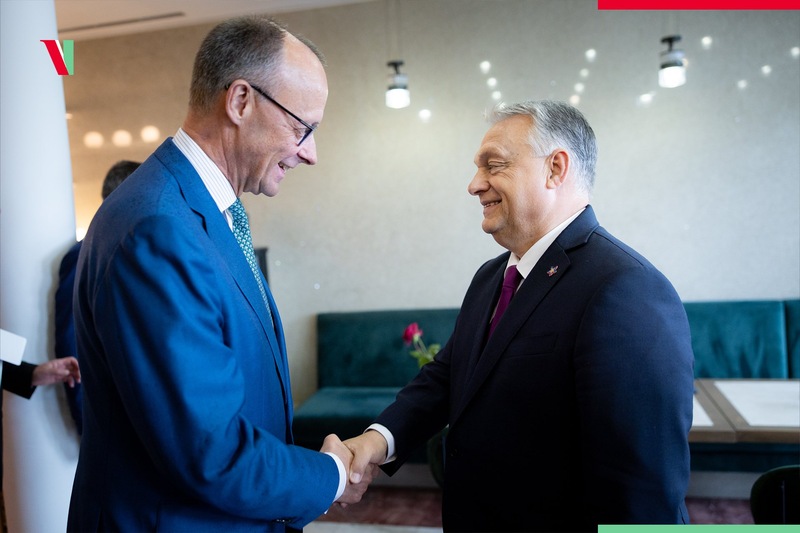
Johann Wadephul, a CDU/CSU politician and key figure in the ruling coalition, made it clear even before his appointment: Germany is extending a hand to Budapest but expects the Hungarian government to change its stance. According to Átlátszó, the issue also came up in May during a meeting between Orbán and Friedrich Merz at the European Political Community summit in Tirana. Then, in July, State Secretary Géza Andreas von Geyr met with several Hungarian leaders in Budapest. Germany’s core message: future cooperation depends on Hungary no longer blocking EU support for Ukraine and measures against Moscow.
Escalating EU measures
Berlin believes Hungary’s vetoes are undermining European security policy. As a result, Germany is pushing at the EU level for stricter measures that go beyond the usual debates over rule-of-law issues. Experts say Orbán’s room to maneuver is shrinking: the EU could revive Article 7 proceedings, which may lead to the suspension of Hungary’s voting rights. Although this would normally require unanimous approval, Brussels is reportedly exploring options to limit Hungary’s veto power in security matters specifically.
Threat of losing EU funds
Political will for tougher action is growing within both the European Commission and several member states. According to multiple EU sources, the complete freezing of funds allocated to Hungary could be placed on the agenda this fall. This move would affect the entire seven-year EU budget and the recovery fund, totaling around EUR 43 billion, including agricultural subsidies, posing disastrous consequences for the Hungarian economy.
Beyond rule-of-law disputes
The German government’s new approach signals that the issue is no longer just about democratic norms: it’s about European security. Orbán’s pro-Russia, anti-Ukraine policy has worn thin the patience not only of Germany but also of other EU member states. If Hungary refuses to change course, it could soon face not only the loss of funding but also partial exclusion from the EU’s decision-making process.
Read more about German-Hungary relations on Daily News Hungary.
Read also:
- Sending packages to the US? Not anymore: Europe’s postal giants suspend shipments
- PM Orbán’s crucial announcement about how long guest workers may stay in Hungary
To read or share this article in Hungarian, click here: Helló Magyar



It is deeply concerning how the bureaucratic elite within the European Union, many of whom have never been democratically elected to their positions (with the European Parliament being an ineffective body at best), impose decisions on all EU citizens. These individuals have unilaterally determined that a corrupt and war-torn country, which has failed to adhere to international agreements (such as the Minsk II accords), and which seeks NATO expansion up to the Russian border, should be forcibly integrated into the EU framework. This process is carried out through undemocratic means that pressure member states to comply with the EU’s agenda—namely, admitting Ukraine into the Union and aligning with policies dictated from Brussels.
Such pressure tactics include withholding financial support, sabotaging energy supplies, and maligning elected political leaders who represent the will of their citizens, as seen in Hungary’s case. In some instances, there are attempts to replace these leaders with more compliant figures. What is the ultimate aim of these actions? To advance mass immigration, increase financial commitments to NATO, escalate tensions with Russia, and offload the economic burden of supporting Ukraine onto ordinary citizens.
The policies of the EU have contributed to widespread instability. The euro, rather than functioning as a unified currency, has become an economic burden. Germany, for example, is now facing a recession due to the costs of its green energy initiatives. The migration crisis continues to strain member states, while the growing tax burdens are making life increasingly difficult for citizens. As a result, the EU finds itself in a state of economic, social, demographic, and cultural decline.
The question must be asked: who is ultimately responsible for this predicament? While Russia is often blamed, it is the EU’s own leadership that has set the stage for these crises. Either European citizens will begin to take control of their own political destinies, or the Union will drive the continent into further conflict and disarray. The current leadership in Brussels and its vassal states will likely continue to avoid taking responsibility for the consequences of their actions.
So many lies and the same old propaganda again. Facts are very different than what “Péter” claims.
Fact: EU is democratic. Decision makers are democratically elected. It is too democratic as one member state can overrule the decisions of majority, making the European Parliament ineffective in many cases as we have seen with Hungary and Slovakia vetoing Russian sanctions.
EU does not seek NATO expansion. “Brussel” does not dictate it. Individual countries decide it for themselves. NATO expanded to Russian border (e.g. Finland) due Russias bloodthirsty and invasive politics, and countries made their own decision after seeing how Russia again braking all previous promises of not attacking its neighbor country.
Nobody is escalating tensions with Russia, Russia does it perfectly well on its own without any help. Russia can end tensions whenever it wants by stopping the war and taking its troops back to Russia.
EU is not in a state of decline. Unfortunately Hungary is in decline due to bad political management and corruption; this can be seen in many economic factors that show Hungary becoming the poorest country in Europe.
EU has not set stage in any crises; Union is not driving into further conflict. Union is supporting the independence and sovereignty of Ukraine against an aggressive attacker that has caused nothing but death and mayhem.
Hes telling the truth. The eu bureaucrats are unqualified for their positions and alp seem to fail up in life. Its all staged
The EU has a security policy? Since when?
The all do as told, all pay, a large part receives and should be the slave and do as told because they get paid. It sounds like threat over threat over threat.
It’s interesting how each country with every provoked war always plays the same role.
There is a life without EU. Enough money is wasted on wars that cannot be won. Wars where only genocide, stealing the sources of a country and distracting entire countries seem to play a role.
Hungary, under the Prime Ministership of Victor Mihaly. Orban if they had played by the Laws of being a Member of the European Union, instead of RISING to be correctly referred to as the “Judas” member through eradication of being a country Governed as a DEMOCRACY, the CORE of being a member country of the European Union, the PRICE rightly Hungary pays through Victor Mihaly. Orban is correct passed down by the European Union.
Victor Mihaly. Orban, his Fidesz Government, in POWER (15) fifteen years, that sees Hungary, a country – its name Disgraced and Humiliated as a member country of the European Union, of Democracy not just in Europe and Great Britain and Northern Ireland, but Globally countrys that are DEMOCRACY’s or that “embrace” the functionality existence and practice of DEMOCRACY.
Victor Mihaly. Orban has FAILED the citizens / population of the ageing decreasing PEOPLE of Hungary.
Orban’s “games of power” seeking the FALL, the destruction of the European Union, through transfering Hungary, removing DEMOCRACY through a distillation process aligning Hungary as a “gofer” of Putin’s Russia that factually leaves Hungary rightfully, the doing(s) of Victor Mihaly. Orban without ANY global friendships, respect and trust in country’s of Governance under DEMOCRACY.
Orban, his Fidesz Government the “Heinous” acts that have played out attempted to CRUSH the European Union, a country that has been JUDGED of Guilt, by the Courts of Justice of the European Union that Hungary pay the HEFTY rightful price through the name – Victor Mihaly. Orban.
Hungary, under the name Victor Mihaly. Orban, a country with gargantuan Government Debt, a humongous outstanding accumulating through compound interest structure to the European Union of Fines for under Victor Mihaly. Orban, the Prime Minister of Hungary, his DOINGS – his aggressive un-relenting attacks on the European Union that “spills over” to be the attack on DEMOCRACY.
Spring of 2026 – through the POWER of the People the process time of the National Elections in Hungary, the people will SPEAK and the DOWNFALL in DISGRACE will rightfully be seen in the OUTING of Victor Mihaly. Orban and his Fidesz Government, the strangulation process adapted and practiced , the abusers – the users for personal individual gain over-riding the people of Hungary, the ABUSE of the population of Hungary, over the course of (15) fifteen years in POWER, that has CRUSHED Hungary, sending it backwards into a darkened abyss, that the “nadir” caused by Victor Mihaly. Orban and his Fidesz Government, remains un-known other than placing Hungary as a country in a place of great future un-certainty.
This statement from Germany is what everyone knew for many years now. Hungary is a security threat to Europe and has been working all along for Russia. There was absolutley no other rational explanation for Hungary’s blockade of Swedish and Finnish accession to NATO for almost two years. The Russian puppet Orban lied when he said Hungary would not be the last to approve their accession. Hungary was last. These traitors that run Hungary have become fabulously wealthy on corrupt deals with Russia and in return they pledged their loyalty to Putin. They are traitors.
HUNGARY is a security threat!?!
Riiiiiiiiiiiiiiiiiiiiiiiiiight…
It’s not the literally millions of violent, illiterate fighting-age parasites from the third world that the E.U. has allowed to invade the continent, and who are now raping, robbing, stabbing, and bombing their way country after country… – except, of course, Hungary.
Seriously, what is the benefit of E.U. membership anymore? Does it make us richer, safer, more cultured, more confident, more optimistic?!? What do we get out of it that we couldn’t get from just W.T.O. membership? All we get is lambasted for looking after our own people first instead of dancing to the tune of the globalist-socialist-fascist cabal. What has the E.U. done for us n the past 10-15 years, except made us drink from bottle and cartons with the plastic caps attached?!?!?
@ Stiener, again your stupidness ?
full of bulls#it as usual.
“What has the E.U. done for us n the past 10-15 years,..”
On average, net EU funds towards Hungary have contributed the equivalent of 2.8% of GDP per year since 2004, rising to 3.5% annually after 2010. Yes, last year or two the net money flowing from EU to Hungary has been less since Fidesz decided to start an anti-EU campaign to cover up the corruption in Hungary and rather co-operates with Russia – thus creating a security threat to the majority of EU countries that do not accept Russias brutal attack on Ukraine.
Hungary will get what it deserves. Hungarians will have the opportunity to decide their fate next April. If they are that stupid to chose Fidesz it won’t be good and they will deserve what happens to them. I will watch from my safe and comfortable country across the Atlantic to see if they have any brains or they are birka who did not experience enough theft from their pockets by the Fidesz bandits who would sell their own mothers for money if they could.
Your safe country across the Atlantic risks becoming a failed state with heavy arms in every pantry. Best of luck to you.
Unfortunately, some continue to glorify full EU membership and total submission to the bureaucrats in Brussels as the only way forward for Hungary. In reality, however, everything dictated by Ursula von der Leyen and her Commission is presented to Parliament as a demand: Parliament is powerless, the Commission always gets its way. The COVID-19 deal, for instance, was secretly negotiated behind closed doors by von der Leyen and her team, with little transparency. Meanwhile, the media is silenced, censorship is enforced, and critics or speakers who exercise their rights are financially penalized. It doesn’t matter if entire populations suffer – it seems to be of no consequence.
In countries like Romania, Moldova, and now Hungary, election results are tampered with to enable the centralization of power in the hands of a small, authoritarian elite. The EU is not the neutral entity it claims to be. It has stoked the war with Russia, spread disinformation through its media outlets, and even within the Parliament, corruption thrives: how many MEPs check in the morning, only to turn around and leave? This was happening 25 years ago, and it’s still the case today. For every politician in Brussels, there are three lobbyists. Well-paid, well-informed individuals with deep pockets, pushing the interests of multinationals, not those of the ordinary citizen. Meanwhile, decisions are made daily that harm the common man and woman – like the approval of Roundup for another four years.
In Hungary, as in many other countries, the pro- and anti-government factions tear each other apart, deepening societal division. Divide and conquer! Instead of sitting down together as a nation to decide what the government should be doing for the people, they fight verbally. The people need better education, solid healthcare, senior care, public safety, and healthy food. These are things worth paying for, and these should be the priorities. Everything that doesn’t serve the people’s interests – including the current dictatorship in the EU – should step down.
Real change, however, can only come when the people rise up, refuse to be misled by the political machine, and stand up for themselves. The system must be broken, a system that exists solely to maintain itself, even if that means waging wars and letting masses of people die for causes that benefit no one but the powerful.
@Péter: intelligent commentary, debatable conclusions.
The EU is not the enemy; it needs reform. We all benefit from the free movement of goods and people among the member states. We do not need a supranational parliament in Strasbourg or a giant bureaucracy in Brussels. We need enforceable multilateral agreements. I have similar views of NATO: who is the enemy? Russia needs reliable trading partners just as much as the EU countries. Trade and diplomacy are the keys, not war. It is unimaginable in the 21st century that we need to resort to killing people to solve our problems.
Hungary, be brave and leave the Nazi run EU.
There was reason the largest member voted out the EU- unfortunately the fools in control ignored the people. The revolt by the people in the UK that is taking place may not end well. the EU will have to step in and demand the people be put down. What does Putin have to do with this, you say.
This is incoherent nonsense.
1. The UK was never the largest EU member state, either in terms of population or economic size.
2. The UK government did not ignore the electorate. It enacted Brexit, moreover it had wriggle room to seek to remain in the single market or negotiate equivalence, successive governments variously failed, neglected to, or flat out didn’t want either of these things and the country ended up with a hard border with the EU, therefore the country experienced a ‘hard’ Brexit as it was labelled. The UK now has a tariff and quota free arrangement with the EU akin to Turkey but all imports and exports need to clear customs.
3. There is no revolt in the UK. Protests at hotels housing asylum seekers involve a relatively small gathering of people, many of whom are concerned by the cost of providing hotel accommodation and its proximity to where they live, rather than the presence of the asylum seekers in the country per se. Numbers of irregular arrivals are small compared to the levels of legal migration. There are no mass demonstrations or civil disobedience and anyone saying otherwise is disingeniously hoping there will be, but there isn’t at the moment and it shows no signs of materialising. The government recognises the levels of discontent and is actively working on a solution.
4. The EU will not step in to anything as it has no right to. The UK has left the EU. I cannot fathom what dark thoughts are going through your mind about people being ‘put down’ akin to dogs. What on earth are you talking about?
5. Yes, I might ask why you’re bringing Putin into something where there’s no apparent nexus.
I might add that the reason why the UK is unable to deport illegal migrants back to France (or their EU country of entry) is because they left the EU. In doing so, they also exited the Dublin Agreement that permits member states to do exactly this. Had the UK not left the EU, nobody would be attempting to cross the channel on a small boat because they could be immediately deported back to France. This problem exists because of Brexit.