Hungary’s quiet anniversary: 105 years since the Treaty of Trianon
A few minutes after the signing of the Treaty of Trianon, Ágost Benárd and Alfred Drasche-Lázár (the Hungarian delegation) leaving the Great Trianon Castle in Versailles.
Source: Wikimedia Comms / Author:
Agence de presse Mondial Photo-Presse
Change language:
On 4th June 2025, Hungary will commemorate the 105th anniversary of the signing of the Treaty of Trianon. This anniversary is not merely the date of a historic event, but a living part of the Hungarian collective identity, one that continues to shape public discourse, social sensitivity, and the foundations of national self-image. The name “Trianon” does not evoke a distant castle but symbolises the end of an entire era and the beginning of a new and difficult period for Hungarians—both within the country and beyond its borders.
The consequences of the Trianon Peace Treaty continue to affect Hungary to this day—not only in geopolitical and economic terms, but also on a deeply emotional and cultural level. It may be difficult to grasp, from an outside perspective, why this historic decision still carries such weight, especially in an era when Europe’s borders are no longer drawn by arms but by EU treaties. That is why it is important to shed light on this matter: Trianon is not merely a relic of the past, but a living memory that influences how Hungary relates to itself, its neighbours, and the wider world.
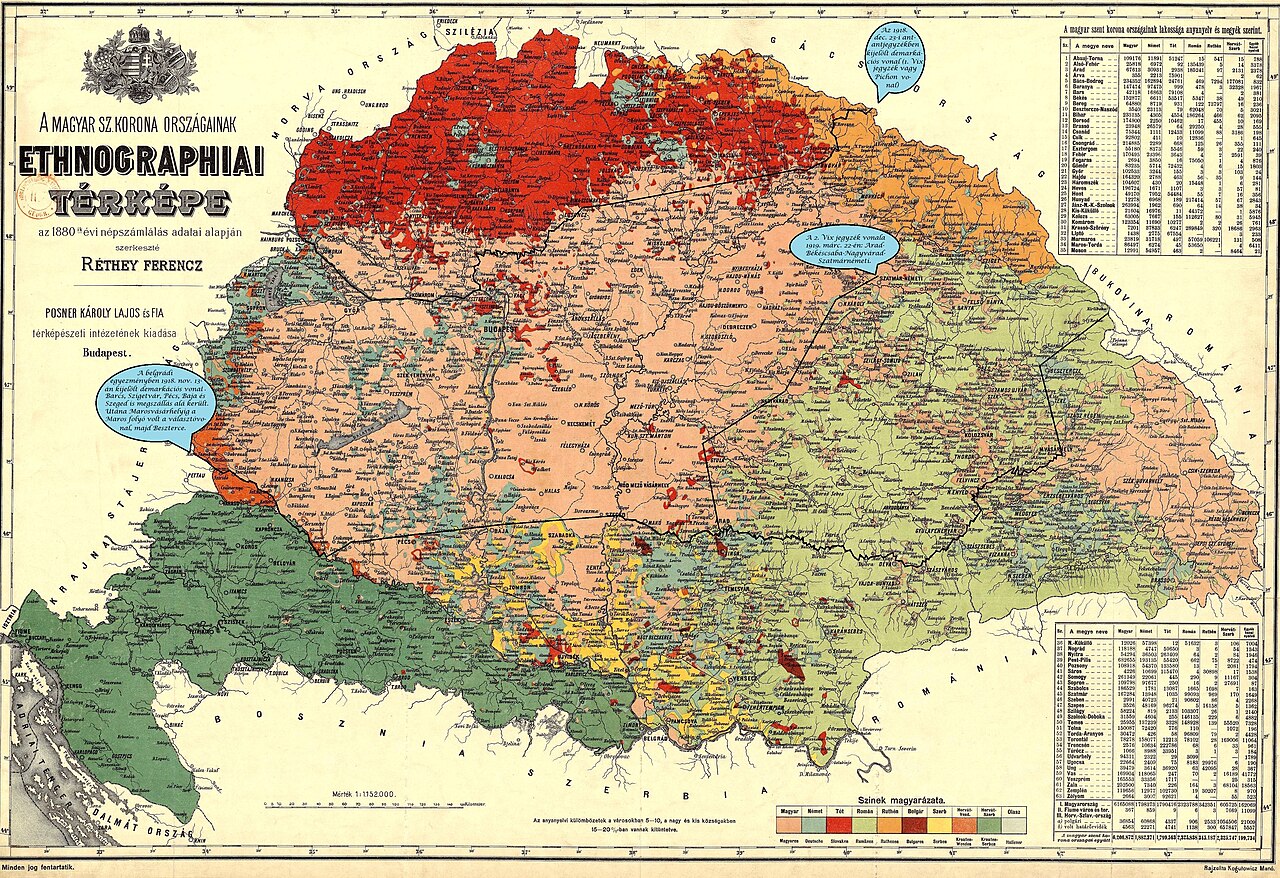
Ethnic map of Hungary according to the 1880 census.
Source: Wikimedia Comms / Author: Réthey Ferenc
The end of an empire and the redrawing of the map
With the end of the First World War, the map of Europe was redrawn. The dismemberment of the defeated powers, including the Austro-Hungarian Empire, served the political interests of the victors. Although official declarations were framed around the principle of national self-determination, as articulated by U.S. President Woodrow Wilson, in practice the decisions were driven more by strategic and economic considerations.
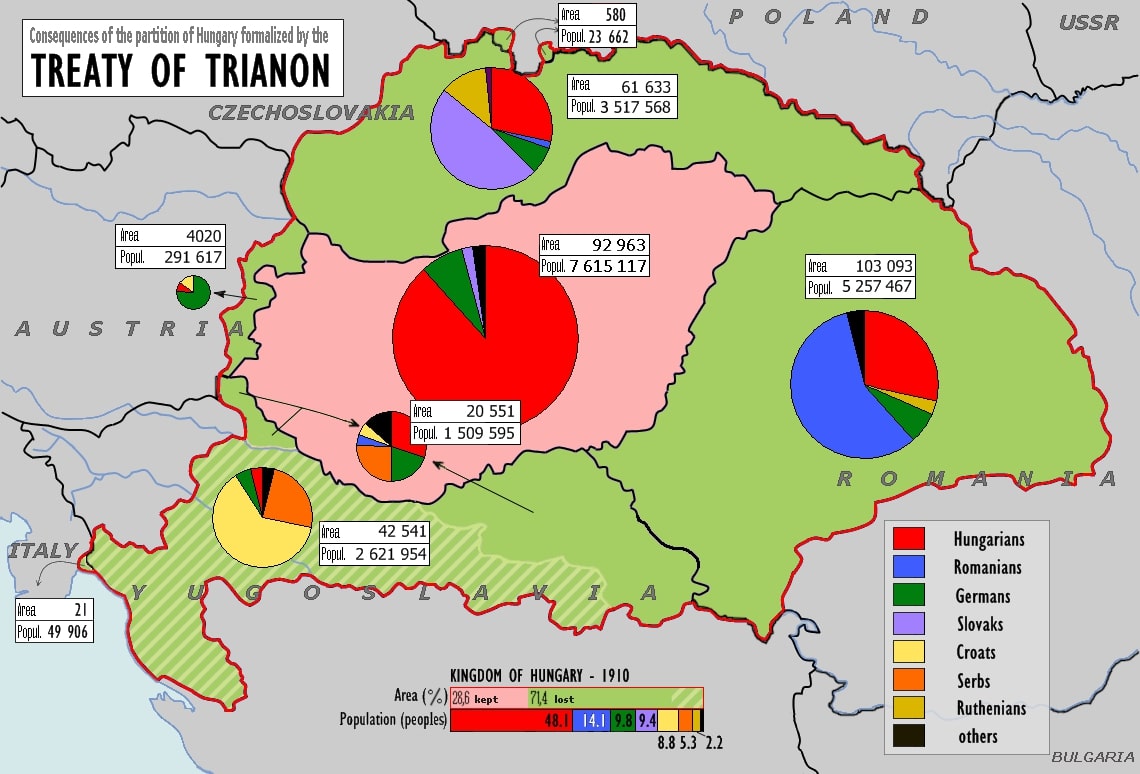
Hungary suffered substantial losses: more than two-thirds of its former territory was ceded, and over half of its population found itself outside the new national borders.
The collapse of the Austro-Hungarian Empire created opportunities for surrounding nations—Romanians, Slovaks, Serbs, Croats, and other minorities—to gain statehood or greater political autonomy. These aspirations were supported by the victorious powers, partly to stabilise the region and partly to curb German influence in Central Europe. Thus, the borders defined by the Treaty of Trianon were drawn with minimal regard for Hungarian interests.
Consequences of the partition of Hungary formalised by the Treaty of Trianon / Source: Wikimedia Comms / Author: CoolKoon / Fz22
Hungary was only invited to the peace talks at the end of 1919, by which time most key decisions had already been made. Nevertheless, the Hungarian delegation, led by Count Albert Apponyi, used all available arguments and diplomatic tools to prevent the complete disintegration of historic Hungary. The famous “red map”, for example, clearly illustrated the territorial distribution of Hungarians, and Apponyi’s speech made a significant impact. He proposed referendums in the disputed territories, but these were ultimately ignored, as the outcome was already politically predetermined.
The consequences of the Trianon Treaty
Post-Trianon Hungary experienced far more than a geographical reduction. The social and psychological consequences left an even deeper imprint. Around 3.3 million ethnic Hungarians suddenly came under the jurisdiction of newly formed or expanded states—often in hostile environments where their culture, language, and identity were under threat. In Hungary’s collective memory, Trianon represents not only a loss of territory but also a profound loss of identity.
A sense of grievance, a perception of injustice, and a continuing sense of responsibility towards Hungarian communities beyond the borders are all elements that continue to shape Hungarian politics, culture, and education today. The phrase “Trianon trauma” is no exaggeration: this historical fault line remains active across multiple layers of Hungarian society, resurfacing repeatedly in public discourse.
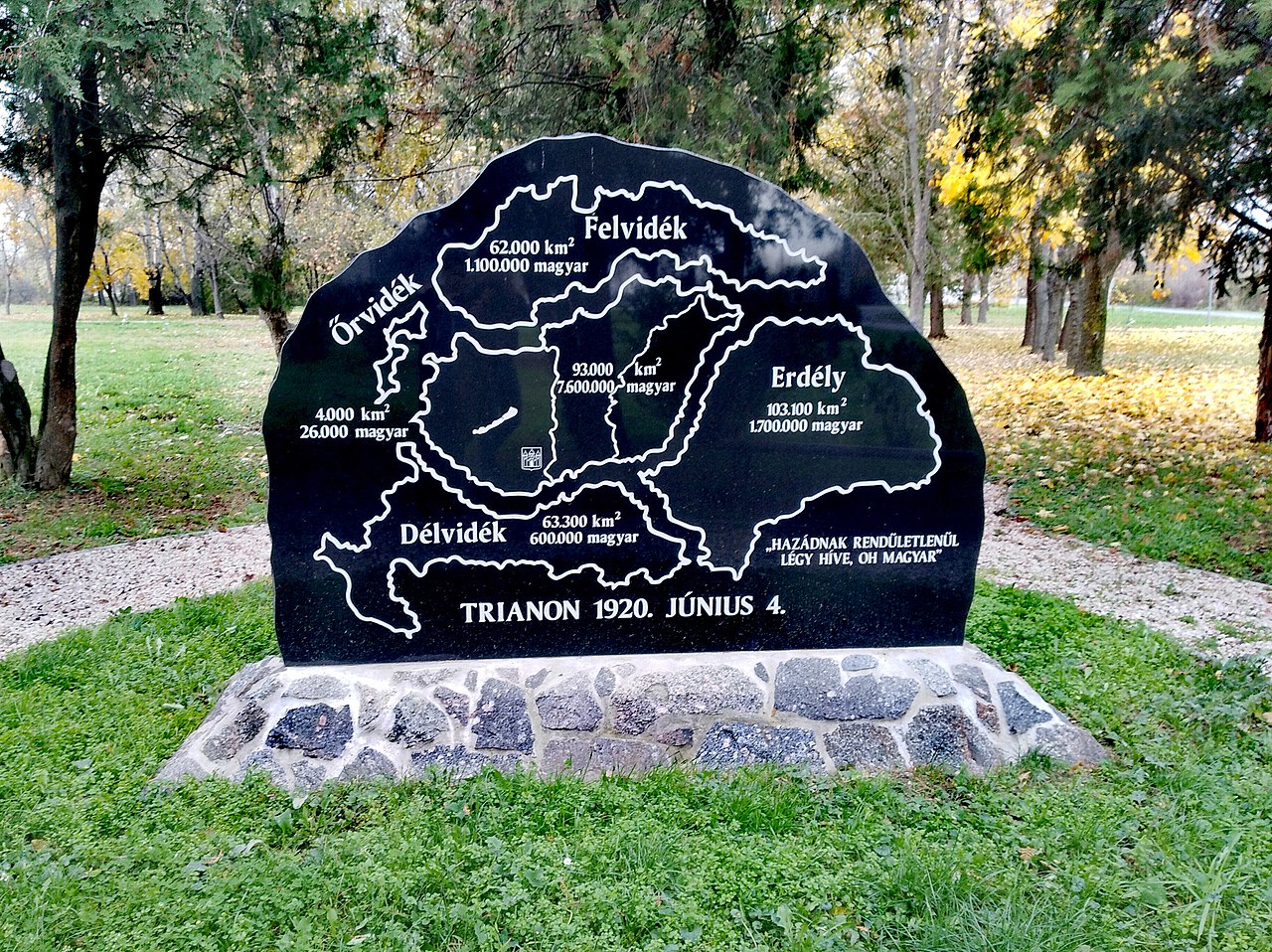
Memorial in Bátaszék. Source: Wikimedia Comms / Netpartizán
The delineation of Trianon’s borders was often arbitrary—frequently splitting individual settlements in two. Some villages found themselves divided between two countries, creating absurd and impractical situations. Transport networks, especially railways, were severely disrupted. The Budapest-centred rail system became almost unworkable. While Hungary’s railway infrastructure was gradually reorganised over subsequent decades, the effects of the dismemberment are still felt today.
The Treaty of Trianon did not merely redefine Hungary’s borders; it also imposed numerous military and economic restrictions. Hungary’s armed forces were reduced to a minimum, the maintenance of an air force and navy was prohibited, and reparations were imposed. These measures not only diminished national pride but also severely hampered the country’s security and economic recovery. The loss of rail lines, industrial hubs, farmland, and natural resources plunged the nation into a long-term economic crisis.
International response and a referendum
Although the Treaty of Trianon was established by the victorious powers, it was not universally supported. In the British Parliament, several MPs voiced support for Hungary, and the possibility of revision was also raised in France. The so-called Millerand Letter, while hinting at future relief, was ultimately declared legally non-binding. The United States never ratified the Treaty of Trianon and later signed a separate peace treaty with Hungary.
One significant exception to the imposed borders was Sopron. A referendum held there in 1921, under the Venice Convention mediated by Italy, allowed the population to choose between Austria and Hungary. The majority opted to remain within Hungary, and thus Sopron and several nearby settlements were retained. This was the only officially recognised revision of the Treaty’s borders. In recognition, Sopron was awarded the title “the most loyal city”.
The legacy of the Trianon Treaty
Trianon plays a central role not only in Hungary’s historical narrative but also in its contemporary national identity. The Day of National Unity is not a day of mourning, but a reaffirmation of national solidarity and shared heritage. In Hungary’s cultural memory—in the arts, literature, and political discourse—the Trianon motif recurs, sometimes as a source of pain, sometimes as a warning, and sometimes as a foundation for identity-building.
Supporting Hungarian communities beyond the country’s borders has become a cornerstone of Hungarian foreign policy. Issues such as autonomy, cultural rights, education, and language use are regularly raised—particularly in relation to Transylvania, the Highlands (Slovakia), and Vojvodina. This is not a matter of revanchism, but of safeguarding rights and preserving cultural identity.S
Stay informed! Read more about Hungarian history HERE!