Subscribe to our social channels to get the latest news about Hungary!


The peasants of Hortobágy gave us goulash, fishermen gave us fisherman’s soup (halaszlé): both traditional dishes evolved from the meals of simple people living in harmony with nature. Even though most people consume fisherman’s soup once a year at Christmastime, it is just as Hungarian as goulash, chicken paprikash or stuffed cabbage. Get to know the story of fisherman’s soup and learn a great recipe 🙂
Based on Hungarian ethnographic sources, fisherman’s soup is similar to fish paprikash, only with more liquid. The secret of authentic Hungarian fisherman’s soup is the good quality fish (mainly carp), the shaving-horse, the bogrács (in case the meal is cooked outdoors), onion and paprika. Do these ingredients sound familiar? Well yes, they form the base of most of our national dishes.
According to korkep.sk, the tradition of making fisherman’s soup is relatively young, it is around two centuries old. Fish meals had been part of the Hungarian cuisine for a much longer time, but the special flavouring of today’s soup is connected to the presence of paprika, more exactly to the 19th century, when it started conquering the spice shelves of Hungarian kitchens.

Different versions of the dish evolved throughout history, but all of them are connected to our waters, meaning the Danube, the Tisza, and Lake Balaton. However, the rivalry between the different versions and methods is still present today. The most famous versions are probably the fisherman’s soup of Baja, Szeged and the Tisza region.
The variations are truly endless. For instance, the classic recipe of Szeged swears by pureed fish, while other recipes call for leaving the fish in bigger pieces, chunks. According to hvg.hu, the main difference between the Danube and Tisza versions is that when making fisherman’s soup of the Tisza region, you first make the broth and then add the fish, while the Danube-version calls for adding everything to the bogrács/pot at once, also noodles. (The Balaton-version is closer to the Tisza-version than the Danube-version.)
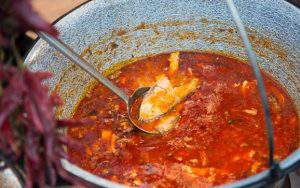
So highlighting a single recipe is quite hard. We tried to look for one, which you can alter any way you’d like to. Therefore, think of the following recipe as a guideline to finding the flavours you enjoy the most 🙂
Start by gutting/cleaning the fish with the adequate tools (it’s recommended to ask for suggestions at the fish-dealer). Cut off the head, net the fish and remove the inedible parts (gill, eyes). Chop up the onions, put it into the pot along with the head, fins and bones. Add enough water and let the mixture cook for 5-6 hours or until the fish parts fall apart. At this point you could puree the fish. Finally, you need to flavour the dish with salt and paprika (and whatever your heart desires) and add the prepared, salted fish pieces and haslet (again, optional) which you need to cook for an additional 10-15 minutes.
Enjoy your meal!
Featured image: Wiki Commons By Themightyquill
Ce: bm
Source: Daily News Hungary


Please do not cook it on full fire for 5-6 hours! Weak will be enough! The trick that the water don’t have to boil like hell, just a little bit.