

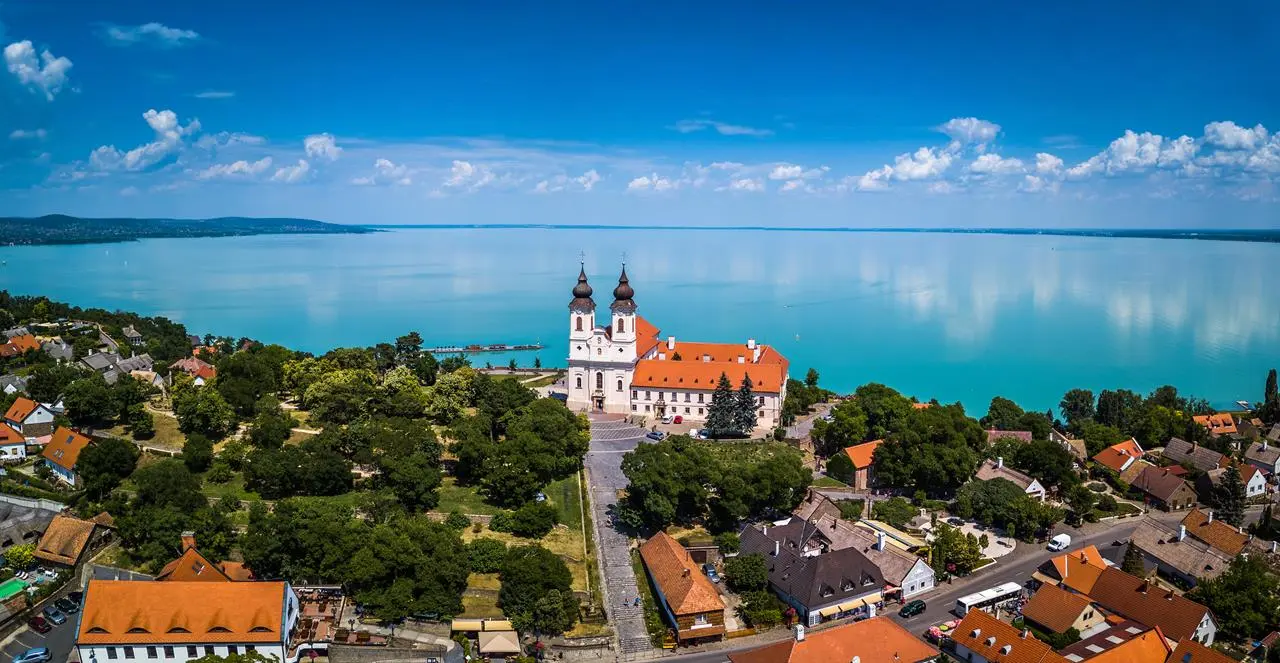
Visitors are now barred from approaching the shoreline in the otherwise picturesque village of Tihany, where a mass fish die-off has been unfolding in the Inner Lake for several days. Emergency mitigation efforts are ongoing, yet authorities are struggling to keep pace with the scale of the devastation.
Mystery at Lake Balaton? Thousands of fish perish in Tihany’s Inner Lake
The Inner Lake of Tihany is one of the most treasured natural features in the Balaton region, its entire area protected owing to its ecological significance. Formed by volcanic activity, the lake sustains a unique habitat for a wide array of plant and animal species, including, inevitably, invasive ones.

The overwhelming majority of the dead fish are Prussian carp, a non-native invasive species in Hungary. While it may offer some reassurance that native stocks have not borne the brunt of the losses, the phenomenon nonetheless serves as a stark warning about the lake’s ecological health. Experts point to oxygen depletion as the primary cause—a condition that can develop rapidly in shallow, enclosed lakes during periods of summer warming.
Drought and heat
The crisis has not emerged in isolation. In recent months, reports have highlighted a marked decline in the water level of the Inner Lake. Areas of the lakebed and muddy shoreline, unseen for years, have been exposed. Specialists suggest that beyond drought and lack of rainfall, broader changes in the local hydrological system may also be at play, infostart.hu wrote.
This episode of mass mortality may therefore represent more than a routine seasonal environmental issue. Shallow lakes are particularly vulnerable to climate change: rising water temperatures reduce oxygen levels, while the decomposition of organic matter further exacerbates the problem. Combined with persistently low water levels and prolonged dry conditions, these factors can quickly create an environment in which large-scale fish deaths become inevitable.
Ecological processes under investigation
The gravity of the situation is reflected in the launch of a comprehensive research programme to assess the lake’s condition. The Balaton Uplands National Park, the municipality of Tihany, the HUN-REN Balaton Limnological Research Institute, and researchers from Eötvös Loránd University are all involved. Their aim is to determine precisely which processes are reshaping the ecological systems of the Inner Lake and the nearby Outer Lake, and what long-term consequences the region’s water scarcity may entail.
If you missed: Lake Balaton could be the biggest victim of strong Hungarian forint
Meanwhile, national park staff continue to collect and remove the dead fish in an effort to prevent further environmental damage and to mitigate the overwhelming odour. Visitors are urged to steer clear of the lakeshore and to avoid hindering ongoing recovery operations.

For decades, the Inner Lake of Tihany has been one of the Balaton Uplands’ most cherished and romantic natural landmarks, prized for its distinctive ecosystem. The current die-off, however, stands as a sobering reminder that even the most familiar and valued habitats are not immune to the effects of climate change. If forecasts prove accurate, Hungary’s climate may increasingly resemble that of the Mediterranean in the years ahead—raising serious questions about the future of the Inner Lake.
Water level problems
Concerns over the potential drying up of Lake Velence have already been widely reported, with water replenishment seen as the only viable solution. Time, however, is fast running out.
Lake Balaton’s water level, experts insist, is not unusually low. Compared with the current level of 85 centimetres, the lake stood significantly lower in the 19th century, while in 2003 it fell to just 23 centimetres—yet even then, its ecology was not imperilled. According to the director-general of the HUN-REN Balaton Limnological Research Institute, there is no single “ideal” water level for what Hungarians fondly call their “inland sea”: an optimal range lies between 70 and 110 centimetres, though water quality depends on far more than this single indicator.
What’s next? Multiple zebras owned by Hungary’s wealthiest man and Orbán ally, Lőrinc Mészáros, have died



