Subscribe to our social channels to get the latest news about Hungary!


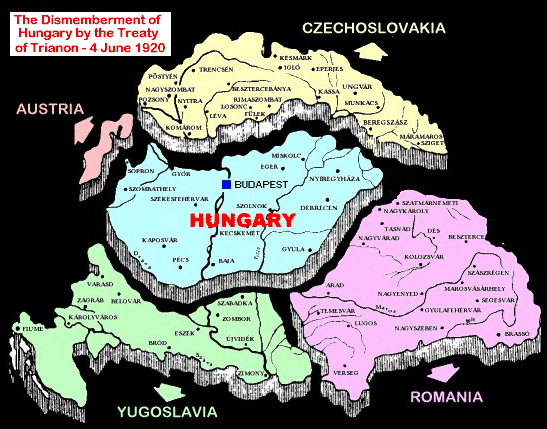
It is that time of the year again when Hungarians mourn the great loss that the Treaty of Trianon. June 4 is the 98th anniversary of Hungary losing 2/3 of its territory and about 1/3 of its population.
Hungary joined WWI as part of the long-ago Austro-Hungarian Empire. Even though the Hungarian leadership disagreed on the decision of the declaration of war against Serbia, it was its duty to follow the Empire’s command. In the end, WWI costed 660,000 Hungarian military personnel’s’ lives. On the top of being part of those countries who lost, Hungary had to pay a big price: the Treaty of Trianon included taking away 2/3 of Hungary’s territory including those 13 million Hungarian citizens living there.
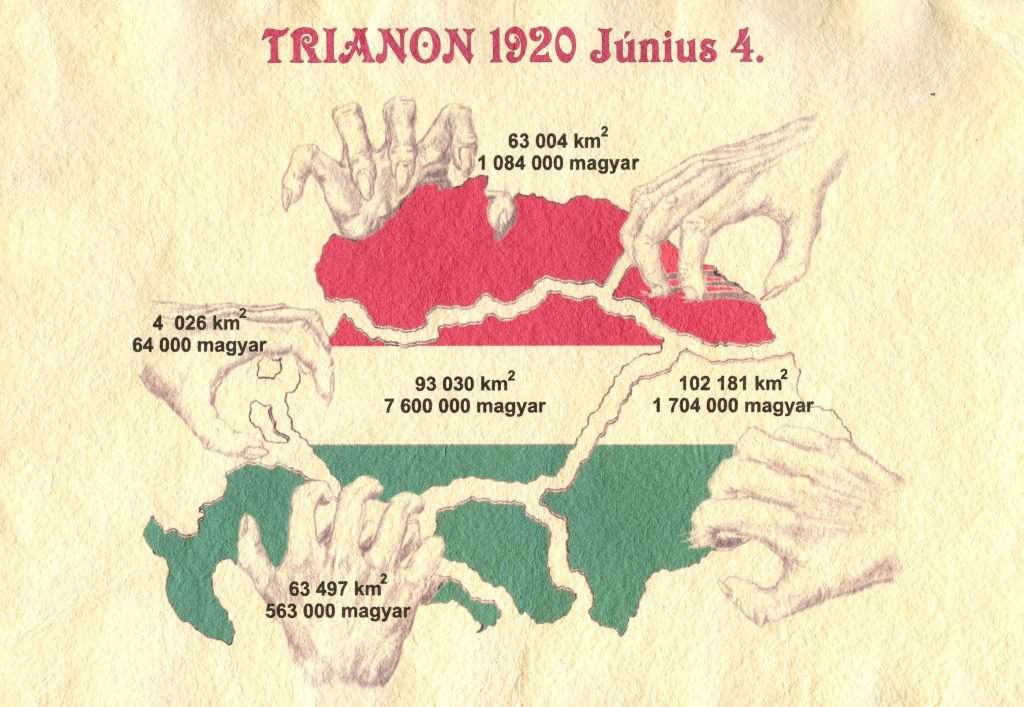
As we have already given a deeper understanding on Trianon in our previous articles (see on the bottom), we decided to share some interesting facts as remembering this year.
Some people claim that the Hungarian motto “No! No! Never!” comes from the meaning of the word Trianon. It has a Latin origin and means “three nos”. It is easy to conclude that there is a connection between the motto and the meaning of the word. However, Urbanlegends.hu revealed the truth according to which the motto has already existed in 1918, while, on the other hand, the Treaty of Trianon was signed only in 1920. Therefore, this interpretation seems to be false.
George Clemenceau, the French character who played an important role in creating the conditions of the treaty, had a son who married a Hungarian woman. After their marriage declined and they ended up filing divorce, Clemenceau was said to be so angry with Hungary that led him to make the conditions even more strict. Hungarian historians contradict this hearsay and reason that Clemenceau did not like Romania either, but he still supported their territorial claims.
Citizens of Sopron had the opportunity to vote whether they still want to be part of Hungary. They vote yes, and that is why they won the “Civitas Fedelissima” title and they became the Town of Loyalty.
From one day to another, the population of the Hungarian Kingdom has decreased from 20,886,487 to 7,615,117 people.
According to a very interesting part of the treaty, Hungary shall not capitulate to Egypt. It may sound funny at first, but this condition had the aim only to secure Great Britain’s mere authority in Egypt.
Many people believe that the United States of America did not sign the treaty because they found it so drastic. However, this statement is not entirely true. The truth is that by the time the treaty was signed, only some diplomats stayed in Europe who came from oversees. Most of them were only observing, they did not have the right to sign the treaty legally.
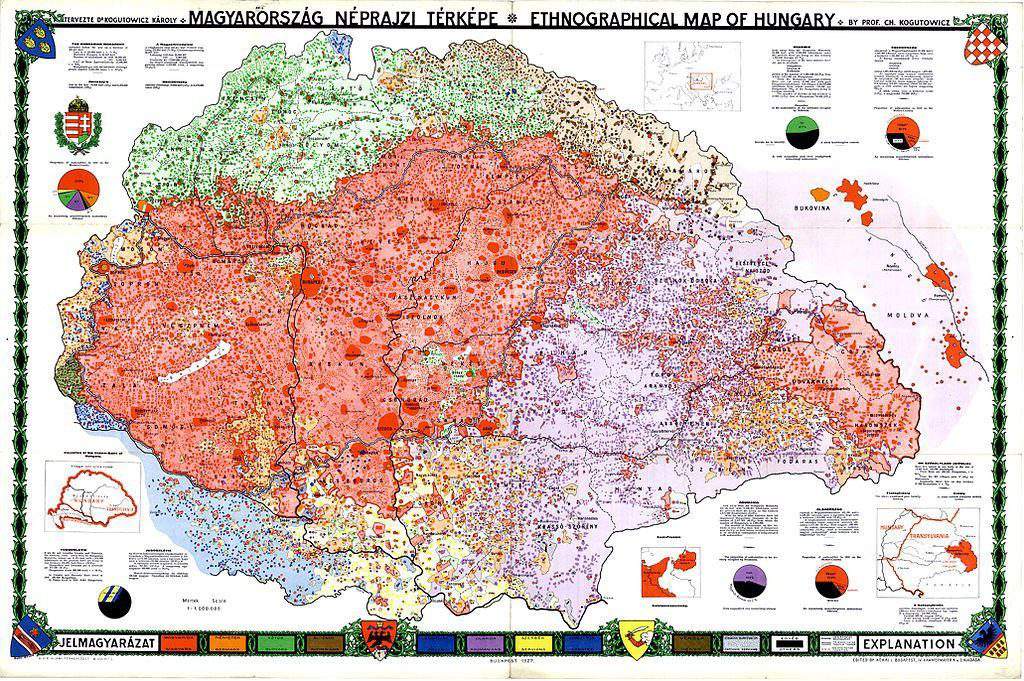
Pál Teleki created a map indicating the Hungarian population within the borders of the long-ago “Big Hungary” with red dots. The name ‘Red Map’ comes from here.
As part of the treaty, Hungary had to compensate the winner countries for their lost ships in battle by giving them Hungarian ships. Because Hungary did not have enough of those, it obligated all Hungarian ship owners to help out.
If you wish to gain further understanding on the details of the Treaty of Trianon, we recommend you our previous article on this topic: Hungary, 96 years after the Treaty of Trianon. You may want to browse Hungary’s detailed ethnographic map online made for the Treaty of Trianon here. Furthermore, it is also worth taking a look at quotes about the Treaty of Trianon by famous non-Hungarian people. Finally, if you are interested not only in Hungarians living abroad but also in minorities living in Hungary, we wholeheartedly recommend you our series: Minorities in Hungary, which has the following episodes so far:
Featured image: the Versailles Palace (Pixabay), and the map of Hungary’s dismemberment by the Treaty of Trianon (Wiki Commons by HunTomy~huwiki)


Soros should concentrate on getting all parts of old Hungary back if he has any pride in being a
Hugarian This subject should be brought to life again by someone as prominent as he is’
Soros is only concerned with making money and the destruction of Hungary.
Soros’ real name is Schwartz György. He is not Hungarian; he is Jewish, decended from the tribes of Judah, Benjamin and Levi.
The first map (above the title) is not correct. South of Poland has never been within historic borders of Hungary. At least not Kraków and Przemyśl. It was part of Austrian, than Austro- Hungarian empire for 123 years in XIX but under Austrian administration. And definitely this region (so called Galicja) was back in independent Poland in 1924.
And Helena, that map is correct btw. That is map of the monarchy not map of the historical hungary.