


Hungarians among the world’s best Duolingo language learners!

Change language:
Czechs and Hungarians are among the world’s hardest-working nations in terms of learning a new language. If we take the number of single lessons completed per learner, we can say that the Czechs rank first in the world, followed by the Japanese, Belarusians, Germans and Hungarians.
According to blog.duolingo.com, their 2021 Duolingo Language Report presents the latest language trends and learner behaviors based on data from over 500 million Duolingo learners around the globe. Duolingo is the world’s most downloaded education app,
offering over 100 courses teaching 40 languages—all for free.
As a result, their data offers unique insights into what languages learners worldwide want to study and how their interests change over time and geography. In 2020, the Duolingo Language Report noted record growth of new learners who started studying a language during the pandemic, whether to keep up with schoolwork or connect with people around the world. This year’s report investigates how those patterns have evolved in 2021.
Love for Asian languages continues to grow around the globe
In 2021, Asian languages—especially Japanese and Korean—attracted learners worldwide, building on the impressive growth observed in 2020.
- Japanese surpassed Italian globally to become the 5th most popular language to study, and it’s the fastest-growing language in the U.S. and U.K.
- Korean—holding strong at the 7th most popular language to study around the world—is the fastest-growing language in Brazil, France, Germany, India, and Mexico, and it ranks as the second-fastest growing language in Japan!
- Chinese, which was the 10th most popular language to study in 2020, has overtaken Russian and Portuguese for the 8th spot worldwide. It is also one of the top 5 fastest-growing languages in Mexico and Brazil.
World interest in under-studied languages increases—again!
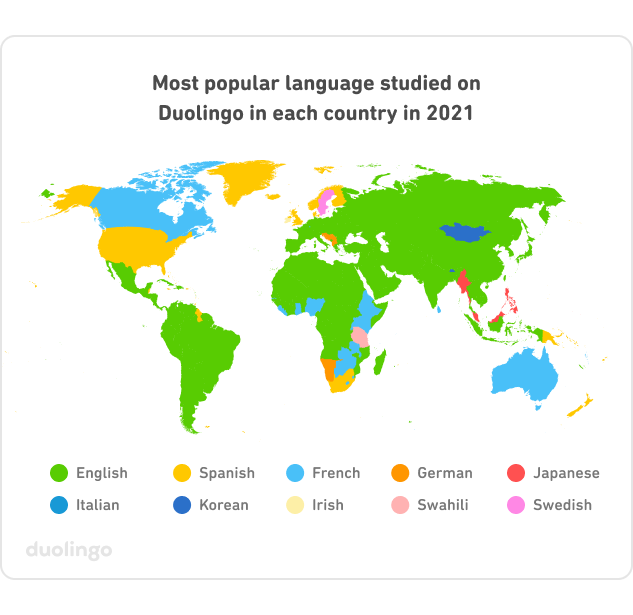
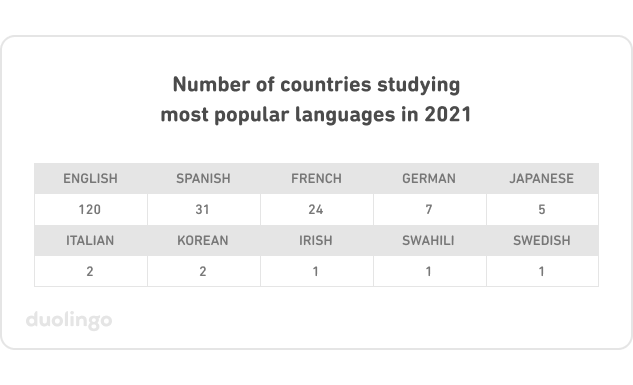
English, Spanish, and French remain the most popular languages to study globally.
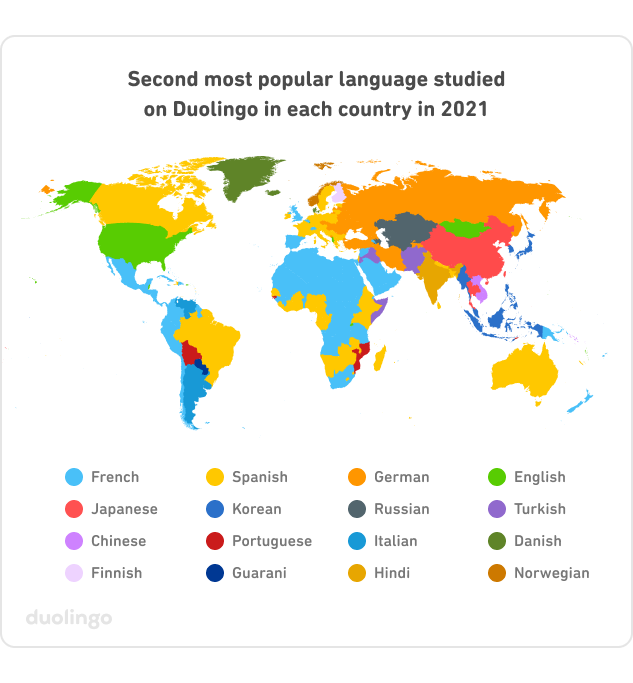
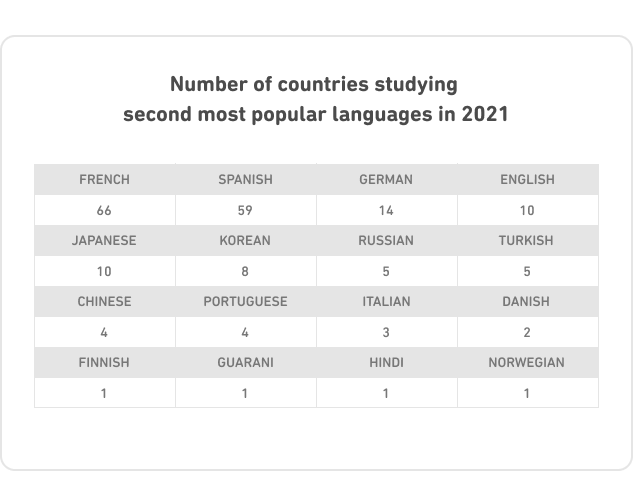
The languages occupying the #2 spot in each country are also becoming increasingly diverse: this year, old favorites like French, Spanish, and German are joined by two new additions to this list: Finnish and Guaraní. Finnish has become the second most popular language to study in Finland, and similarly Guaraní, an indigenous language from South America, is now the #2 language studied in Paraguay, where it is an official language.
Family and culture drive learners to study new languages
Family and culture have become important motivators for language study, and this is especially true for learners studying Asian languages. For example, over 18% of new learners studying Japanese are motivated by culture; in contrast, only 8% of English learners, 9% of Spanish learners, and 10% of French learners in 2021 chose
culture as their primary reason for language learning.
The importance of family and culture for U.S. language learners was echoed in a recent national consumer survey Duolingo conducted in collaboration with DKC Analytics. Across all respondents, including those not currently learning a language, 65% said learning about a new culture would be their top reason for studying a new language—and culture ranked ahead of all other potential motivators.
Of those respondents who had started learning a language during the pandemic,
70% say their learning is related to family heritage, ancestry, or culture.
In fact, 94% of learners whose family language is endangered, indigenous, or otherwise under-studied said they would be interested (or very interested!) in learning that language. Data from learners on Duolingo supports this finding: when learners have access to more diverse course offerings, including less-commonly studied languages that better represent their interests, families, and communities, people are excited to start studying a language.