Subscribe to our social channels to get the latest news about Hungary!


The opposition Tisza Party would “recapture Hungary” and build a new “peaceful, humane, and functioning” country, Tisza leader Péter Magyar told a party rally held in Kötcse, in western Hungary, on Sunday.
Referring to next year’s parliamentary elections, Magyar said “the people of Hungary will turn a page in the history book in 217 days and start a new chapter about an equitable, peaceful and free homeland.” In that country, “state leaders are not lords but servants, labour ensures a decent living, pensioners are not humiliated but respected, while taxes are not a burden but fair and affordable contributions to a shared life,” he said, adding that “Hungary in the future will be associated with honesty, order, stability, a successful economy and democracy”.
Magyar said the country could become rich and successful, “no longer lagging behind other European countries but march in the forefront”, whose economy could be “innovative and creating value rather than being a toy in the hands of some oligarchs, a stable basis for the prosperity of every Hungarian.”
Magyar said a “peaceful and orderly” Hungary in Tisza’s programme would mean a country in which “law enforcement is free of political influence”, adding that “there is no future, development or public trust without peace and order.”
Magyar pledged to build a “clean and progressive” country with “clean air, clean water and clean politics”, which could become “a country of sustainability” that could address future challenges and in which energy efficiency and clean technologies would be “natural basic principles.”
In Tisza’s vision for the future, “health and welfare services would really serve the people with a focus on prevention, care, and human dignity”, while “education will prepare young people to face the challenges of the 21st century.”
Magyar said Hungary could be “home to all Hungarians, whether from this or the far side of the border, because the unity of the nation is not just a political phrase but a shared, serious responsibility.”
At the event, Ágnes Forsthoffer, Tisza’s tourism expert, was announced as a vice-chairperson of the party. In her address, she said her party would “stop wasting funds” in tourism and would strive for a partnership with municipalities.
At the upcoming election, Hungarians need to decide whether they want a “sovereignist Orban government that represents Hungarian interests” or a Tisza government that “serves Brussels” and would introduce “the Tisza tax”, the communications director of ruling Fidesz told journalists in Kötcse on Sunday.
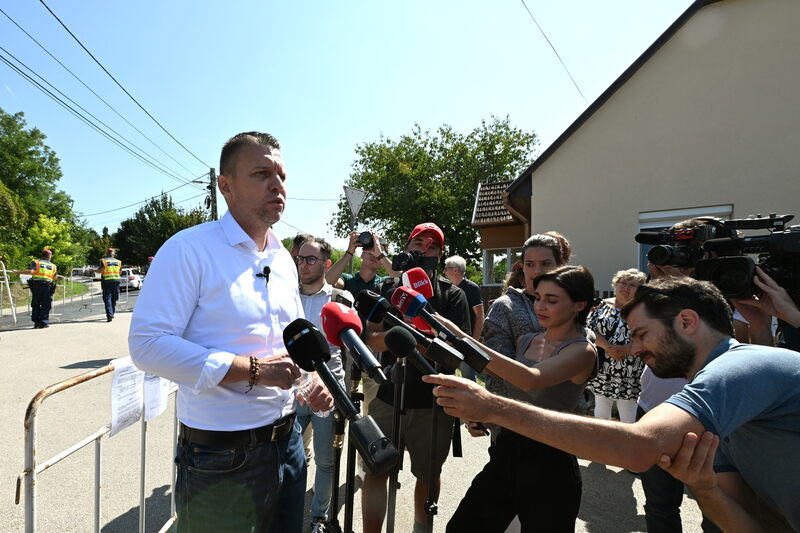
Menczer said nobody had denied the existence of a document from the economy cabinet of the opposition Tisza Party that indicated higher taxes for Hungarians earning over 400,000 forints (EUR 1,020) a month. He added that Tisza officials had acknowledged that details of the plan could not be revealed until after the election.
Menczer warned that the tax changes Tisza wanted would take hundreds of thousands of forints from taxpayers. He highlighted government measures such as the Home Start Programme, increased tax allowances for families raising children, personal income tax exemptions for mothers, food vouchers for pensioners and the PIT exemption for under-25s that have benefitted Hungarians.
He said “credible surveys” gave Fidesz a ten percent lead, adding that left-wing liberal researchers had not conducted surveys but carried out “political work”.
Read also:


Orban serves Moscow. Ask yourself why the 1956 memorial with the eternal flame of Russian gas was removed from the front of Parliament and why was Nagy Imre’s statue also removed from the Parliament area.
By “functioning country” he means he’ll prostrate himself before Brussels and do whatever they tell him to: accept tens of thousands of third-world migrants, abolish energy subsidies causing our gas and electric bills to soar, lavish tax money on minority causes, indoctrinate schoolkids with “gender” degeneracy, etc.
In return, Brussels will stop picking on Hungary and let us have the $$$ we’re entitled to, of course to be spent exactly how Brussels directs us: interpretive dance classes for gypsies, bicycle tracks that stand empty for days, Soros’ “university,” etc.
As usual
Just liar Steiner
Péter Magyar’s vision for Hungary offers a more moderate, cooperative approach to both domestic and EU politics, setting it apart from Orbán’s sovereignist stance. Magyar emphasizes economic fairness, inclusive nationalism, sustainability, and democratic governance, ideas that contrast with Orbán’s divisive nationalism and anti-EU rhetoric. Orbán frames Hungary as a defender of national identity against what he sees as the erosion of traditional European values, with an overreaching EU threatening Hungary’s sovereignty.
However, until Magyar releases concrete policy proposals, especially on key issues like taxation and immigration, it remains unclear whether his promises are realistic or just empty rhetoric. His vision of a “humane” Hungary may be an attempt to position himself against Orbán’s more confrontational leadership. While his rhetoric sounds progressive and inclusive, it will require closer scrutiny once actual policy details are unveiled.
The lack of specific plans raises concerns that his vision might be more emotional appeal than a tangible agenda. For example, the “Tisza tax” is mentioned but not explained, leaving important details that may only be revealed after the election.
Key criticisms of Magyar’s vision include:
Lack of Specificity and Substance: Without clear policy proposals, his vision could come across as an empty promise, lacking the depth needed to address Hungary’s complex issues.
Emotional Manipulation: The use of emotionally charged language could be seen as an attempt to sway voters without offering real solutions.
Failure to Address Structural Problems: Magyar’s vision talks about unity and sustainability, but doesn’t tackle critical issues like economic inequality, the aging population, and a struggling healthcare system.
Unrealistic Promises: Lofty claims, like turning Hungary into an economic leader in Europe, may seem unrealistic given the country’s current struggles.
Political Opportunism: Some might view his rhetoric as trying to capitalize on public dissatisfaction without offering real solutions.
Avoiding Key Issues: His hesitation to directly address sensitive topics like Hungary’s relationship with the EU or immigration may be seen as a way to avoid confrontation.
Potential for Divisiveness: Though he promotes unity, the vagueness of his policies could create division if they fail to meet voter expectations.
In my opinion, the gap between Magyar’s vision and its execution is a major concern. While his emotional appeals and aspirational goals may resonate with voters, without concrete policies, they risk becoming hollow promises. His rhetoric of hope and unity must be backed by realistic plans to address Hungary’s real challenges, especially in times of economic uncertainty and political division.
Voters should demand clarity, specificity, and accountability from Péter Magyar. While his vision is appealing, it’s the details and practicality of his proposals that will determine if he can deliver on his promises. Without clear plans to tackle Hungary’s pressing issues, his rhetoric could remain just that—words without substance. Holding him accountable will ensure Hungary moves toward a better future, rather than one based on empty idealism or populist appeal.