
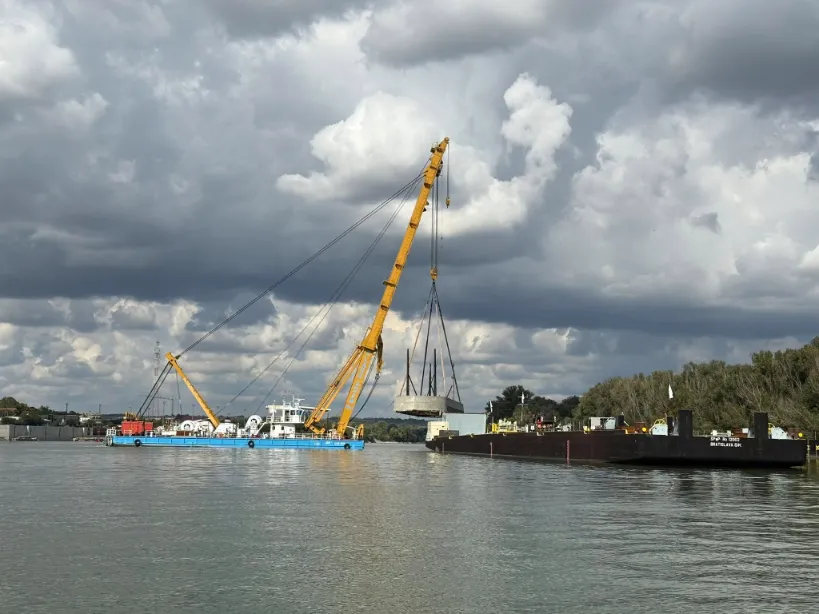
Hungary’s government has approved the continuation of the long-awaited Mohács Danube Bridge project, but a major road expansion has been scrapped after a review found it was not justified by projected traffic. The decision is expected to save up to HUF 76 billion (approx. EUR 210 million), which will instead be spent on renovating the country’s roads.
Mohács bridge project gets the green light
The Hungarian government has decided to proceed with the construction of the new Mohács Danube Bridge, Transport and Investment Minister Dávid Vitézy announced following Wednesday’s cabinet meeting.
According to Vitézy, the bridge itself will be built as originally planned. The project is already sufficiently advanced that cancelling or fundamentally redesigning the structure would no longer be a rational option. However, a government review of the project’s technical content has identified elements that were considered unnecessarily expensive and oversized.
One of the main changes concerns the road connection on the Great Plain side of the Danube, where an approximately 20-kilometre section had been expanded from the original two-lane configuration to a four-lane, dual-carriageway road. That additional element will now be cancelled.
Have you read this? Orbán’s graveyard for taxpayers’ money laid bare: why the new Danube bridge is pointless and exorbitantly priced
HUF 76 billion in savings
Vitézy said the four-lane section was added to the project earlier this year, shortly before the election, increasing the planned cost by more than HUF 76 billion. Crucially, construction of the expanded section has not yet begun, making it relatively straightforward to remove from the project.
The minister argued that available traffic forecasts do not justify the larger road even in the long term. According to the review, a four-lane road would not be necessary in the area even by 2050, including when the expected impact of planned Serbian and Vojvodina transport developments is taken into account.
The section will therefore retain the original two-lane design, with one lane in each direction.
“The ship has sailed” on changing the bridge itself, Vitézy said in his post, arguing that the structure can no longer realistically be redesigned either to accommodate rail traffic or to reduce the bridge from four lanes to two.
He also reiterated his criticism of the project’s original design, saying that the four-lane bridge itself was not justified by traffic projections and that, given its approximately HUF 300 billion (EUR 827 million) cost, incorporating a connection for the planned Pécs–Szeged railway link would have made more sense.
If you missed it: Key deal secured for new Danube bridge at Mohács – new photos
Money redirected to Hungary’s roads
The government expects the project review to save approximately HUF 74–76 billion in public money. Vitézy stressed that the money will not simply disappear from the transport budget. Instead, it will be redirected towards the renovation of Hungary’s national road network.
“There are hundreds of roads in Hungary waiting for complete renovation,” the minister said, arguing that spending the money on deteriorating roads used by tens of thousands of people every day would provide greater value than constructing additional lanes that traffic forecasts do not support.
Vitézy said the approach would be to continue projects that are technically and economically justified, while refusing to spend tens of billions of forints on unnecessary additions simply because they were approved by the previous government.



