

A Russian State Duma member has warned that Moscow could suspend oil and gas supplies to Hungary after the country’s new government formally described Russia as a security threat. The warning comes as Prime Minister Péter Magyar’s administration pursues a major foreign policy shift away from the close Budapest-Moscow relationship maintained under former PM Viktor Orbán.
Russia threatens Hungary’s energy supplies
Andrey Kolesnik, a member of the Russian State Duma’s Defence Committee and a member of President Vladimir Putin’s United Russia party, said Russian energy deliveries to Hungary could now be called into question. Speaking to Russian outlet Gazeta.ru, Kolesnik suggested that Moscow could stop supplying Hungary with oil and gas following Budapest’s decision to classify Russia as a threat.
“I think that after such statements, oil supplies to Hungary and energy supplies from Russia to Hungary are in question,” he said.
Kolesnik also claimed that Hungary had adopted the new position under pressure from Brussels, arguing that the country could ultimately be the first to abandon Russian energy imports as it aligns itself more closely with EU policy towards Moscow. His comments do not amount to an official announcement from the Russian government that supplies will be halted.

Hungary formally labels Russia a security threat
The warning follows the publication of a document outlining Hungary’s position ahead of the 81st session of the United Nations General Assembly. In the document, the new Hungarian government condemns Russia’s military aggression and expresses full support for Ukraine’s sovereignty and territorial integrity. At the same time, Budapest calls for negotiations aimed at achieving lasting peace and security guarantees.
Crucially, the document states that Russia’s behaviour represents a threat to Hungary, Europe and the global order, while also posing a threat to the Hungarian minority living in Transcarpathia. The statement represents a significant departure from the foreign-policy approach of the previous government.
Read more here: Fundamental changes in Hungary’s foreign policy reflected in new UN guidelines
Major foreign policy shift under Péter Magyar
Péter Magyar’s Tisza Party defeated Viktor Orbán’s Fidesz government in April’s parliamentary election. Since taking office, Magyar has pledged to strengthen Hungary’s ties with the European Union and NATO while moving away from the close relationship with the Kremlin that characterised much of the Orbán era.
Under Orbán, Hungary repeatedly opposed or blocked EU statements and sanctions targeting Russia. The former prime minister also argued that Moscow did not pose a direct threat to Hungary, pointing to NATO’s military strength and Hungary’s membership of the alliance.
Russia’s intelligence services previously criticised Magyar in an unusual written statement, portraying him as an instrument of the EU and echoing narratives promoted by Fidesz. Since the change of government in Budapest, however, Russia’s Foreign Ministry has said it remains prepared to maintain pragmatic relations with Hungary’s new leadership.
Living, working or doing business in Hungary?
Make things easier with professional support in English. Explore Daily News Hungary’s Services in English and find the help you need.
Hungary still heavily dependent on Russian energy
This warning is particularly significant because Hungary is one of the EU member states most dependent on Russian energy. Budapest continues to import substantial quantities of Russian crude oil and natural gas through pipeline infrastructure dating back to the Soviet era. Alongside Slovakia, Hungary received an exemption from EU and US restrictions on Russian pipeline oil imports introduced after Russia’s full-scale invasion of Ukraine in 2022. Any major disruption to these supplies could therefore have significant consequences for Hungary’s energy security.


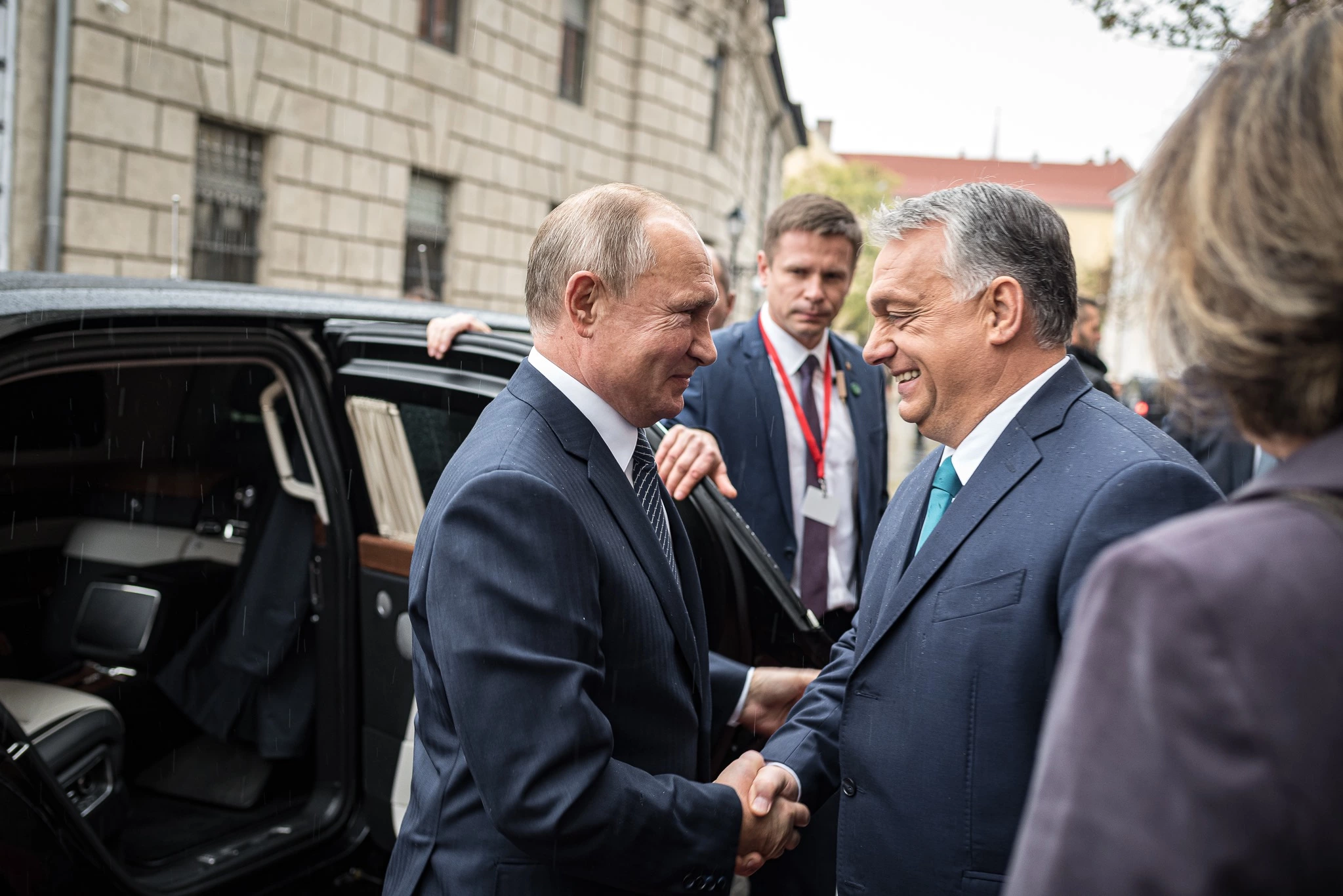

This is to be expected, without being reported out of proportion. Straightforwardly, an EU country labeling Russia a security threat is correct. There is no longer an Orbán government to deny this.
Russia invaded a neighboring sovereign country, annexed or claimed its territory, and has spent years prosecuting a major war a few hundred kilometres from Hungary. Hungary doesn’t have to declare Russians evil, sever diplomatic relations, or reject negotiations to acknowledge the obvious security consequence of that.
If Kolesnik’s statement became actual Russian government policy, it would be coercive and morally wrong. There is nothing to hesitate about when confronting this, just keep speaking loudly for what is right.
Concern is growing in the West about a potential Russian attack on NATO. Military expert Carlo Masala says the CIA chief’s trip to Moscow supports this view.
CIA Director John Ratcliffe’s visit to Moscow on Tuesday apparently had more serious implications than previously known. According to various US media reports, Ratcliffe warned the leadership in Moscow against attacks on NATO territory, particularly in the Baltic states.
The mere fact that Ratcliffe traveled to Russia made military and security experts sit up and take notice. The last such visit was in November 2021, when then-CIA Director William Burns flew to Moscow—unsuccessfully—to warn Kremlin leader Vladimir Putin against invading Ukraine. Ratcliffe’s trip is just one indication of the growing threat posed by Russia. Germany itself likely narrowly escaped a devastating kamikaze drone attack on Leipzig/Halle Airport in early August.
t-online spoke with political scientist and military expert Carlo Masala from the Bundeswehr University Munich about the gravity of the situation on NATO’s eastern flank.
t-online: How significant is the CIA chief’s visit, given reports that it involved a warning to Russia against attacking NATO?
Carlo Masala: You don’t send the CIA chief to Moscow unless you have concrete information leading you to believe something might be imminent. And Ratcliffe didn’t fly to Russia secretly, as his predecessor Burns did in 2021; he flew in a C-17 transport aircraft with its transponder switched on. That was a clear message from the US government to Russia. However, we do not know what specific information the CIA possesses and can only speculate.
Is the trip itself an indication of the growing threat on NATO’s eastern flank? US intelligence agencies have recently warned that potential Russian attacks could range from massive hybrid operations and cyberattacks to military actions against alliance territory. Indeed, such attacks have been occurring almost daily of late—from an attempted attack on Leipzig/Halle Airport and drone incursions into Romanian airspace to explosions at arms factories, such as the recent incident near Rome, which may also be attributable to Russia.
NATO recently responded with an unannounced exercise in the vicinity of the Russian exclave of Kaliningrad.
The maneuvers in the Baltic region were certainly impressive. They involved the deployment of specialized electronic warfare aircraft—types rarely seen in the region with their transponders switched on. Just this Wednesday, Poland deployed 28 new tanks to the border with Kaliningrad. Meanwhile, the British government is explicitly warning its citizens of potential Russian attacks in retaliation for the UK’s military support of Ukraine.
Are such signals enough to deter Putin from further escalation along the alliance’s eastern flank?
It is impossible to say. The very nature of deterrence requires the adversary to believe that one is prepared to strike back in the event of an attack. We do not know whether the Kremlin leadership would be deterred from attacking NATO territory. What is certain, however, is that Russia is becoming increasingly willing to take risks.
Is it time for NATO to invoke Article 4—that is, to hold formal consultations regarding a threat to the alliance?
What would that achieve? The question would be what concrete steps NATO would then take. To do so, it would have to clearly identify the perpetrator behind the hybrid attacks in Europe. Yet the insidious nature of hybrid warfare lies precisely in the fact that the aggressor remains in the shadows.
Is the German government doing enough to prepare the public for the growing threat posed by Russia?
The Chancellor stated as early as last year that while Germany is not at war, it is no longer at peace either. Merz also spoke in clear terms following the failed attack at Leipzig/Halle Airport. The problem is that if the government issues warnings but nothing happens, those warnings eventually lose their impact.
What concrete steps can the West take to better arm itself against the threat from Russia?
We urgently need better technical solutions to protect our critical infrastructure—especially against the small drones used in the attempted attack at Leipzig/Halle. There is currently no effective defense against these weapons. I fear there isn’t much else the West can do at the moment.
Mr. Masala, thank you for the interview.
Carlo Masala is a professor of international politics at the Bundeswehr University Munich. The political scientist also heads the university’s Metis Institute for Strategy and Foresight. Masala regularly discusses security policy on the podcast “Sicherheitshalber.”
https://www.t-online.de/nachrichten/ausland/internationale-politik/id_101407838/masala-zur-moskau-reise-des-cia-chefs-russland-wird-risikofreudiger-.html
Thanks for your post.
The new president Peter magyar ,he destroys everything, what Orbán has build.he loves Ursula von der ley, instead he loves Hungarian, and does everything for Hungarian, no he does everything what they say in Brussel,,he loves the EU,
The EU I hope it will fall apart, it is very bad,and they do not tell the people ,you love the EU,you love the bad rules and bad people.
Fidesz put out a lot of propaganda for years through the media monopoly they controlled. They have taught Hungarians to hate the EU and Ukraine and that Russia is not so bad. How is it possible that Hungarians after 46 years of Russian occupation with the executions, torture, and suppression of freedom could forget that? Somehow Fidesz says the EU is your enemy yet at the same time says Hungary should not leave the EU. Anyone who thinks that holding those two contradictory positions as true is a victim of lies.
How is it that Ukrainians including Ukrainians of Hungarian ethnicity are being snatched if the street many are n their fifties and with legitimate reasons they cannot fight and the eu says nothing , where is Magyar condemnation of that
This is not a new question; it is an old one. It has been awaiting an answer since the very beginning of the war.
So, first we should ask: what has your favorite Prime Minister, Orbán, actually done about it—aside from making public accusations that significantly worsened the situation without leading to any improvement, let alone a solution?
The simple answer: NOTHING. Why? Because Orbán didn’t actually want a solution; he wanted to keep exploiting the issue for his own political gain. Harsh as it sounds, he didn’t really care about the people!
But you aren’t interested in a real answer either; you just want to cast Ukraine and the new government as the scapegoats. Otherwise, you would have put that question to Orbán four years ago.
Please come up with something else—something not so transparently obvious and something actually worth the effort of a reply.
The perfect example of Orban exploiting an issue for political gain is railing against migrants and casting himself as the protector of Hungary and then releasing from Hungarian prisons hundreds of migrant smugglers which actually caused a diplomatic row with Austria. He actually wanted migrants to be a problem in order to stir up public reaction. Orban also pushed migrants to cross from Hungary across the Slovak border during the Slovakian election mimicking Putin’s tactics of using migrants as a political weapon. The purpose there was to stir up right-wing nationalism in Slovakia to get Fico elected.
https://spectator.sme.sk/politics-and-society/c/news-digest-did-orban-help-fico-win-by-sending-migrants-to-slovakia
Steve maybe live in Ukraine under Russian bombardment for a few months and visit the front line and then come back and tell us about aggressive tactics to save the country from being overrun by Putin. What gives you or anyone else the right as an outsidet to dictate to Ukraine now to defend itself from being extinguished as a nation?
Oh. You didn’t think there were any strings attached to that Russian oil and gas? The lesson is never NEVER make your country dependent on Russia because they will use that dependency to make you bend to their wishes like obstructing Finland and Sweden’s accession into NATO, blocking EU sanctions on Russia, obstructing aid to Ukraine, removing the 1956 memorial from Kossuth ter, etc. etc. etc. Now what if you need some parts for that new Russian nuclear reactor you are building at Paks that you are sinking billions of euros into? Sorry, no parts for you unless you do what we want.
Note the contradiction of Orban as he (and the other Fidesz politicians) constantly talked out of both sides of his mouth hoping that Hungarians were too stupid to realize the contradictions and quite frankly a lot of Hungarians just ignored the contradictions. Orban said that Russia was not a threat “pointing to Hungary’s membership in the (NATO) alliance”. Well, why do you join the alliance in the first place idiots? You join because Russia is a threat.
Yes, Dear Larry – ‘talking out of both sides of your mouth’ is basically what a small nation has to do – so as not to be eaten by the larger fish. The only good way forward for Hungary is to act like Switzerland and be everyone’s friend, or, if failing that, to be no one’s enemy. I am sorry that Magyar is so university-educated he does not have this basic common sense – which Orbán Viktor most certainly did have. That said, this is also Orbán’s failure, as he did not make living outside of the Bruxelles-satellite orbit comfortable enough for Hungarians to continue choosing that.
“The only good way forward for Hungary is to act like Switzerland and be everyone’s friend, or, if failing that, to be no one’s enemy.”
Actually, it’s not worth engaging with their idiotic drivel, but I don’t want to leave the above uncommented. Because there are certainly many authoritarian dictatorship supporters here who will buy into this nonsense and want to jump on the bandwagon.
In case it was lost in the grief over the lost election, Switzerland voluntarily supports all EU sanctions against Russia. So Switzerland can’t be everyone’s friend, nor can it be Russia’s friend. Furthermore, Switzerland is also massively rearming, having recently purchased many F-35 fighter jets from the USA, and is now a major importer of German weapons.
So, the same old story: just cheap drivel to obscure reality. It is certainly easier to claim this than to honestly say that one is an enthusiastic supporter of Putin.
The problem Dear Idiot is that there is a very large country to the east that does not act like Switzerland and be everybody’s friend. The shit head dictator Putin is bent on imperial expansion and will invade anyone he can unless they submit to become vassal states like Belarus and Belarus has to allow the Russian army to use its territory as a launch pad to attack anyone. Only an idiot disarms himself in this situation. World history teaches the most basic lesson that you need deterrence if you want peace. As long as Europe arms itself with a strong and united military force Putin will be deterred from his evil plans. Shit head traitor Orban is now history and we have a government loyal to the protection of Europe.
So, now the millions of ordinary Hungarians may suffer greatly, because St. Peti read out from the script dictated to him by the globalist-socialist cabal. Great going.
Like, seriously, what did this dumb “Russia is a security threat” rhetoric achieve? Did it make Putin reconsider his life choices? Did it alter anything in Ukraine? Did it make anyone richer or safer or somehow more secure?
None of the above.
It is a throwaway, hot-air remark, accomplishing nothing of any value to this nation. Its purpose was only for St. Peti to publicly express his obedience to the foreign elites.
So stupid.
“So now the millions of ordinary Hungarians may suffer greatly because St. Peti read from the script dictated to him by the globalist-socialist cabal.”
Have you ever asked yourself who is threatening whom here? In your view, it’s not the aggressor who is to blame for the war, but the victim. Logic doesn’t seem to be your strong suit! I would never want to delve into your dark thoughts; that would surpass even the worst horror film by leaps and bounds and can only lead to a distorted perception of reality.
Thirty-five years ago, on the morning of August 19, 1991, tanks rolled through Moscow. Their commanders believed they were making history: A handful of Politburo apparatchiks—the Vice President, the KGB chief, the Defense Minister—had decided the night before to forcibly keep the sinking ship of the Soviet Union afloat. It was supposed to be a last-minute rescue. It became the accelerator of its collapse. For the conspirators had overlooked the crucial point: You can’t hold an empire together permanently with tanks if the people within it no longer believe in it.
Among the cadres of the crumbling Soviet order at that time was a young KGB officer in Dresden who witnessed the collapse of the Eastern Bloc firsthand: the enraged crowds outside the gates, the hastily burned piles of files, the impotence of the once all-powerful apparatus. Vladimir Putin has never forgotten this impotence. He later called the collapse of the USSR “the greatest geopolitical catastrophe of the 20th century”—a phrase that fits every lock of his subsequent policies like a key.
He wants what the coup plotters wanted: to restore lost greatness. Only he is more cunning and ruthless than they were. He knows that tanks alone are not enough. A narrative is also needed. That is why he has spun a lie, which he has been indoctrinating Russians for years on television and the internet, in schools and workplaces: the legend of a supposedly encircled and humiliated Russia that must defend itself against an allegedly aggressive West.
A ruler who cannot offer his people a better life must create an enemy to rally them behind him. Russia possesses fabulous natural resources—oil, gas, metals—the profits of which could finance a thriving nation. Instead, they have flowed into the pockets of a mafia-like clique. Those who refuse to address the question of distribution shift it to the question of the enemy. Those who fear democracy—and Putin fears it like the devil fears holy water, because it signifies the end of all unchecked rule—need a permanent state of emergency. This is certainly not unknown in Hungary, albeit in a milder form.
For over four years, Russia has therefore been waging a war of aggression against Ukraine, turning the propaganda about the “fascism” of its neighbors into a monstrous self-incrimination: It is Putin’s missiles that are destroying apartment buildings, power stations, and schools. And it is his own countrymen whom he is sacrificing by the hundreds of thousands in the death zones of the Donbas—as if the lives of Russian soldiers were the cheapest of all commodities. This is the cynical symmetry of his rule: He invokes the greatness of Russia and sacrifices the Russian people in the process.
The threat from the East must move from the back rooms of security policy into the consciousness of the entire society. Students, employees, managers, civil servants – all citizens should be informed about the Putin regime’s hybrid warfare. The era of deceptive security, into which many in Europe have lulled themselves for decades, is over. The duty of those in power is now not to further reassure the population, but to awaken them. Only those who prepare for crises can prevent their worst eruptions.
The writing is on the wall, but few seem willing to acknowledge the impending disaster, even though it is unmistakably before our very eyes. Putin wants total war, and he will not stop at Ukraine. No amount of sacrifice by the West will change his mind or appease him. Perhaps later, but then it will be too late for everyone. He wants to succeed Ivan IV Vasilyevich, also known as Ivan the Terrible, as the great ruler of an imperial Russia. But the intellectually blind, the stupid, the self-absorbed narcissists, and those paralyzed by fear do not see this.
This is another extremely well-informed comment of yours, Dear Peter. So much history here, and you are to be respected for your ability to coherently regurgitate it. That said, you are not knowledgeable about Russia from the inside, and so many of your assumptions are skewed with a kind of Russo-hatred/fear, that your nation spread all over Europe, in the 1940s, to get volunteers for their war of conquest in The East, and which the CIA//MI6 have carefully fostered ever since. Though you will not hear it : I will give you the objective truth. In Russian, the ruler, known as ‘Ivan Grozhny’ is not heard as ‘Ivan The Terrible’, but, rather, Ivan The Awesome.Also, your notion of Vladimir Vladimirovka is largely off-base. He is, beyond any doubt, the most anti-war, reasonable, and unaggressive leader you could possibly imagine. But, yes, he is not a coward or a traitor, as are so many leaders of our West. So, he will NOT allow countries on the border of Russia to be used to destroy Russia. For the bankers that control The West, and the Intelligence Services that weaponize NGOS to do the bankers’ bidding, this is simply unacceptable, so they train people to constantly fear Putin, and, for that manner, Xi, as well. Fortunately, you are about to live in a country run by the AFD, so German Russophobia will soon be incredibly unstylish. Germany (if it does not return to pre-Bismark form of many different countries) will return to the relationship it had with Russia in the 19th century, under Bismark and his successors. Yes, Dear Peter, 20,000,000 displaced Ukrainians, since 2022, not to mention 2,000,000 dead and many more hurt and crippled. All of this the result of the Victoria Nuland-led 2014 Maidan Spring coup to depose President Viktor Yanukovich – the legitimate democratically-elected leader of the Ukraine, who was friends with everybody – both East & West. No, Dear Peter, if you detest Russia and Putin so much, go join the foreign volunteer force that your country has been trying to put together in Latvia – for they have not been successful at getting many German soldiers to go there. As to The Ukraine : it will not likely survive this war, as no right-thinking Russian can be in favour of leaving it in Western hands. Russia was okay with a newly formed nation of Ukraine for 30 years, but, now they are not. The West Political Elite have made it so. All the best to you, somewhere in Western Germany.
I suspect you’re writing all this nonsense while completely drunk, because you can’t just make up that much rubbish on your own.
My suggestion: apply for the E.T.A. Hoffmann Memorial Prize. You won’t win anything because of your weak writing style, but you might convince the jury of your utter inability to perceive reality.
That’s not something you see very often in this world. You’re certainly one of the few exceptions who can do it, or rather, who can’t.
Cheers!
In Russian, his epithet is *Grozny* (Грозный). The word more accurately translates to “the Fearsome” or “he who inspires awe and dread.” Over time, the harsher term “the Terrible” became the standard translation in German.
Reasons for the epithet:
The boyars, who were supposed to care for him after his mother’s death, mistreated the child instead.
This mistreatment turned Ivan into a sadist.
The list of atrocities Ivan committed—or ordered to be committed—during his reign is long. Some of these acts are disputed; it is not always certain whether Ivan actually had the deeds carried out or merely threatened to do so.
Ivan’s cruelty intensified as his reign progressed. He may have been influenced by military setbacks, taking out his resulting rage on his people.
While the Tsar usually only ordered executions and murders, he did occasionally get his own hands dirty.
For instance, Ivan IV reportedly raped women regularly, having them abducted from their homes for this purpose. Afterward, the Tsar would strangle them and have their bodies returned to their husbands.
In 1563, Ivan committed a murder himself, killing Prince Ivan Shakhovskoy during a battle in the Livonian War.
A year later, he plunged a knife into the heart of Dmitri Obolensky, who had previously criticized the Tsar.
In November 1581, Ivan most likely killed his own son during an argument. He struck the Tsarevich on the head with his royal staff, causing him to fall into a coma and die a few days later.
The *Oprichniki* were a brutal police force assembled by Ivan himself. Numbering 6,000 men, they bore two distinguishing symbols: a broom (signifying a “cleansing” or purge) and a dog’s head (signifying subservience). The Oprichniki had the right to kill anyone in Russia who uttered a bad word about the Tsar. Ivan frequently employed the Oprichniki to carry out his cruel deeds.
Their name derives from “Oprichnina,” meaning “prerogative” or “separate domain.” The people also called these butchers *Kromeschniki*, meaning “the chosen ones.”
At times, the Oprichniki were led by a man named Grigory Lukyanovich Skuratov-Belsky, known as Malyuta Skuratov. He had previously made a name for himself as a judge and executioner.
After joining the Oprichniki, Skuratov rose rapidly through the ranks, aided by his own cruelty. He carried out countless executions, participated in punitive expeditions, and fought in the Livonian War.
He died in 1573 during the siege of Weissenstein in that conflict.
Ivan was not content merely to torture and execute his victims using conventional methods. He delighted in devising his own variations and watching people in their death throes; the suffering of the unfortunate victims reportedly amused the Tsar.
He favored having his victims dismembered or burned alive. As a novel method of execution, he invented a large pan capable of roasting a whole human being.
A physician supplied Ivan with a specially concocted poison that was reliable and—depending on the dosage—would kill at a precise moment. Ivan took pleasure in scheduling the exact time of his victims’ deaths.
A mass execution took place on July 25, 1570. Ivan had approximately 200 people killed in various ways in Moscow’s main square; the unfortunate victims had participated in the Novgorod uprising. Before the executions began, Ivan displayed an array of torture instruments before the condemned to show them what awaited them. Methods of execution included alternately dousing victims with boiling and ice-cold water, as well as pouring boiling pitch over them. Others were dismembered alive, burned with hot irons, or subjected to having their teeth or fingernails torn out.
Presumably, few onlookers witnessed this mass execution. The populace had largely fled to avoid falling victim to the Tsar’s wrath themselves. Ivan had those who remained in hiding dragged to the main square.
A remark made by his daughter-in-law triggered a wave of mass torture. She had complained to Ivan that other women were mocking her. In response, Ivan ordered women and girls to be rounded up indiscriminately and brought to the palace. They were forced to undress and walk naked through deep snow. He had some of them whipped to death as well, and threw their bodies to the bears.
Ivan Mikhailovich Viskovaty was a chancellor and a confidant of the Tsar; Nikita Funikov was the treasurer. Both fell victim to the mass executions of July 25, 1570. Ivan had the former sawn into pieces by the *Oprichniki*. To this end, the chancellor was suspended upside down; this position caused him to lose less blood during the ordeal, thereby prolonging his life, and prevented him from losing consciousness due to the pain.
He ordered boiling water and cold water to be poured over Funikov alternately until his flesh fell from his bones.
Ivan then vented his rage on Funikov’s wife, demanding money from her. When she had none, Ivan had her seated naked on a rope and dragged from side to side; she survived the ordeal.
He had Bishop Leonidas dressed as a bear by sewing him into a bearskin. Ivan then unleashed hunting dogs upon the “bear,” and they tore the man inside to pieces. The reason for the execution was Leonidas’s refusal to bless Ivan’s fourth marriage.
Ivan remained merciless toward the boyars. One nobleman attempted to flee the Tsar by seeking refuge in a monastery; Ivan tracked him down and strapped him to a powder keg. The man died in the resulting explosion.
Dimitri Ivanovich Sheverov and Boris Telepov—also noblemen—were impaled after being found guilty of high treason. Both remained alive for several hours; the latter reportedly spent a total of fifteen hours conscious on the stake. In addition to his own torture, he was forced to watch his mother being raped.
Ivan is also said to have executed Vasilisa Melentyeva, his sixth wife (or perhaps merely a mistress). She had been unfaithful to him; Ivan had the other man impaled. Vasilisa was bound and gagged, then placed in a coffin and buried alive. Other sources, however, claim that he merely banished her to a convent.
When Ivan received a French envoy, the man forgot to remove his hat in the Tsar’s presence. In response, Ivan had the hat nailed to the man’s head. He drove a sharp staff through the foot of another envoy and then had the message read aloud to him.
How Ivan IV Acquired the Epithet “the Terrible”: Novgorod 1570
There are two theories regarding how Ivan acquired his epithet. According to some sources, he adopted it as a deterrent against his enemies; these sources suggest the name emerged as early as the conquest of the Khanate of Kazan.
Other sources point to a specific event in 1570. That year, Ivan ordered the *Oprichniki* to surround Novgorod. With no escape route available, his henchmen began slaughtering the citizens. They bound women and children and threw them into the Volkhov, the river flowing through the city. Many drowned; those who managed to reach the bank were killed by the *Oprichniki* with axes or forced beneath the ice.
If this event was indeed the origin of the epithet, Ivan’s subjects used the term as a euphemism. Fearing further atrocities, they felt compelled to resort to a less negative moniker. In Europe, no such constraint existed, allowing the loose translation “the Terrible” to become established rather than a literal translation of *grosny*.
In January 1558, Ivan the Terrible attacked Livonia with a force of 40,000 men, aiming to secure access to the Baltic Sea by force. The First Northern War for the Baltic region had begun.
In May, Narva—located in present-day Estonia—was captured. That summer, the city of Tartu also fell. Subsequently, a defensive alliance led by Poland was formed, and the war went into a lull for several years.
It was not until February 1563 that the situation shifted once more. That year, Tsar Ivan IV personally led a major campaign against the city of Polotsk. The siege of Polotsk ended with the capture of the city and its surrounding territory. However, the Lithuanians halted the Russian advance in 1564 at the Battle of Ula, where they decisively defeated a Russian army 25,000 strong.
In 1570, the warring parties concluded a truce in Moscow, with the Russians retaining control of Polotsk. Yet, the formation of the Polish-Lithuanian Commonwealth heralded a shift in the balance of power in Eastern Europe. This became apparent a few years later when, starting in 1579, Poland-Lithuania—under King Stephen Báthory—recaptured Polotsk and, alongside Sweden, ultimately turned the tide of the entire Livonian War in their favor.
In the end, the Tsar was forced to yield to Poland (which by then had a new king from Hungary who proved to be a highly successful military leader), Lithuania, Sweden, and Denmark. Russia had to abandon its hopes of gaining access to the Baltic Sea. Ultimately, Russia was left utterly impoverished and economically ruined for the long term. In late February 1584, Ivan’s health deteriorated rapidly, and he ordered the monks of the Kirillo-Belozersky Monastery to pray for relief from his ailments. Ivan was plagued by depression and an intense fear of death. Suffering from dropsy and arthritis, Ivan IV died in the Kremlin on March 18, 1584.
Contrary to Orbán’s claims, the energy supply from Russia is anything but secure! Although Orbán traveled to Moscow many times, Putin could not be persuaded to compromise on the war in Ukraine. Orbán—who styles himself as a major global statesman—failed to achieve a single thing that wasn’t in Russia’s interest. Yet he carried on as before, because he needed the “Russia narrative” to continue lining his pockets without restraint.
Andrey Kolesnikov, a member of the Russian State Duma’s Defense Committee and President Vladimir Putin’s “United Russia” party, stated that Russian energy supplies to Hungary could be called into question.
He seems entirely unaware that, by saying this, he is adding fuel to the fire. After all, he is explicitly demonstrating that Russia genuinely poses a threat to Hungary. Did he really think this through? Presumably yes, as it is intended to serve a specific purpose. It is a familiar tactic of intimidation—the same kind we see time and again with Trump: the aim is to instill fear.
Very well put posts. I was thinking the exact same thing about the counter-productive nature of Kalesnikov’s threat. Ya dummkopf! Russia day and night demonstrates that it is a threat and then is offended when you say it is a threat and then goes on to make a new threat against you. Steiner and Mouton are just Russian propagandists.
Uncharacteristic for you, Dear Larry, you are sleepwalking here. If you feel Russia has become a threat, you need to ask yourself why it is so. Yes, of course, anyone you does not have your Russophobic view must be ‘a propagandist’.
Do not be so insecure, Dear Larry: you are so much better than that.
You probably only perceive your wife as a threat when she hides the alcohol from you. But I can’t really imagine any woman being able to put up with that from you.
Russia is the world’s biggest country and that is never enough for Russia. It always strives to continue its imperial expansion like a cancer on Eurasia. It wants to control vassal states either through the front door using the military as it is now doing in Ukraine and did in Hungary in 1945 or through the back door inflitrating governments through use of corruption as was happening under Fidesz. Hungary has now kicked Russian control out a second time. As Garry Kasparov said, Russia’s most successful export is not oil. It’s corruption.
I respectfully disagree with Mr. Kasparov, Dear Larry, as no one exports corruption on the level of my country. We bribe almost everybody, and those we cannot bribe we often bomb. Concerning Russia’s size and their appetite I do agree that Russia is an empire – and has been since at least around the time of Czarinas Elizabeth and Catherine – maybe longer. That said, we, of Anglo blood, in The West, cannot be lecturing anybody about this, as we have long been in the business of empire. Your comments about Russia controlling the Ukraine are just as easily applicable to us, and not just in the Ukraine, but, everywhere around the world, especially in the border areas of Russia. I think it is important to be just, Dear Larry – and that means what is sauce for the Goose is sauce for the Gander, as well. Speaking of ‘well’ , I hope you are doing well!
Beste mensen
Voor de tijd die we hier hebben op aarde
Maken ze er toch een potje van
Ieder het zijne en wees content met het land dat je hebt landen veroveren is voor dommerikken
Berokkend schade op alle vlak en crieeerd
Onenigheid overal
Nie doen dus
Geniet van de jaren die we hebben
In English:
Dear all,
For the time we have here on Earth,
they really do make a mess of it.
To each their own, and be content with the land you have – conquering other lands is for fools.
It causes damage on every front and creates
discord everywhere.
So don’t do it.
Enjoy the years we have.
I can only say that I couldn’t agree with you more.
And I agree with this, too, Dear Peter – the problem is that the bankers who control The Western Political Elite do not agree with this. They want to own and run everything. Russia and Iran seem to be the ones Fate has accorded to teach them that they cannot control and run everything.
Whenever you supposedly agree with me, I get a jolt of excitement and a chill runs down my spine. I feel an overwhelming urge to re-examine my own opinion on the matter. But then, in the very next sentence, you make it clear that you actually disagree, and I’m relieved to find I’m still sane. That’s incredibly calming!
Feel free to have another drink if it helps. Don’t let facts unsettle you, and tell yourself that you’re incapable of understanding them anyway, let alone interpreting them.
Thank you for the civil and humourous remark, Dear Peter. By the way, I hardly ever take a drink. Nevertheless, next time I do, I will toast you and your brilliant mind – even if it is a mind that will only contemplate those ‘facts’ which seem to corroborate Modern Leftist-Globalist Orthodoxy! One thing is for sure, you are an extremely religious person.
Russians have begun leaving the country en masse amid fears that the Kremlin is preparing to announce a new wave of mobilization to replenish the army, according to Politico.
In just one week, more than 113,000 Russians crossed the border through the Verkhny Lars checkpoint on the Russian-Georgian border. The sharp increase in the number of people leaving is attributed to fears of a possible draft.
“At the same time, Russian authorities officially deny that a new mobilization is being prepared. However, the Kremlin is simultaneously strengthening its system for registering and recruiting reservists. Employers have been required to provide the government with the personal data of potential military personnel, and reservists are being assigned to military units in advance,” the article states.
The Kremlin’s attempts to find alternative ways to replenish the army are also facing challenges. In particular, the program to recruit students into unmanned systems units has not lived up to expectations. In some regions, pressure on potential conscripts is already sparking resistance and grassroots organizing.
Yes, Dear Peter, their definitely are young men, particularly in the big cities, who do not want to fight for The Motherland, and, yes, some are fleeing. Now take note : a large number of Russian men, Good-Ole-Boys like me, are flocking to recruitment. Why are they doing that? Because, instead of spending their life drunk, they appreciate the fact that they can become extremely well-compensated young men who will go down in history as heroes to their country. Your assumption, that Russia is on the verge of a revolt, is far-fetched, fueled by a knowledge of Russia that arises from Bloomberg and Politico. By the way, Putin is the only politician in Russia who is widely popular. But, yes, there is a minority who detest him, because they want Russia to become homosexual, hopelessly divided, and anti-Orthodox – just like The West.
“Now take note: a large number of Russian men, good-olive boys like me, are flocking to recruitment.”
Then you must be Russian if you write it like that. That also explains your alcohol abuse.
На здоровье!
Thank you for the well wishes, Dear Peter. И я тоже поднимаю бокал за ваше здоровье —
Russia turning off the energy taps might be a blessing in disguise. In a flash Hungary would be forced to transition to alternative supplies resolving this long standing matter while allowing Budapest to point the finger at Moscow: “You turned off the taps and forced us to find a solution.” That would politically take the heat off the government who state they were forced into a position against their will.
Hungary’s energy demands are very modest compared to larger European countries, its oil needs can be fully met via the Adria pipeline while Norwegian and Dutch natural gas and imported LNG can be supplied via existing gas pipelines. Will it cost more? Somewhat more, yes, mainly because of the increased transport cost. There is a longstanding myth about ‘cheap Russian energy’. It was ‘cheap’ (i.e. the global oil and gas price was cheaper than today) until the nutcase in the Kremlin decided to attack his neighbour, sending shockwaves through international energy markets. Prices have since reverted closer to historical means but remain elevated, to a great degree due to the situation in the Middle East. Russia meanwhile demands the prevailing international price for its energy and is offering no bargains for forward supply contracts. Urals crude trades at a discount to Brent precisely because there are relatively fewer buyers in the market, most of the current ones ignore western disapproval and are willing to bear the risks inherent in using shadow fleet tankers to move crude to their domestic refineries, their motivation is solely to buy oil at a discount on the spot market on a tanker-by-tanker basis.
It would best if Russia closed the taps now before the onset of winter ensuring Hungary has transitioned to alternative supplies by December. Of course it won’t, Russia will instead wait for a moment of maximum pain when the winter freeze has arrived. Precisely because of this Hungary needs to preemptively turn up the volume on alternative supply routes and I’m hopeful this is already happening behind the scenes. Once these are secure Hungary is then in a position to negotiate with Russia from a position of strength, demanding a healthy discount if Moscow wants to remain part of the syndicate of suppliers from whom Hungary buys its energy. This will of course hurt Moscow’s interests as it’ll reduce both the volume and the price of energy that Hungary is willing to buy, the alternative to which is selling none at all.
Many—particularly the AfD—repeatedly advocate for a return to “cheap” Russian gas. An AfD party member refutes this “myth” in a detailed post in *Focus*. And, of course, it is highly unlikely that an AfD member would be biased on this particular issue.
“Cheap gas from Russia is a myth.” In no uncertain terms, Rainer Kraft—an AfD member of the Bundestag from Augsburg—contradicts his party’s official line. In a detailed post on X (formerly Twitter), Kraft explains that Germany consistently paid world market prices for Russian gas. At times, Russian gas was even more expensive than liquefied natural gas (LNG) traded at the Dutch TTF gas hub.
Kraft points out that projects like Nord Stream primarily lined the pockets of the Russian gas giant Gazprom—and, by extension, Russia itself. “We could have bought the gas at the same price via the hub,” the AfD MP criticizes. The drastic rise in gas prices across Europe is often attributed to the shift toward imported liquefied natural gas (LNG) and the subsequent passing on of higher costs to consumers.
“Neither is true!” writes Kraft. Between 2009 and 2015, in particular, Europe actually paid more for Russian pipeline gas than for freely traded LNG at the Dutch TTF hub. “The conclusion is clear: Russia was the one profiting.”
With this analysis, Kraft directly contradicts the prevailing AfD party line. Since Russia’s attack on Ukraine, the party has advocated for resuming relations with Russia—which implies Germany sourcing gas from Russia once again.
According to Kraft, the higher prices for Russian gas stemmed from the fact that the selling price was contractually linked to the price of crude oil or a basket of various traded oil grades. Furthermore, the long-term contracts Germany concluded with Russia included “take-or-pay” clauses. These work as follows: the supplier commits to delivering a specific volume of natural gas, and the buyer is required to pay for a portion of that volume—regardless of how much is actually delivered.
Tim Boersma, a researcher at Columbia University in the US, also highlighted the discrepancy on ResearchGate between the price of Russian gas at the European border and the price of gas at the TTF hub. According to his findings, Russian gas was significantly more expensive than TTF gas—particularly during the winter of 2008/2009, the spring of 2012, and the period from autumn 2014 to winter 2015. While Boersma’s calculations did show brief periods when Russian gas was cheaper, Russian prices were generally higher overall.
For Kraft, an AfD member, all of this demonstrates that “gas from Russia is not a magic substance that will solve Germany’s economic problems.” To prevent future dependencies—such as the reliance on Russian gas—Germany is currently signing smaller gas contracts with a wider range of trading partners. A complete ban on Russian gas is planned by 2027.
“Germany has various import options at its disposal. Gas volumes can be imported via pipelines (particularly from Norway) as well as through LNG terminals,” states the Federal Network Agency. In recent years, Germany has also opened up additional import routes via France and Belgium.
The notion, Dear Peter, that AFD members only want good relations with Russia, just to get cheap fuel, is pure blatant reductionism.
True, but I suspect, reading your posts, that you’re drinking the cheap gasoline that the AfD (Alternative for Germany) opposes.
I believe this because your thinking is so utterly muddled, and right now, Chinese-made gasoline cars are breaking down left and right in Russia because the gasoline quality is abysmal. But quality has never been a Russian strength. The only thing the Russians are absolute experts at is destruction.
Russia could simply return the broken-down cars to the Chinese in exchange for a bottle of vodka, then the Russians wouldn’t have to drink gasoline.
There are many stories from Russia about what people drink there when they’re short on vodka. But remember, if you give in to your gasoline addiction without restraint, you’ll end up in a cheap mental institution.
Well, Dear Peter, there is a long held tradition, when good Corn whiskey is unavailable, in The South that drinking what is called Moonshine, or, in rarer cases still, refined Turpentine, but, I always thought that the latter a bit too scary. These days I am too old to drink often, but, when I do, I like a beer like Bitburger, Spatenbräu, or Stella Artois.
The first two are very fine beers indeed, I commend your choice. Stella Artois is decent in Belgium but undrinkable in the UK as it’s one of the many international beers that are brewed locally for domestic consumption. Brits make fine ales but, unfortunately, they stink at brewing lager. If I spy on the packaging that a lager was brewed in the UK (often in very small lettering) I immediately put it back on the shelf and move on. They even brew the likes of American Bud and Coors in the UK while managing to make it even worse than the American stuff which is quite an achievement. And before some wise guy points out that there are some artisan-made quality lagers made in the UK, there are. For 4x the price. It’s much cheaper to buy the genuine article imported from Germany, Czechia and elsewhere although it can be surprisingly hard to find as the brewers and retailers want you to drink the high profit margin swill that’s brewed locally.
Hungary and Slovakia are currently the only countries in the European Union that remain heavily dependent on Russian energy supplies. While other EU member states have significantly reduced their energy imports from Russia in recent years, Hungary still sources more than 80 percent of its oil and nearly 70 percent of its gas from Russia.
The European Union has granted Hungary and Slovakia a deadline of 2027 to break their dependence on Russian oil; a complete ban on imports into the EU will take effect after that date.
Despite the geopolitical situation and sanctions imposed by the EU and the US, Orbán has refused to cut ties with Russian oil and gas imports. He argues that a complete halt in supplies would place an excessive burden on the state budget.
András György Deák, a Hungarian energy policy expert at Eötvös Loránd University in Budapest, takes a different view. While a supply halt would undoubtedly cost the Hungarian state money, the cost would be significantly lower than Orbán claims. Russian gas itself is no longer cheaper than other gas available on the global market. In the case of oil, the raw material price would rise—since Russian oil is currently available at a lower price due to Western sanctions—but this applies only as long as the sanctions remain in place; after that, the situation resets.
These costs would primarily affect the state rather than individual citizens. This is because the Hungarian energy company MOL has been required to pay a windfall tax on the substantial extra profits generated by cheap Russian crude oil, resulting in huge revenues for the state treasury—revenues that would disappear if imports ceased.
At the gas pumps, however, the low prices of Russian oil had not been passed on to consumers anyway. The current price of gasoline aligns with the average in neighboring countries, deviating only minimally: gasoline is 1 forint (0.0026 euros) per liter cheaper, and diesel is 4 forints (0.010 euros) per liter cheaper than the average in neighboring countries.
According to Deák, moving away from Russian gas will not significantly impact consumer prices either. This is because prices in Hungary have been capped by the state since 2013, making them independent of market fluctuations. The difference between the capped price and the purchase price is covered by tax revenue. “Ultimately, the government decides what energy prices are set for households,” Deák stated.
Are there alternatives to Russian crude oil for Hungary?
JANAF (the Croatian pipeline operator) emphasizes that its infrastructure is capable of fully meeting the demand of both Hungary and Slovakia. Capacity tests—conducted with representatives from MOL present—have confirmed this.
MOL disputes this view. In their opinion, the Adria pipeline has never reliably delivered sufficient volumes in practice.
Government spokesman Zoltán Kovács also emphasized that Hungarian refineries were historically designed to process Russian Urals crude oil.
He also pointed to uncertainties regarding the reliability of the Adria pipeline. At the same time, MOL warned of the risks associated with increased reliance on maritime routes, which are vulnerable to geopolitical tensions and disruptions in global shipping.
However, neither party saw any risks associated with Russia.
Analysts counter that these very arguments highlight the risks of a one-sided dependence on Russia. According to CSD, the technical limitations of the Adria pipeline can be overcome. Furthermore, MOL refineries have successfully processed non-Russian crude oil in the past.
While Russian crude oil is cheaper, CSD notes that this advantage is not reflected in lower fuel prices. In 2024, pre-tax prices in Hungary were actually higher than those in neighboring countries like the Czech Republic.
Energy analyst Ben McWilliams of the think tank Bruegel also attributes the primary reasons to economic rather than technical factors. The decision to stick with Russian oil is driven primarily by commercial considerations. According to McWilliams, phasing it out is fundamentally possible.
Hungary has lost a great deal of time due to its own actions. It could already be far less dependent on Russian oil.
Yes, of course, Dear Peter – reducing dependence on Russian oil, as well as all other trade and commerce, ought be the goal of every Hungarian administration, instead of improving the lives of Hungarians.
We can certainly take a lesson from Orbán’s time in office, where Hungary’s economy steadily declined and has now, in some areas, reached the level of Bulgaria.
But of course, if you drink enough alcohol or gasoline, you won’t notice any of that anymore. So cheers, it won’t help you, but at least reality won’t bother you anymore.
Throughout its history, Russia has invaded and plundered every neighboring country as well as every country that has cooperated with it.
The Russian authorities are struggling more and more in covering up serious economic problems caused by the war against Ukraine, Western sanctions, and mismanagement of the economy. These difficulties have already resulted in concrete operational disruptions, but the Kremlin has no intention of halting hostilities. This is noted in a new report by the Institute for the Study of War (ISW).
At the same time, preparations are underway in Russia to build the infrastructure needed for a potential call-up of reservists. The Russian Ministry of Defense intends to expand the list of personal data that military agencies will be able to obtain from government bodies, companies, and organizations when assessing citizens’ fitness for service.
The draft amendments, published on August 28, will grant military officials access to information on the registration, income, employment, education, disability, and taxes of service members, as well as to their banking and medical records. Analysts say this is part of the Kremlin’s long-term strategy to create a unified digital system for managing conscription and mobilization.
According to the ISW, this initiative does not mean that a decision on mobilization has already been made—rather, the Ministry of Defense is laying the groundwork in case Putin decides to take this step after the State Duma elections.
The Institute notes: “The decision to forcibly draft reservists in Russia remains Putin’s personal decision,” which he will make based on the situation at the front and his assessment of the stability of his own regime.
https://understandingwar.org/research/russia-ukraine/russian-offensive-campaign-assessment-august-28-2026/
“As I have already warned, Russia is escalating the situation,” Tusk wrote on the online platform X after a conversation with NATO Secretary General Mark Rutte. The next six months will be crucial. “We cannot rule out Russian provocations against any NATO member.”
On Wednesday, a visit by CIA Director John Ratcliffe to Moscow sparked worldwide speculation. US media reported that Ratcliffe had warned Russia against an attack on one of the NATO states. When asked about the reports, the Kremlin denied them and pointed the finger at the West.
Poland is one of the most important political and military supporters of Ukraine, which is under attack by Russia. The country also feels threatened by Moscow and is massively increasing its military spending.
https://www.focus.de/politik/ausland/polens-regierungschef-warnt-vor-eskalation-durch-russland_f0dfe055-5b5d-4804-9626-9d6a3895c9c6.html
Germany is facing a drastic escalation of its policy toward Russia. The German government plans to hold Moscow responsible for the attempted drone bomb attack in Leipzig in the coming days and announce “extensive” measures, as three people familiar with the matter told WELT AM SONNTAG and Politico.
In the government district, there is talk of a “watershed moment 2.0”: In response to the Leipzig drone bomb attack, it is no longer sufficient to expel individual Russian diplomats or close the Russian House in Berlin, according to one of the people familiar with the matter. Harsher steps are needed, such as intensified sanctions or even further arms deliveries to Ukraine. The individuals, who were granted anonymity due to the sensitivity of the matter, declined to provide further details.
https://www.welt.de/politik/ausland/plus6a92a1bf518a586e1855c46f/drohne-in-leipzig-zeitenwende-2-0-berlin-bereitet-umfassendes-massnahmenpaket-gegen-moskau-vor.html
Excerpts from the paid article on Welt.de – WELT partner publication “Onet” with General Ben Hodges, the former commander of US Army Europe.
Question: How do you assess Russia’s current capabilities? Is the Kremlin capable of threatening NATO countries?
Ben Hodges: Russia is already at war with us. The Russians are already attacking us. Perhaps not with Iskander missiles, but with Russian drones, acts of sabotage on railway lines, and disruption of our institutions. And even with attempted attacks on executives in the arms industry. We all need to wake up and realize that Russia is indeed already at war with us. We must take this threat seriously.
Question: Could Russia attack a NATO country?
Hodges: That’s definitely something to keep in mind. Yes, such a scenario is possible. Many people used to say that Russia would never attack Ukraine, but things turned out differently. Understanding Russia and its motivations leads one to believe that the Russian president intends to continue his expansion. The likelihood of such an escalation will decrease significantly if we help Ukraine defeat Russia. However, if Russia recognizes that the West lacks both the capability and the political will to assist Ukraine, and if, furthermore, Russia becomes convinced that the United States is not truly committed to NATO, the risk of escalation will increase considerably.
Question: In Poland, you often hear the argument that Russia isn’t even capable of defeating Ukraine, so there’s no reason to frighten people by claiming Russia will attack NATO. What do you think of this argument—that Russia is simply too weak to challenge the West?
Hodges: I understand this argument, but it’s too simplistic. First of all, people need to understand why Russia would even attack a NATO country…
Question: Exactly. What would be the primary objective of such an attack?
Hodges: The objective is obvious: to shatter the Western alliance. To show the world that NATO members aren’t actually prepared to go to war over—let’s say—a part of Estonia, Lithuania, or Latvia. That has always been Russia’s goal. Of course, during the Cold War, the Soviet Union had the plans and the means to conquer a large part of Europe. Today, Russia no longer has those capabilities, but that’s no longer its goal. The goal is rather to divide the alliance and demonstrate that NATO members will not decide to activate Article 5. Russia wants to show that the West lacks the political will for such a decision.
Question: How far have Russia’s preparations progressed to implement this plan?
Hodges: First, Russia is driving a wedge between the United States and Europe. And what could happen after that? Russia could, for example, attack the Suwałki Gap or Daugavpils in Latvia and then ask NATO: Do you really want a nuclear war over Daugavpils or Suwałki? If we don’t react immediately in such a situation and drive them out, Russia will have achieved its goal. That’s why it’s so important to counter Russia’s current actions. I’m talking about sabotage, drone strikes, and all the activities in the gray area. At first glance, these actions often don’t bear the Russian flag (that is, Russia is concealing its connection to them), but there’s no doubt about who is behind them. If we do nothing to counter such actions, Russia will try to escalate the situation further—using methods it isn’t using in Ukraine. That would be a completely different kind of war than the war in Ukraine.
Question: What are Russia’s greatest strengths and weaknesses right now?
Hodges: Its greatest advantage at the moment is that the United States gives the impression of being on the sidelines. There are still countries in Europe that refuse to acknowledge that Russia is already at war with us. Therefore, there’s a lack of willingness to do everything possible to help Ukraine. Russia can, of course, continue to launch missiles and kill innocent Ukrainian civilians, but that’s all. Russia is incapable of defeating Ukraine. This war began twelve years ago. In that time, despite having virtually all the advantages, Russia has only brought 20 percent of Ukrainian territory under its control. Ukraine is on the right track by continuing its attacks on Russia’s fuel infrastructure. This makes it increasingly difficult for Russia to bear the costs of this war.
https://www.welt.de/politik/ausland/plus6a913fe3b3df30a615528903/russische-aggression-russland-koennte-die-nato-fragen-wollt-ihr-wirklich-einen-atomkrieg-wegen-suwalki.html
Russia may be preparing new hybrid attacks against the United Kingdom, and the potential targets have reportedly already been identified. This does not refer to a direct military strike against the NATO country, but rather to possible acts of sabotage, arson, and other operations that Moscow could use to put pressure on London.
Among the potential targets cited are a British-Ukrainian drone manufacturing company and the missile manufacturer MBDA. This is reported by the British publication Daily Mail reports, citing statements by former Russian Deputy Foreign Minister Andrei Fedorov, as well as British officials and experts.
Fedorov stated that the possibility of a “hybrid attack” against the United Kingdom is allegedly being discussed “at the highest levels of the Russian government.” According to him, Moscow is considering actions such as sabotage or arson, since a direct military strike against a NATO country could trigger a collective response from the Alliance.
https://www.dailymail.com/news/article-16090129/Russia-attack-British-drone-factory-missile-Kremlin-warns-described-UK-evil.html
Putin continues to set unrealistic and constantly shifting deadlines for the capture of the entire Donetsk and Luhansk regions. This is reported by the Institute for the Study of War (ISW) in its briefing from August 29.
The Russian leadership reportedly ordered Russian troops to reach the administrative borders of the Donetsk and Luhansk regions by December 31, 2026. However, the Russian military command considers this deadline unrealistic and is requesting an extension until March 31.
As the ISW highlights, Putin has set 15 deadlines since 2022 for Russian troops to capture the entire Donbas, none of which have been met. ISW analysts maintain that the Kremlin’s timelines for achieving its military objectives are unrealistic.
The ISW also notes that Russian forces are increasingly relying on foreign recruits to bolster their ranks. The proportion of foreign recruits (primarily from Latin America, Africa, and Southeast Asia) has recently risen on the Lyman front and now accounts for approximately 30% of the personnel within Russian forces.
https://understandingwar.org/research/russia-ukraine/russian-offensive-campaign-assessment-august-29-2026/
The Finnish President disagrees with Germany. China will not permit Russia to use nuclear weapons against Ukraine. The only step the Kremlin can take to escalate the war is the mobilization expected this autumn.
Finnish President Alexander Stubb stated this, according to the newspaper *Bild*.
According to the Finnish President, he spoke with a high-ranking Chinese official who assured him that Beijing would not allow a Russian nuclear attack.
https://www.bild.de/politik/ausland-und-internationales/finnen-praesident-stubb-widerspricht-deutschland-putin-wird-nato-nicht-angreifen-6a92ee10518a586e1855c84e