Subscribe to our social channels to get the latest news about Hungary!


“Office to go” and flex solutions – that’s what defines the office market post-COVID-19
New Work´s market update report
The past year has turned every aspect of our lives upside down, including the way we work and use office space. CEE-based flex office provider New Work has updated its annual research that confronts these issues and shows how our habits to use the office as a place of work have changed over the past year. Research shows that flexible office space in Hungary, Poland, the Czech Republic and Romania has increased tenfold and workplace needs now are completely different than ever before, so there should be an office ready to use at every corner.
“Office to go” as a property trend for the next few years
COVID-19 took the world in a completely different direction. This uncertain time has significantly changed the office space market. 2020 is over and the office as we know it is almost completely gone. Now we need not only a comfortable workspace and a desk. “Office to go” is a global trend and companies are already investing in them. What we all need is the fastest possible access to the workplace, a comfortable and professional space. Swiss railways have already noticed this trend by creating flexible office spaces at railway stations or the Accor hotel chain, where offices are opened in hotels.
“According to McKinsey’s latest report “The future of work after COVID – 19” the new reality is that, 25 % of the entire workplaces and up to 70 % of the computer related workplaces qualify for working from home and rotation models which will lead to 30 % less office space needed in the headquarters, but much more the need for flexible space in multi-locations. Going forward, companies will need to adjust to remote work policies and accommodate more flexible work routines that allow workers to choose where they work from – says Hubert Abt, CEO of New Work, in the latest market report “Flex Solutions post COVID-19”. The company is one of the largest flexible office space operators in Central and Eastern Europe.
Flex solution with social impact
Workspaces will generally be available in every corner of the city. It will also have its social impact. This not only helps to ensure a better work-life balance but much more to reduce our carbon footprint.
Research has shown that rural management manpower and places with such tools can save up to 30% of traffic pollution in rush hour.
“Currently, both employees and companies have re-evaluated almost all assumptions made so far. The time of commuting to the workplace as well as the aspects of ecology, flexibility and the ability to work and manage a team in the virtual world has become even more important than before,” concludes Abt.
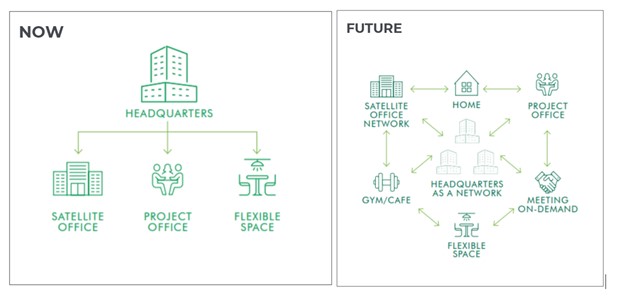
Offices as a place for socializing and exchanging information will not be the only place for this anymore – companies are adapting their culture to the new reality. Companies are forced to manage their workforce in the cloud and keep close contact to each member via the cloud as most of the employees outsource the place to meet and teamwork from the HQ and will organize meetings in third places. This leads to a constant adaption of their organizational structures and workflow models.
Flexible office space as valuable as never before
The office as we know it has completely changed. Now it is a flexible space that customers want to rent according to their possibilities and needs.
Even 10 years ago, flexible office space in the Polish, Czech, Romanian and Hungarian markets was 42,000 square metres in total. In 2020, this figure increased to 482,000 square meters (according to JLL FlexOffice report „FLEXcellent“).
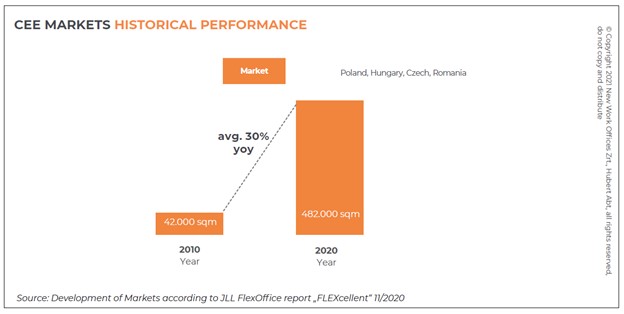
This gigantic difference shows that flexible business solutions are something that the market expects. It is even more important in a pandemic era, where every exit from the house is associated with limitations. In average the flex office industry grew 30 % per year while the increasing demand for flex space will accelerate this rate significantly. Mark Dixon, CEO of IWG which is the world’s biggest operator of flex space, predicts that 70 % of all new leases will be flex. The demand for flex space will soon increase 10 times higher than the actual space is available.
This is not a result of COVID-19, but of the upcoming recession where clients are in desperate need of flex terms and “ready to go” space as they don´t have money to spend on capex.
Digitization of business – challenges of a new era
Before COVID, 85% of the flex operator’s revenues came from office space, while 15% came from services. Today, 60% of revenues come from the rental of offices and their spaces and 40% are services and memberships. According to analyses and forecasts by New Work, further growth in revenues from office space rental will soon drop to 40%. Customer needs and behaviours have changed pandemic services exponentially. Companies, apart from the main central one, focus on more locations that can be used by employees and business partners.
It is important for everyone to avoid unnecessary travel, extra contact with random people and visits to places other than the trusted places.
“Digital solutions allow everyone to work wherever and whenever they wish. I am sure they will occupy a leading position in almost every business sector. Models and features that are paid on an ongoing basis with membership in conjunction with tenant applications will become the standard. Many locations using the digital office pass are state-of-the-art solutions growing in strength. Such offices set new standards,” adds Hubert Abt.
The report also shows that the lease as such will be replaced by service and membership contracts, and complexity services and booking will be handled by dedicated application. According to simple digital solutions, users will have easy access to all office services, such as booking a workspace, conference room or additional services, including IT support. Such applications also will be used as the social platforms.
Source: New Work press release


